
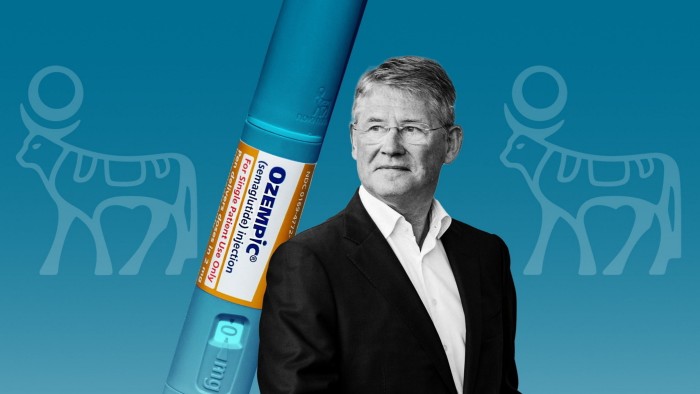
A board shake-up at Novo Nordisk has blindsided the market and concentrated power in the hands of one man at the top of one of Europe’s biggest companies.
Lars Rebien Sørensen, a former CEO of the drugmaker, was this week announced as its chair, as the incumbent and six other directors said they were stepping down.
He is already chair of Novo’s majority owner, the Novo Nordisk Foundation, consolidating his influence over the maker of blockbuster drugs Ozempic and Wegovy. The foundation has also put forward five new candidates to join Novo’s board.
The aim is to accelerate change at a company that has fallen behind its main rival Eli Lilly in the crucial US obesity market.
But Kurt Jacobsen, a Copenhagen Business School professor who has written a history of Novo Nordisk, said the board shake-up was “unbelievable”. Sørensen is now “king of the Novo Nordisk kingdom,” he said. “This is a power concentration I have not seen in Danish business.”
Novo Nordisk and the foundation, which owns 28.1 per cent of Novo’s share capital and 77.1 per cent of its voting rights, declined to comment.
Sørensen has said he intends to be chair of Novo for only two to three years and he is resigning his seat on another related board, Novo Holdings, which manages the foundation’s investments. Novo Holdings will take on responsibility for monitoring Novo’s performance.
Jacobsen points out that there are nonetheless major potential downsides to Sørensen’s wide-ranging role. “He is taking an enormous risk personally because if this fails, or the company doesn’t manage to improve its results and the price of the shares, it all goes back to him,” he said.
The overhaul comes after the foundation ousted former chief executive Lars Fruergaard Jørgensen in May, blaming him for an almost 60 per cent share price fall in the past year as profit growth has slowed and investors worried about Novo’s pipeline of new obesity drugs.

One top 10 shareholder said Sørensen, who was chief executive of Novo Nordisk before Jørgensen, had been influential in his departure. He joined the board as an observer when Jørgensen’s exit was announced. “The board probably should have resigned when they kicked the chief executive out,” the shareholder said.
Sørensen said this week that he acted because the board was moving too slowly to update its composition with directors with more relevant experience to help it navigate the US market.
Another person close to the company said it looked like incumbent chair — energy sector veteran Helge Lund — and the six independent directors had announced their departure this week because they had found they could not work with the foundation. “This is the second time [the foundation] has done things abruptly and in conflict mode,” the person said.
The new chief executive, Mike Doustdar, did not push for the board changes, according to two people close to the discussions.
One of these people said Sørensen was “a temperamental person who often acts before he does any planning . . . He sees himself as a saviour”.
A former executive at Novo said the changes had been “very much in character” for Sørensen who “believes he is right and likes to be seen as a firm and decisive leader”.
But Paul Major, a healthcare-focused fund manager at Bellevue Asset Management, who has previously held Novo shares but would not buy now, said the foundation was also responsible for failing to adapt to changes in Novo’s most lucrative market.
In the US, the company has been slower to focus on the growth in direct-to-consumer sales, a crucial development as more consumers opt to pay for obesity drugs themselves.
“I think the foundation and Sørensen have to take some of the blame for Novo’s problems,” Major said.
He added that Sørensen was a “great man in his day” but “in my mind, he’s as guilty as he is a visionary”.
However, some investors and analysts are pleased that the board is changing, even if they wish it had been a more orderly process.
Mikael Bak, director of the Danish Shareholder’s Association, said it had raised at the AGM in spring whether Lund had the right skills and experience to support the chief executive.
“It is not surprising that something had to happen,” he said. “But of course this is dramatic, and we would have preferred a normal situation where changes come at an ordinary AGM . . . [and] we want a clear and normal governance model as soon as possible.”
Novo’s board has called an extraordinary general meeting on November 14 to elect the new chair and directors. The foundation has also said it intends to appoint a further two directors next year.
Eugen Uretzki, a healthcare analyst at German asset manager Flossbach von Storch, is in favour of the board changes. “This stresses the urgency with which Novo has to transform itself,” he said.
The shake-up has also prompted questions about the roles of foundations that control companies, a Danish model also used by businesses including Lego, Carlsberg, and Maersk.
The Novo Nordisk Foundation’s website says the companies it owns are governed by independent boards of directors “ensuring an arm’s length relationship”.
“The foundation is particularly mindful of observing and respecting the rights of other shareholders,” it says.
Kasper Meisner Nielsen, director at Copenhagen Business School’s centre for corporate governance said the changes were “drastic” and of a type that tend to happen only at companies in “deep crisis”.
He added that the board could become less independent with the former chief executive as chair. “On the one hand we like the board to be independent of owners, but on the other side we like to have active owners,” he said, noting that if the majority shareholder is pursuing value creation, minority shareholders can benefit.
But Niels Lunde, editor of the Danish financial newspaper Børsen, was clear about the potential pitfalls of the concentration of power.
“The most important and valuable company in Denmark is in effect controlled by one person who claims to know better than the highly respected leaders who are leaving the board,” he said.
“At the top of Danish business, everyone is shaking their heads at this tragicomic farce, but no one dares to challenge Lars Rebien Sørensen, so they remain silent.”