
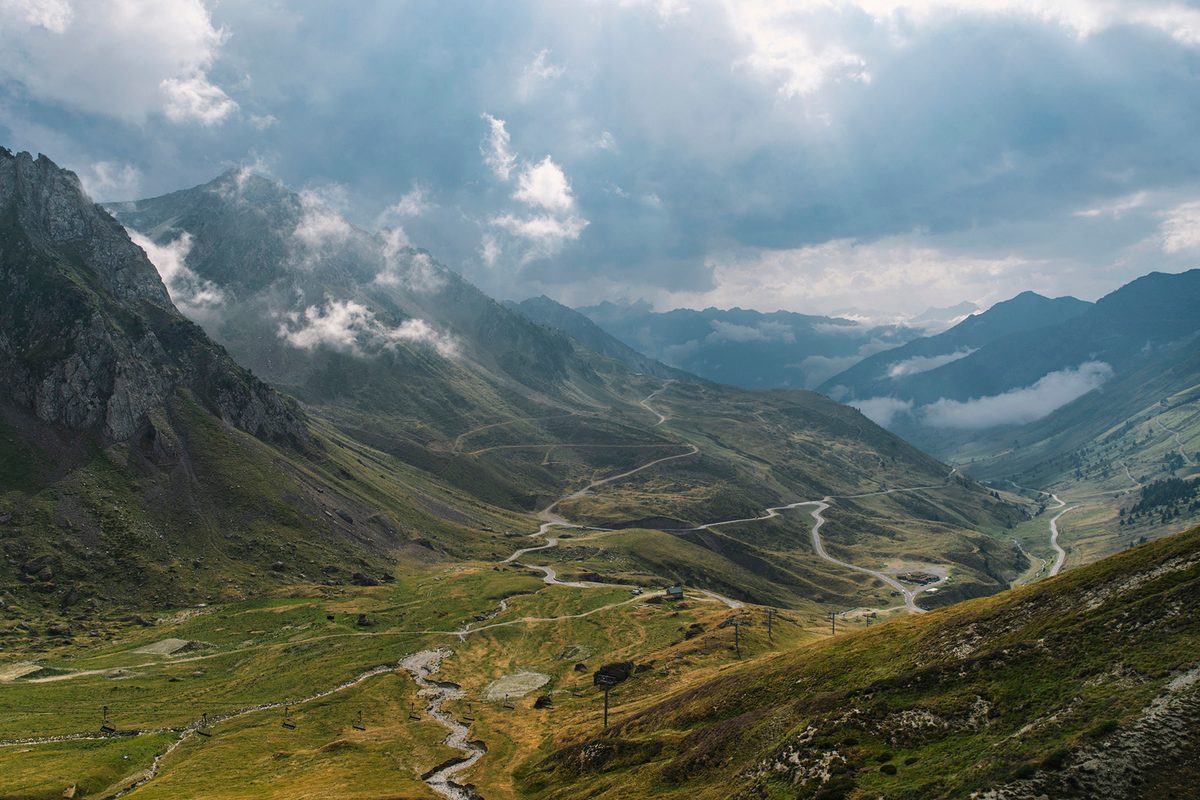
To cycle up a mountain is to pedal into a world of paradoxes. Mountains are a playground and a torture chamber; a means of outdoor adventure and inner discovery; an opportunity for wonder, a guarantee of pain.
In this glorious grind against gravity, a mountain can drag you to despair but leave you soaring with joy.
When we think about cycling, mountains erupt into our imagination – a snaking Alpine pass or the curling grey ribbon of a Pyrenean hairpin.
The most iconic moments of the Tour de France have taken place at altitude, photobooks of snow-capped cols adorn our coffee tables, and riders make pilgrimages to legendary peaks. But we rarely pause to think how strange this fascination is.
Road cyclists aren’t drawn in the same way to forests, fields or flatlands, but those landscapes do, of course, also feature in our rides and races.
Mountains form the architecture of our cycling dreams.
But this obsession cannot be explained simply by the physical challenges of elevation. And neither did this story begin with the Tour de France.
As the author Robert Macfarlane describes in his seminal book, Mountains of the Mind: A History of a Fascination, for most of human history, mountains were regarded as dangerous, foreboding and worthless places.
They were feared as a realm of dragons and mysterious beasts; an abode of bandits, thieves and social outcasts; an extreme terrain of dangers and disasters.
In fact, our ancestors would find our love of mountains absurd.
Hard as this may be for us to grasp, mountains weren’t even regarded as beautiful.
Until well into the 1700s, as Macfarlane writes: “Alpine travellers often chose to be blindfolded to avoid looking at the vertiginous landscapes. Mountains were an ugly irritation, which prevented the free range of the eye, and the free movement of our legs, over the cultivated landscape in which humans lived and worked.”
The mountains didn’t change. We did. There are multiple reasons for this shift in perspective.
From the 17th to the 19th centuries, the Enlightenment sparked a new thirst for reason and knowledge, which saw scientists and geologists explore mountains as a means of learning about the world.
The urbanisation that greeted the mid-18th century Industrial Revolution created a sentimental yearning for nature.
Concurrently, the 17th and 18th century custom of the British aristocracy to explore Europe in pursuit of cultural discovery (a tradition known, in an amusing precursor to later cycling stage races, as the ‘Grand Tour’) led to a new passion for adventure.
And Romanticism – an artistic movement of around the same time, which celebrated emotion, liberty, nature and the individual – saw poets such as William Wordsworth and Samuel Taylor Coleridge treasure the sublime beauty of mountainous landscapes.
“A mountain,” concludes Macfarlane, is “a collaboration of the physical forms of the world with the imagination of humans – a mountain of the mind.”
Max Leonard, author of Higher Calling: Road Cycling’s Obsession with the Mountains, believes these dramatic cultural changes mark the start of our love affair with the mountains.
“You can chart this history from the Enlightenment and the Grand Tours when aristocrats made their way down to Italy and Switzerland and had this great experience of seeing the Alps,” he explains.
“But then the British stopped going because of the Napoleonic Wars, and that’s when you find Wordsworth heading to the Lake District, the beginnings of Romanticism, and those feelings, when in a huge landscape, of being a small part of something much bigger.
“If you put the Tour de France legends aside, that’s something that I still experience as a cyclist when I go to the mountains.
“A lot of the early writings of (Percy) Shelley made the mountains sound terrifying and awesome, and cyclists still feel these things today.”