
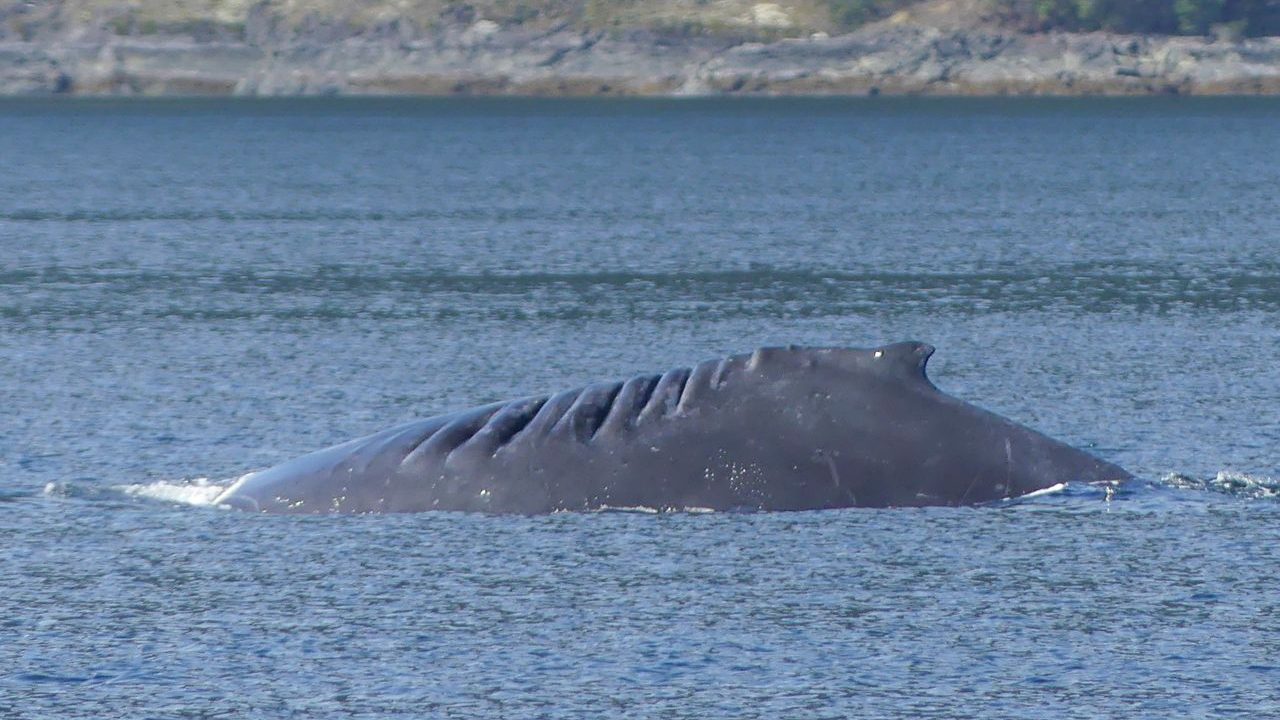
A Prince of Whales whalewatching boat hit a humpback whale on Thursday after it “suddenly and unexpectedly” surfaced in the boat’s path, the company says.
On the afternoon on Oct. 23, the Prince of Whales boat was transiting near Vancouver when the whale surfaced, and the captain took a decisive maneuver to try and avoid the whale.
“Although the vessel was able to stop almost immediately, there was minimal contact with the whale during the maneuver,” the company said in a statement to CHEK News.
“Afterward, our on-board naturalists reported witnessing that the whale surfaced to breathe, then swam away, surfacing at normal intervals. There was no noticeable damage to the whale or the vessel.”
Prince of Whales says the tour was not actively viewing the whale that was hit, “so this was a surprise encounter.”
Due to the sudden stopping, several on board passengers fell.
“A handful were injured, and our trained crew members immediately administered first aid to those affected,” the statement says.
“Three passengers required additional treatment from Emergency Medical Services, who were standing by upon the vessel’s return to Vancouver. We are in communication with the injured guests and have provided full refunds for all passengers on Thursday’s tour.”
Prince of Whales notes it immediately informed Fisheries and Oceans Canada (DFO) of the strike, which is required by law, and the coast guard.
“This was an exceedingly rare event and we are very appreciative for the decisive actions of our crew, and for the gracious support and understanding of our guests,” the statement says.
Incident highlights importance of education for boaters: MERS
Jackie Hildering, humpback researcher with Marine Education & Research Society (MERS), says the fact that trained whale-watching boaters were involved in a whale strike hightlights why it’s important for boaters to be educated on humpbacks.
“If a whale watcher or a researcher can hit a humpback with their expertise of the animals, then it certainly indicates what the risk is to many others,” Hildering said in a Zoom interview.
“There are many things that can be done because there is so much misunderstanding about humpbacks.”
Hildering likens the strikes to when elk are hit by drivers, where it is sometimes unavoidable.
“You could do things like get signage out, be aware of the behaviour of the animals, know what to do if there is collision, but, you could be an elk biologist and hit an elk,” she says.
“There are limitations, as there are on highways, that if you’re in a narrow area, or there’s a cliff, like if we’re using the metaphor, then you can’t change direction quickly.”
Hildering says it is believed that the highest density of humpbacks are in the summertime, but research shows it is actually in the fall when larger numbers of the whales are in the Salish Sea.
“They are concentrated in these areas where they know the tides and can suddenly surface, so it starts with education,” Hildering says.
“It’s why we have a whole free boater course, because we know how real this risk is for the whales and for boaters and that everybody can help by educating themselves through that course.”
Although this is the third publicized humpback whale strike in the past month, Hildering notes they may be more common than people realize.
“These are the known strikes,” Hildering said.
“These last few incidents are going into the world because there were passengers involved. So even with really good company ethics, wanting to make these accidents count, you’re more compelled to have to do so. It may be that large vessels don’t even feel the impact of hitting a humpback as they rest below the surface.”
Hildering also emphasizes that she does not want to see the companies in these recent whale strikes vilified.
“The world does not need more vilification,” she said. “The world needs more knowledge, and in this case, for the safety, not just of the whales, but for other people.”
READ PREVIOUS: