
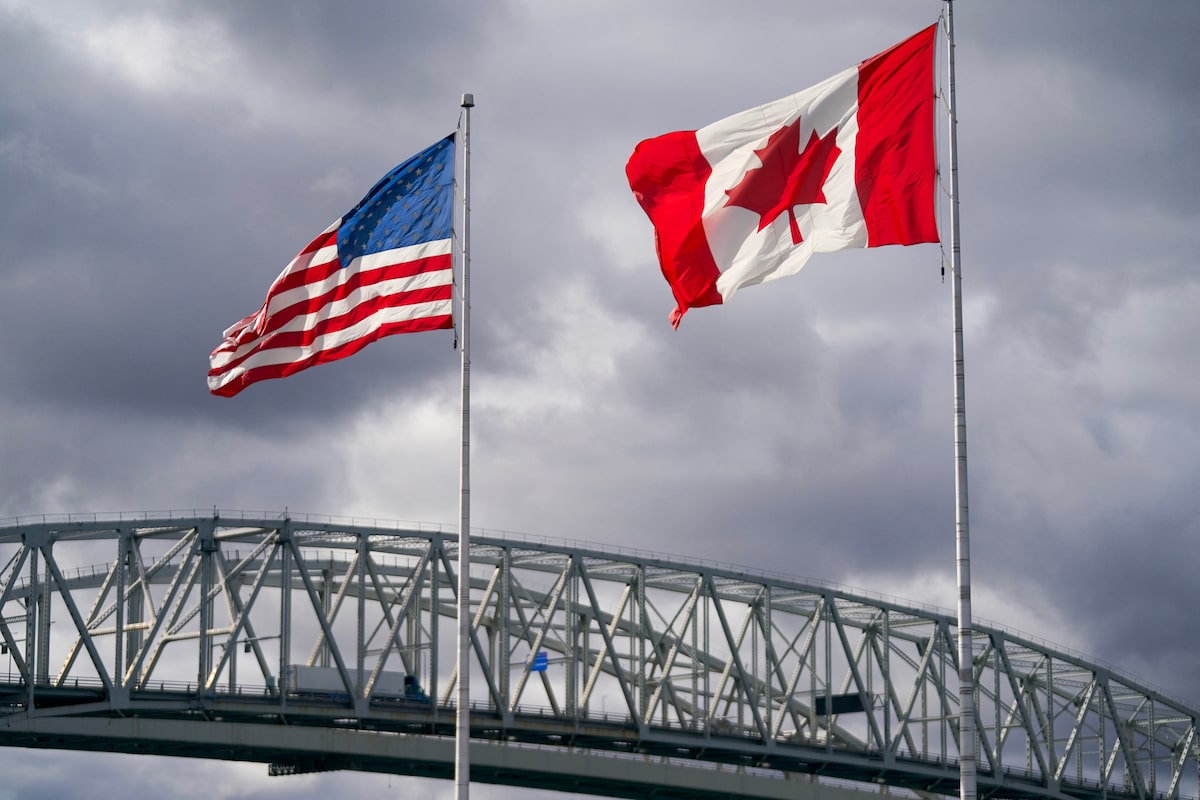
Donald Trump says on Thursday that he was ending trade talks with Canada over an Ontario anti-tariff advertisement. On Saturday, Trump announces he is increases tariffs to Canada by 10%.GEOFF ROBINS/AFP/Getty Images
Donald Trump said Saturday he’s hiking tariffs on Canadian imports by another 10 per cent after an Ontario government TV ad critical of his protectionist levies ran during the first game of the World Series.
The U.S. President, who has imposed a slew of tariffs on Canadian goods since taking office, had already ratcheted up tensions earlier this week by breaking off negotiations aimed at resolving the trade war in response to the ad.
The 60-second TV spot uses footage from nearly 40 years ago of former U.S. president Ronald Reagan decrying American protectionism, saying such trade barriers hurt every American worker and consumer.
Mr. Trump, who has said the Ontario ad misrepresents Mr. Reagan’s comments, said he was raising tariffs by 10 per cent because Canada did not immediately stop running the ad as he wanted.
The Government of Ontario released this TV ad which will be broadcast in the U.S. that uses a recording of Ronald Reagan to argue against tariffs.
Government of Ontario
“Their Advertisement was to be taken down, IMMEDIATELY, but they let it run last night during the World Series, knowing that it was a FRAUD,” the U.S. President said in a post on his Truth Social platform as he flew to Malaysia on Air Force One.
“Because of their serious misrepresentation of the facts, and hostile act, I am increasing the Tariff on Canada by 10% over and above what they are paying now,” the U.S. President said in his post.
Both Prime Minister Mark Carney and Mr. Trump are in Kuala Lumpur this weekend to attend the Association of Southeast Asian Nations, or ASEAN, summit.
Speaking at the summit on Sunday, Mr. Carney, in an apparent reference to Mr. Trump, talked of the need for dependable allies in turbulent times.
“It makes ASEAN more important than ever. It underscores the importance of reliable partners who honour their commitments, who are there in tough times and when things are not working, work collaboratively to fix them.”
He said Canada plans to reduce its economic reliance on the U.S.
While Canada will continue to trade with its neighbour and the world’s largest economy, he said, the country is embarking on an ambitious mission to double non-U.S. exports in the next decade.
Dominic LeBlanc, the minister responsible for Canada-U.S. trade, posted a statement on X following Mr. Trump’s announcement, saying Canada is “ready to build on the progress made in constructive discussions with American counterparts over the course of recent weeks.”
“We will remain focused on achieving results that benefit workers and families in both the United States and Canada, and that progress is best achieved through direct engagement with the U.S. administration — which is the responsibility of the federal government,” he said.
After Mr. Trump said he would terminate trade talks, Ontario Premier Doug Ford, whose government paid for the ad campaign, said he would pull the ad after this weekend.
The ad is much shorter than Mr. Reagan’s original address. It is edited, with certain passages presented out of order.
In Mr. Reagan’s original speech, the late president defended imposing duties on Japan during a trade dispute over semiconductors. He alleged Japan was failing to enforce Japanese companies’ violations of a trade agreement with the United States.
But Mr. Reagan explained why tariffs are bad for the U.S. and hurt free trade, which is largely what the Ontario government quoted in its ad. However, Mr. Reagan also argued that his duties on Japan were justified “to stop unfair practices against American products,” while extolling the virtues of free trade overall.
The United States under Mr. Trump has imposed 35-per-cent tariffs on trade not covered by the United-States-Canada Agreement (USMCA). He has also imposed a number of sectoral tariffs that affect Canadian industry disproportionately, including a 50-per-cent levy on steel and aluminum and a 25-per-cent levy on automobiles.
Softwood lumber, too, has been hit hard. Canadian producers are facing levies totalling more than 45 per cent after the administration recently announced a new 10-per-cent tariff on lumber shipments into the U.S. on top of existing duties.
Last month, Mr. Trump set a date of Nov. 1 for imposing a 25-per-cent tariff on medium- and heavy-duty trucks, a measure previously announced along with tariffs on pharmaceuticals and furniture.
Tony Keller: Is Ford’s ad to blame for Trump’s 10-per-cent tariff hike? Please, it’s an excuse
The Globe and Mail earlier this week reported that Mr. Carney and Mr. Ford spoke to each other Thursday night and on Friday. The Prime Minister expressed his preference that the ad be pulled off the air.
The Prime Minister on Friday said Canada was ready to resume talks at any time. He spoke while boarding a plane for a trip to Asia, where he is expected to see Mr. Trump in South Korea for next week’s Asia-Pacific Economic Co-operation Summit.
“We can’t control the trade policy of the United States,” Mr. Carney said, noting that “detailed and constructive progress” had been made in recent weeks to get tariff relief on steel and aluminum, as well as a possible deal on energy.
“We stand ready to pick up on that progress … when the Americans are ready to have those discussions because it will be to the benefit of workers” in both countries, said Mr. Carney, who did not take questions from reporters.
Kevin Hassett, Mr. Trump’s economic adviser, said Friday morning that the U.S. President’s “frustration has built up over time” because “the Canadians have been very difficult to negotiate with.”
David Shribman: Trump’s bizarre outrage over Ontario’s anti-tariff ad is a symbol of his presidency
“I guess the lack of flexibility and also, I would guess, the leftover behaviours from the Trudeau folks can be very frustrating,” Mr. Hassett told reporters outside the White House.
In a statement Friday afternoon, Mr. Ford said the ad would run as planned over the weekend – including during the first two games of baseball’s World Series between the Toronto Blue Jays and the Los Angeles Dodgers – but would no longer air as of Monday.
“Ontario will pause its U.S. advertising campaign effective Monday so that trade talks can resume,” the Premier said.
He said the spot had “reached U.S. audiences at the highest levels.” Mr. Ford allocated $75-million for the campaign, which ran across all four major U.S. television networks and several cable channels, including Fox News.
Flavio Volpe, president of the Automotive Parts Manufacturers’ Association in Canada, called the new 10-per-cent tarrif the “latest in a series of unprovoked and unwarranted escalations in tariff policy with other sovereign nations.”
He said this will mean higher prices for U.S. consumers.
“Lost in the accountability loop here is the president’s threat is really to charge American taxpayers billions of dollars because of a benign World Series ad he doesn’t like.”