
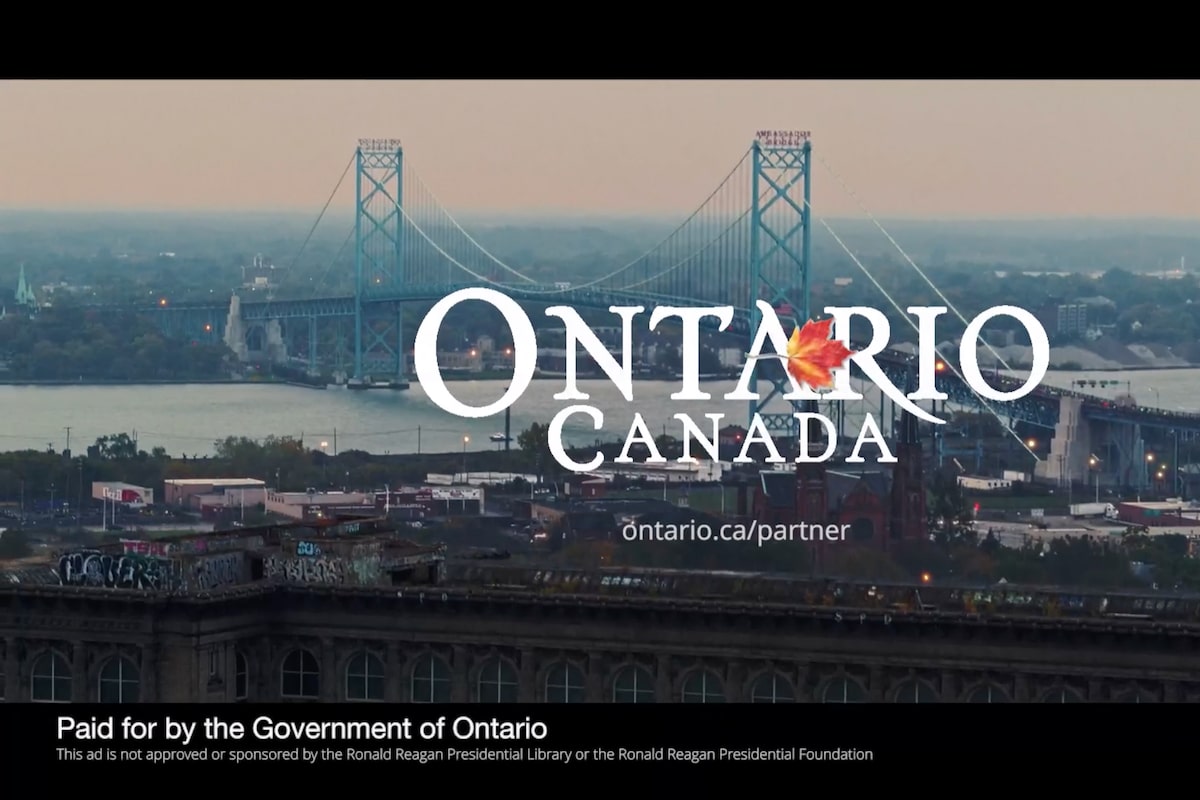
President Donald Trump said all trade talks with Canada were terminated following what he called a fraudulent advertisement in which former President Ronald Reagan spoke negatively about tariffs.
Reuters
The advertisement seems innocuous enough: Over scenes of American industry, commerce and daily life, a voiceover from Ronald Reagan warns of the dangers of imposing tariffs. “Markets shrink and collapse, businesses and industries shut down and millions of people lose their jobs,” he says.
The late 40th U.S. President’s support for free trade and opposition to protectionism, of course, were central to his political agenda.
But this one-minute television spot, produced for the Ontario government, has triggered a furious reaction from U.S. President Donald Trump. On Thursday, he broke off trade negotiations with Canada over it. On Saturday, he hiked tariffs on Canada by 10 per cent. And he has spent the weekend venting his anger on social media and to reporters.
“CANADA CHEATED AND GOT CAUGHT” with a “FAKE” ad, he wrote on Truth Social. In one scrum with reporters, he asserted that Mr. Reagan actually “loved tariffs” and the ad “was AI or something.” He also accused Canada of attempting to influence an approaching tariff case at the U.S. Supreme Court.
The Ronald Reagan Presidential Foundation, meanwhile, also complained that the ad “misrepresents” Mr. Reagan’s comments.
Analysis: Trump’s bizarre outrage over Ontario’s anti-tariff ad is a symbol of his presidency
What’s going on here?
The short answer: No, Mr. Reagan did not love tariffs and no, his comments in the ad are not generated by artificial intelligence but were excerpted from a longer radio address. What Mr. Reagan says in the ad – and in that radio address – is consistent with his long-time support of free trade and opposition to economic protectionism.
The long answer: The blow-up over this television spot is part of a longer-running, low-key battle within Mr. Trump’s Republican Party to reconcile the legacy of the revered Mr. Reagan with Mr. Trump’s agenda, despite the two being opposed on much of their economic philosophy.
Mr. Trump’s motivation in breaking off talks, meanwhile, is somewhat less clear.
What’s with the Ontario ad? Why does Mr. Trump say it misrepresents Mr. Reagan?
Ontario’s television spot uses Mr. Reagan’s comments from a radio address on April 25, 1987, in which he explains why he opposes tariffs and favours free trade. He says there are only limited circumstances in which tariffs are justified, such as the duties he had just imposed on Japan over a trade dispute regarding semi-conductors.
The ad edits Mr. Reagan’s five-minute address down to one minute and rearranges some of its sentences. But everything said in the ad really was said by Mr. Reagan and is consistent not only with the overall views expressed in the radio address but with his general pursuit of free trade as a policy.
Ontario Premier Doug Ford’s purpose in ordering the ad – and allocating $75-million to air it on U.S. television – is pretty clear: Mr. Reagan is arguably the most beloved figure in American conservatism and Queen’s Park seems to be hoping to push Republicans to put pressure on Mr. Trump to go back to Mr. Reagan’s anti-tariff ways.
Neither Mr. Trump nor the Reagan Foundation has said explicitly what they accuse Ontario of putting in the ad that is inaccurate. But Mr. Trump has suggested it is the fact that the ad doesn’t mention that Mr. Reagan did put tariffs on other countries, as he did in the Japanese semi-conductor dispute.
Opinion: Is Doug Ford’s TV ad to blame for Donald Trump’s tariff tantrum? Be serious
In his address, however, Mr. Reagan presents the tariffs as a limited measure in “certain, select cases” that he is “loath” to take. “In imposing these tariffs, we were just trying to deal with a particular problem, not begin a trade war,” he said.
More generally, he pursued a free-trade agenda throughout his presidency: Mr. Reagan signed the original Canada-U.S. free-trade deal (which later morphed into NAFTA and then USMCA) and he launched the talks that created the World Trade Organization.
Mr. Trump, by comparison, has declared himself a “tariff man,” put levies on nearly every country in the world and disregarded free-trade deals such as USMCA, which he signed with Canada and Mexico in his first term.
Is there something bigger going on here?
In an Oval Office question-and-answer session with reporters this past August, Mr. Trump appeared to frame his trade policies as a break from the Gipper’s legacy.
“I loved that man, but he was not good on trade,” Mr. Trump said after gesturing toward Mr. Reagan’s portrait, which hangs next to the Resolute Desk in the Oval Office. “I totally disagreed. He allowed the car industry to be taken out of this country.”
While such criticism would not appear to be surprising, given how central trade protectionism is to Mr. Trump’s economic agenda, it was nonetheless unusual.
Not only is it rare for any Republican politician to say anything negative about Mr. Reagan, but Mr. Trump and his supporters have long tried to paint his policies as a continuation of, rather than a break from, Mr. Reagan’s.
U.S. President Donald Trump pauses as he speaks in front of a portrait of former president Ronald Reagan in the Oval Office at the White House on Oct. 16.Jonathan Ernst/Reuters
In a Lawfare podcast last year, Robert Lighthizer, who worked as a trade negotiator in the Reagan administration and served as U.S. Trade Representative in Mr. Trump’s first term, summed up the argument. He pointed to both Mr. Reagan’s use of tariffs against Japan and other countries, and the managed trade deals that Mr. Lighthizer negotiated at the time.
“Ronald Reagan was basically an economic nationalist,” Mr. Lighthizer said. “He had me go around and negotiate what were called voluntary trade agreements, but they weren’t that damn voluntary. They were quotas, basically, that other countries had to agree to on carbon steel, on specialty steel. He put limitations on automobiles, which were a huge problem coming in.”
Scott Lincicome, a trade expert at the libertarian Cato Institute think tank, however, contends that Mr. Reagan’s limited use of protectionist measures to deal with specific trade disputes was a far cry from Mr. Trump’s sweeping use of tariffs.
It was also a different context: In the pre-WTO era, there was no international forum to resolve trade disputes. And Mr. Reagan overall moved the U.S. toward free trade.
“In that sense, Reagan was the exact opposite of Donald Trump. Reagan was broadly in favour of free trade and only narrowly protectionist, where Trump is broadly protectionist and only allows for a few free-trade carveouts,” Mr. Lincicome said.
What’s this about the Supreme Court?
The U.S.’s top court has scheduled a Nov. 5 hearing in a case against Mr. Trump’s use of the International Emergency Economic Powers Act to impose some of his tariffs.
A lower court previously ruled that the President’s use of the IEEPA for this purpose was illegal because the law, which is typically used to freeze the assets of hostile governments and terrorists, says nothing about tariffs.
Most of Trump’s tariffs declared illegal by U.S. federal appeals court
Some of Mr. Trump’s tariffs on Canada – the ones on anything traded outside of USMCA – were imposed under the IEEPA. The more damaging ones, however, on autos, steel and aluminum, are under Section 232 of the Trade Expansion Act, which is not subject to this court case.
The President did not specify how he thought Ontario was hoping the anti-tariff ad would influence the IEEPA case.
Where do things go from here?
It’s not clear if Mr. Trump’s anger is a genuine fit of pique or an attempt to turn up the pressure on Canada in negotiations. Either way, it is an abrupt change of tone from the President’s friendly treatment of Prime Minister Mark Carney, whom he praised repeatedly during an Oval Office meeting earlier this month.
Still, the White House has appeared in recent weeks to be frustrated that Canada has so far not signed onto the sort of trade deals that Britain, Japan and the European Union have agreed to with Mr. Trump this year. Under those agreements, U.S. trading partners have accepted Mr. Trump’s tariffs and quotas in exchange for Mr. Trump not setting the tariffs even higher.
Asked if there was anything Canada could do to get trade talks restarted, Mr. Trump told reporters this weekend that he was happy to leave things where they are – with high U.S. tariffs on Canadian steel, aluminum, autos and other goods.
“I don’t think there’s really much they can do. So, I assume, leave it the way it is. If you leave it the way it is, it’s very good for us,” he said. Asked if he would meet Mr. Carney at this week’s APEC summit in South Korea, Mr. Trump said: “I don’t have any intention, no.”
Ironically, Mr. Trump’s fury at the ad may have inadvertently drawn more attention to it. His top Democratic opponents – including California Governor Gavin Newsom and Pennsylvania Governor Josh Shapiro – used the conflagration to highlight the importance of trade with Canada.
The New York Times published a side-by-side comparison of Ontario’s ad and Mr. Reagan’s address showing how Mr. Reagan said all of the things quoted in the commercial.
Manitoba Premier Wab Kinew put out a social-media video of his own that riffed on the address: In shirtsleeves behind a desk in a wood-panelled room resembling Mr. Reagan’s Camp David mise-en-scène in the original, he urged his “good friend” Mr. Ford to keep airing the ads.
“President Trump’s damaging tariffs go completely against Mr. Reagan’s legacy. And it’s clear that these ads are working. If you throw a rock at a lake and you don’t hear a splash, you’ve probably missed,” Mr. Kinew said.
Whether any of this will make any difference in trade talks – or the trade war Mr. Trump has visited on one of his country’s largest trading partners – remains to be seen.