
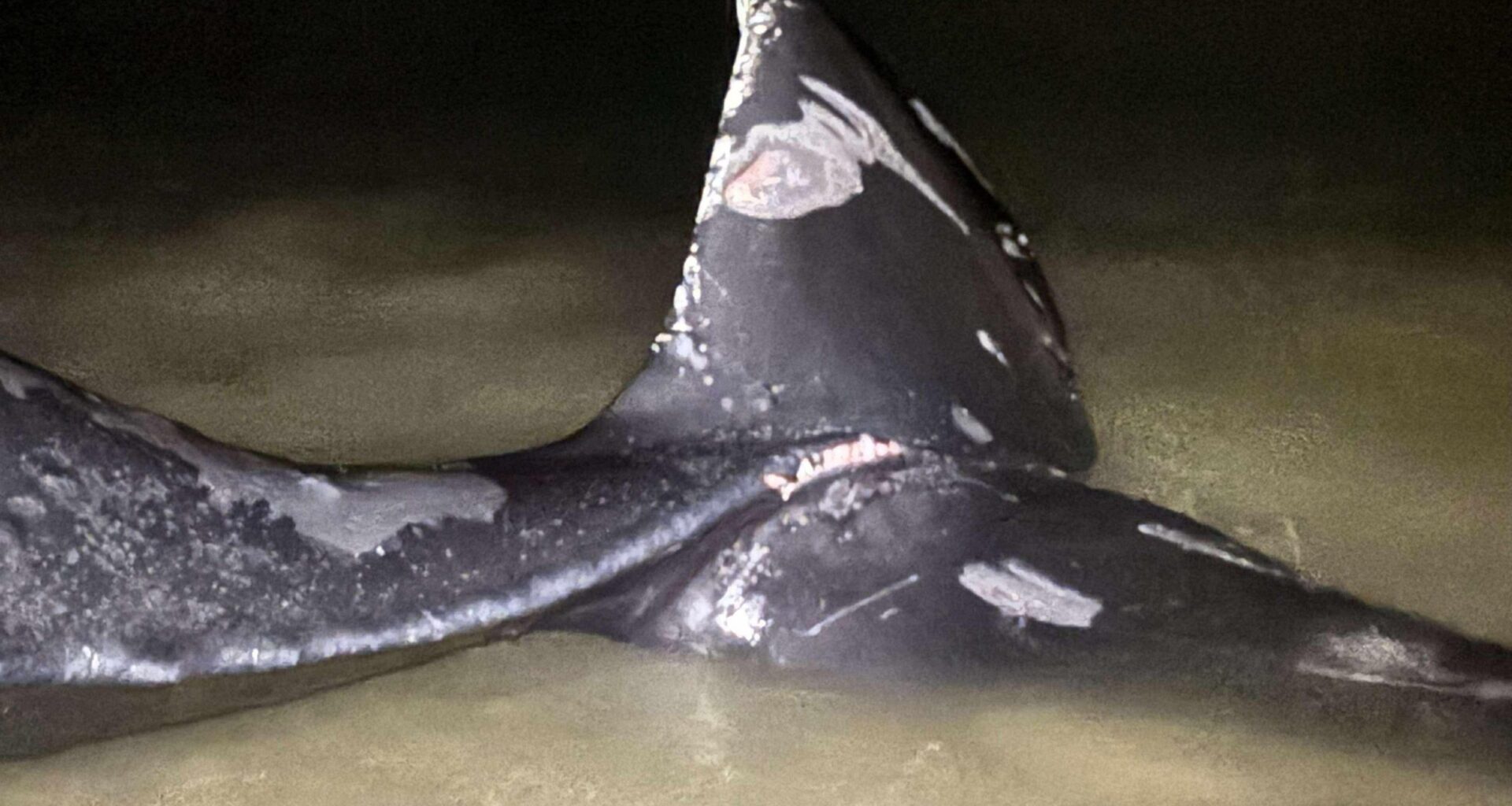
A dead humpback whale has washed ashore on Keats Island, prompting an investigation by the Department of Fisheries and Oceans (DFO) just days after a whale-watching vessel struck a humpback in the same area.
DFO confirmed the whale’s death Monday, saying it is “working to better understand what happened.”
“As this is an active investigation, we are unable to provide additional details at this time,” said DFO spokesperson Lara Sloan.
The discovery comes just days after a Prince of Whales vessel made “accidental contact” with a humpback while transiting near Keats Island in Howe Sound on Thursday, Oct. 23.
“We were not actively viewing any whales at the time, and it suddenly surfaced directly in the vessel’s path. Although our vessel performed an emergency stop maneuver, contact with the whale was made,” the company said in a statement Monday.
Crew members did not see any injuries on the whale when it swam away but the animal was not fully visible at the time.
Organizations including Prince of Whales have since confirmed the whale found on Keats Island is believed to be BCY1464 or “Wisp,” a four-year-old humpback.
“We do not yet have any information on the whale’s cause of death, but based on the timing and location, we believe this could be the whale involved in Thursday’s incident,” said the company.
Prince of Whales said it is “devastated” by the death as it has advocated for whale conservation and education for decades.
The company said it is working with DFO and other government agencies as the investigation into the whale’s death continues.
Conservation groups ‘heartbroken’, urge vigilance
Members of the whale-watching community say they are “absolutely heartbroken” by the loss.
Erin Gless, executive director for the Pacific Whale Watch Association, said the sudden emergence of humpbacks in the water can happen to anyone and boaters must stay vigilant.
“If an event like this can happen to trained professionals while actively looking for whales, it can easily happen to any boat on the water,” said Gless. “We hope this can be used to raise awareness not just amongst professional whale watchers, but all boaters.”
Marine Education and Research Society (MERS) executive director Caitlin Birdsall said her organization was devastated to hear of another apparent strike.
“We’re heartbroken to hear about any vessel strikes, and we recognize that it is a significant threat and and it’s one that can happen to any type of boater,” said Birdsall. “We’re really dedicated to trying to raise awareness about this issue and also trying to provide resources, because it’s not inevitable.”
Prince of Whales echoed the calls for awareness, saying humpback strikes can happen “to any boat at any time” and called it “critical” to remain vigilant when operating in the ocean.
True number of whale strikes unkown
The DFO says vessel strikes are one of the primary threats to humpbacks whose populations along the B.C. coast have grown significantly since industrial whaling ended in the 1960s, increasing their overlap with boat traffic.
Birdsall said the true number of whale strikes in B.C. waters is unknown because many injured or killed whales are never found, adding some may sink to the bottom of the ocean or wash up in more remote areas than places like Keats Island.
Awareness and education are key to reducing future collisions, experts say. MERS offers a free online course for boaters called Whale Safe Boating aimed at teaching techniques to avoid collisions and spot whales on the water.
Birdsall also noted that fall is actually peak feeding season for humpbacks in the Salish Sea, a time when encounters with vessels are most likely.
“Whales are not just here in the summer months, and this is sort of a misconception about humpback whales. They are here,” she said. “And so recognizing these whales are not gone. They are still on our coast. Vigilance absolutely is still needed for all types of vessels.”
As the DFO continues to investigate the circumstances surrounding the death of the whale found on Keats Island, it is encouraging anyone who witnesses whales being harassed, disturbed or injured to contact the Marine Mammal Incident Hotling at 1-800-465-4336 or by email at DFO.ORR-ONS.MPO@dfo-mpo.gc.ca.
With files from CHEK’s Dean Stoltz.