
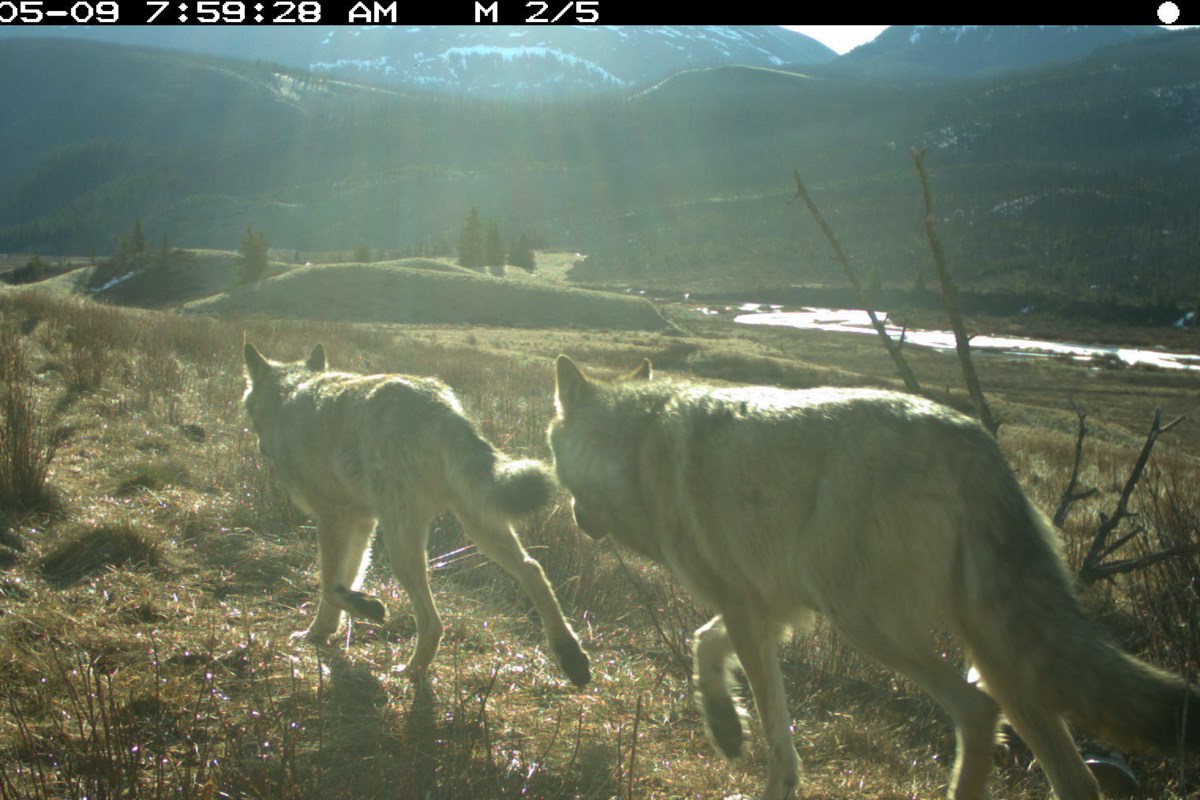
“The wolf’s been exhibiting what I would call atypical behaviour, not wary behaviour, walking along the side of the road, walking through day-use areas, walking through campgrounds, not fleeing and even approaching vehicles, and in a few cases, people.”
KANANASKIS – Provincial wildlife officials warn against feeding or approaching a habituated wolf in Kananaskis Country to give the animal the best shot at survival.
The wolf, which has been boldly walking through campsites, day-use areas and along roads in Peter Lougheed and Spray Lakes provincial parks since early May, is being hit with rounds of chalk balls to try to scare it away from busy areas in a bid to reverse its non-wary behaviour.
There are no plans to collar or relocate the wolf, but destruction for public safety reasons is not off the table if visitors don’t do their part to keep their distance and not feed or leave food or garbage accessible – which is illegal in the provincial parks.
“I can’t think of any place better for this wolf to be in terms of it’s in a protected area with stringent garbage management and staff who are trained and have the tools to apply aversive conditioning techniques,” said John Paczkowski, human-wildlife coexistence team leader for Alberta Parks.
“We really want to monitor situation. I think if this escalates to the point where it is actually approaching people and getting getting food rewards, the results might be severe for this animal. In the interim, we will do what we can to keep it on the landscape. We’re always hopeful.”
A structured program in which deterrents like rubber bullets, noisemakers, beanbag and chalk rounds are continually and consistently used, aversive conditioning aims to modify undesirable behaviour by pairing it with pain or an unpleasant stimulus.
The technique is most commonly used on bears.
“We have managed to condition the wolf a few times with chalk balls and we’re also at the ready with bear spray in case the wolf approaches a vehicle or something like that, just anything to increase its wariness around people,” Paczkowski said.
“I wouldn’t say it takes off at a run, but it will leave the area. We’ve been able to apply aversive conditioning where it moves away and we may not see it for a few days and then it pops up again showing that habituated behaviour.”
Paczkowski said there have been almost weekly reports of the wolf across a 500-square-kilometre area of Kananaskis Country since early May, sometimes two or three times a week, sometimes 25-km apart on the same day.
“The wolf’s been exhibiting what I would call atypical behaviour, not wary behaviour, walking along the side of the road, walking through day-use areas, walking through campgrounds, not fleeing and even approaching vehicles, and in a few cases, people,” he said.
“It seems like it’s curious behaviour right now and the wolf seems quite habituated, but our big fear is that someone has or will feed this wolf and it will become food-conditioned and start to exhibit that sort of food-seeking behaviour.”
Visitors are asked to help by reporting any sightings of this wolf to Kananaskis Emergency Services at 403-591-7755.
“The key message we say over and over again – never feed wildlife, any wildlife at all,” Paczkowski said.
“Your cooperation in your behaviour and reporting might help this wolf.”
In mid-June, Parks Canada was forced to euthanize a young injured wolf that showed up in a backyard in the community of Field in Yoho National Park, B.C. The wolf, which had an injury to its leg, had been digging up herbs and potatoes.