
5. She was told she’d never be successful in TV with her accent
While working as a local journalist, Lorraine was desperate to get a job at the BBC, applying for every job that was advertised – even farming correspondent. “I wouldn’t have known one end of a cow from another,” she laughs.
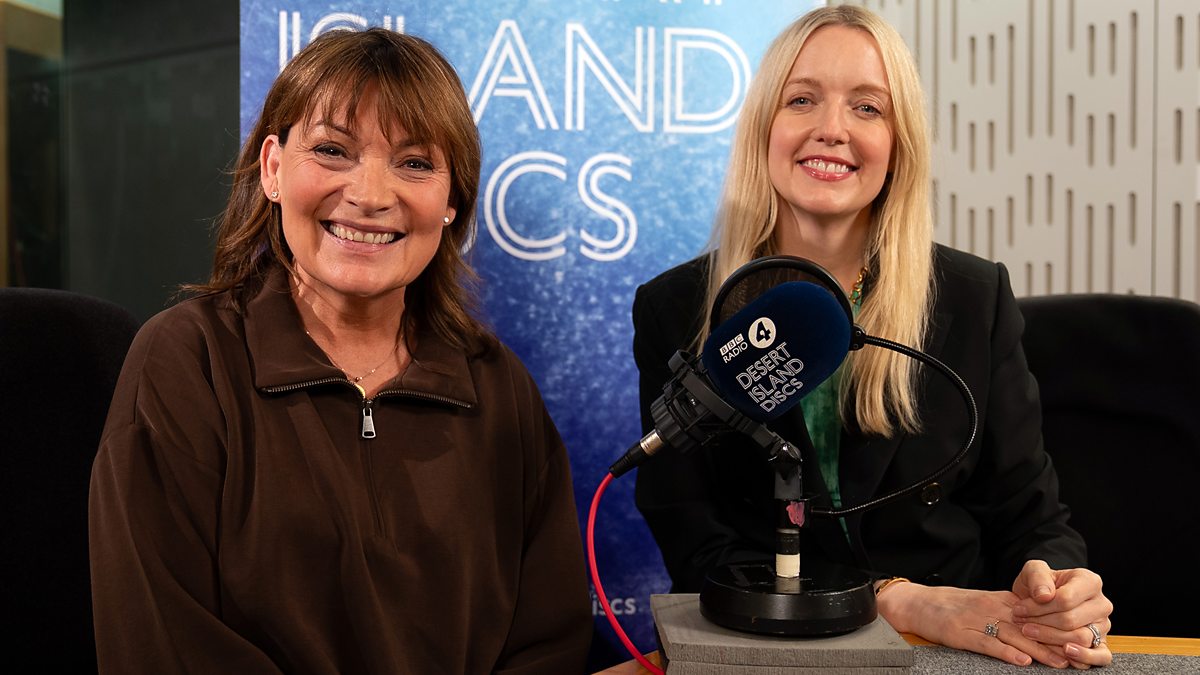
Lorraine Kelly in the Desert Island Discs Studios.
He went, ‘Nope. You’re never going to be a reporter. Maybe if you take elocution lessons, but you’re never going to make it in telly with that accent.’
Lorraine recalls being told she wouldn’t make it in TV.
Her tenacity paid off; in 1983 she got her first TV job as a researcher, even though it came with a pay cut. “I worked as a waitress at night for a pound an hour to pay the mortgage.”
She loved the job, and wanted to be a news correspondent, but was eventually called into the boss’s office. “He just took his glasses down and looked over them. He went, ‘Nope. You’re never going to be a reporter. Maybe if you take elocution lessons, but you’re never going to make it in telly with that accent.’ I was absolutely crushed.” But the next day she heard there was a job going as an onscreen reporter at TV-am – and got the job.
6. TV in the eighties was an old-school environment
Working in an office of two kept Lorraine very busy: “I’d get mail in the office and it would say, ‘Head of Politics’. Oh, that would be me. ‘Head of Sport’. Me again. ‘Industrial Correspondent’. That’ll be me,” she laughs. “But it was amazing because in a newsroom back then, women of my age wouldn’t be allowed near a big news story. They would do the funny wee bit at the end, or the girly story, whatever that may be. So, it was an amazing learning curve.”
And the job required some strange methods in order to get the stories from Glasgow to the London office. “We would send the cassettes in an envelope. I would go to the airport, find a pilot — British Airways, British Midland — and say, ‘Is there any way you can take this with you? Somebody will be at the other end to pick it up.’” She laughs now. “I know it’s insane!”
7. She had a special chemistry with her first on screen co-host
Lorraine began presenting Good Morning Britain alongside Mike Morris in 1990. They forged a strong working relationship, developing secret codes to help navigate live interviews.
“Mike was a very kind, very generous, underrated presenter. We got to the stage where we could finish each other’s sentences. I knew when he was going to do a follow up question, obviously I’m not going to stand on that. I will lean back. And we had this kind of thing where if he asked the first question and I wanted to ask the second question, I would tap him on his leg and if he leaned back, I could jump in but if he leaned forward, he had something else to say.”
8. She still feels like an outsider — even with an OBE
Lorraine has been honoured with an OBE, a CBE and a BAFTA Special Award, but says the imposter feeling never goes away. “I still feel as if I don’t really belong here. Somebody’s going to tap me on the shoulder and say, ‘I’m terribly sorry, there’s been a mistake. You have to leave. You’re not good enough.’”
And she worries now about whether a career like hers could happen. With recent cuts to TV broadcasting, “there’s a whole raft of working-class people being left behind,” Lorraine says. “These kids can’t afford to come to London. Therefore, they cannot get the jobs they absolutely should be allowed to do.”
The cultural cost? “Enormous. If you’re only going to hear elite opinions, we’re never gonna get anywhere.”