
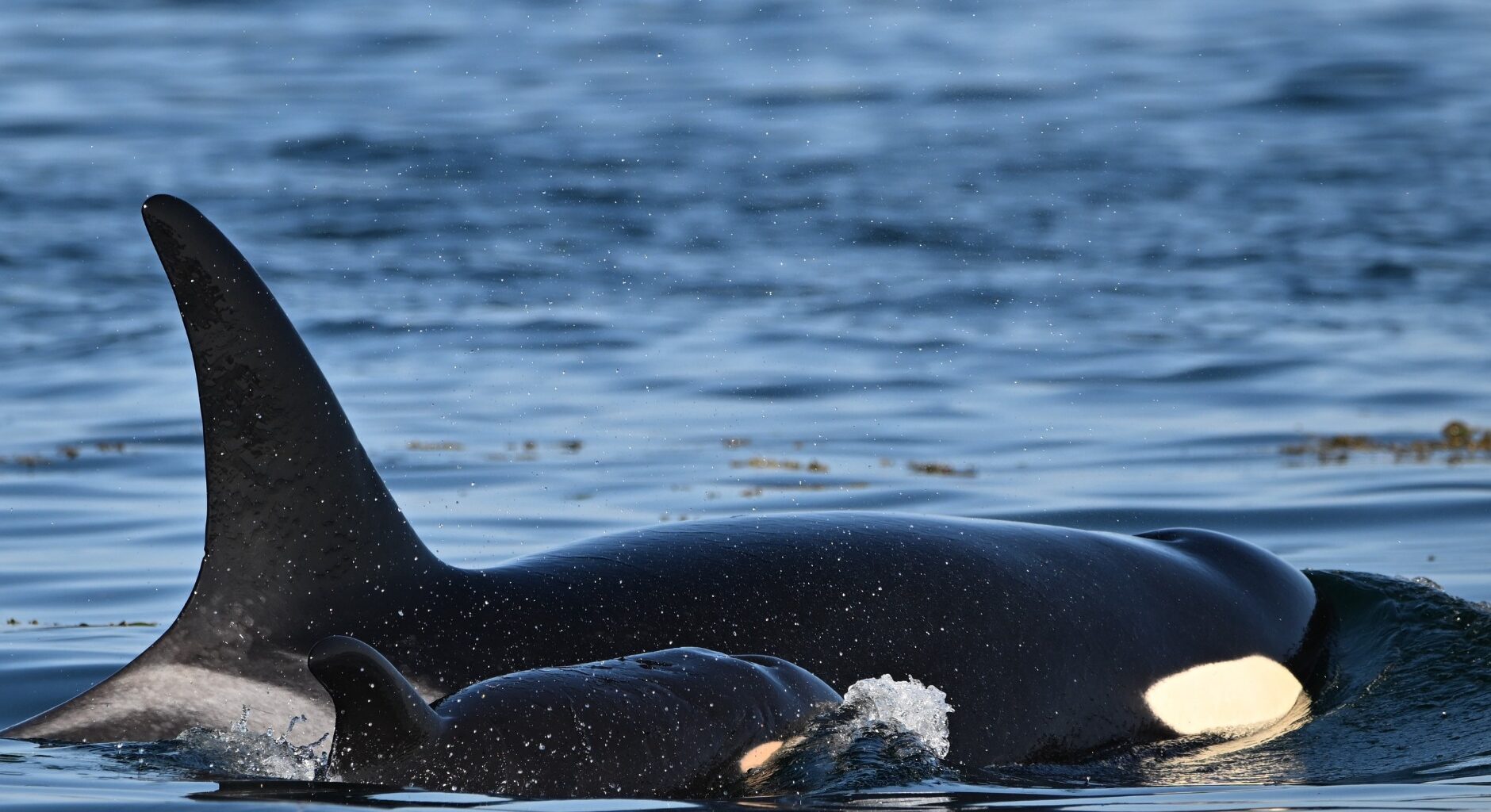
A rare moment of hope for the endangered southern resident killer whales has turned to heartbreak.
The Center for Whale Research (CWR) says J64, a calf born to 16-year-old J42, is now presumed dead just weeks after its birth was confirmed in late September.
During a research encounter on Oct. 23, CWR observers located J Pod traveling near Mayne Island but found no sign of the newborn.
Despite extended observation and repeated dives from the mother, J42, the calf never surfaced.
“After a few long dives and still no calf, we had to conclude that J64 did not survive and was now gone,” said CWR in a Facebook post. “We kept taking photos of the whole group, hoping J64 was playing with other whales. However, there was no sign of the newest calf even though we kept seeing J62 and J63.”
J42 was seen swimimng with her mother J16 and her brother J26, but without her young calf. CWR says it will continue monitoring the pod in future encounters, though the loss appears certain.
This was J42’s first confirmed calf and researchers note that mortality rates for newborns are extremely high among the southern residents, particularly for first-time mothers.
“Poor nutritional status and the transfer of toxins from mother to calf during gestation and lactation are key factors,” CWR said. “Southern Residents need healthy, abundant Chinook Salmon populations to sustain themselves and the calves they raise if this population is to survive.”
J64’s presumed death is a painful setback for a critically endangered population that now numbers around 74 whales. The southern residents, made up of J, K and L pods, continue to struggle with limited prey, pollution and disturbances from boats and noise.
The calf was first spotted on Sept. 18 by researchers with Orca Network and SeaDoc Society and confirmed by CWR days later in the Strait of Georgia. At the time, it appeared healthy and closely bonded to its mother.
J64’s loss follows a series of difficult years for the population, including several stillbirths and calf deaths.
The Center for Whale Research continues to document every encounter with the southern residents. Photos and data from J Pod’s Oct. 23 sighting are available on the group’s interactive encounters map.