
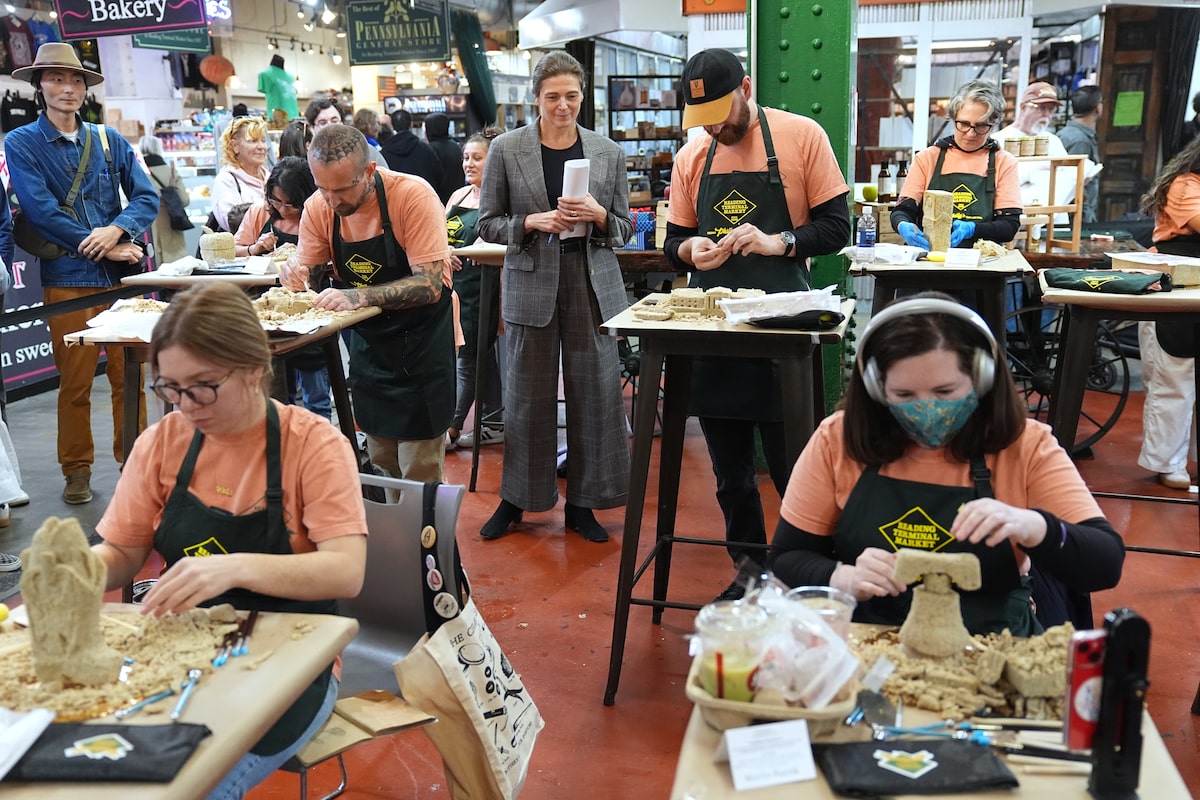
Then-chief executive of the Philadelphia Art Museum, Sasha Suda, centre, walks among competitors in the Scrapple Sculpting Contest at the Reading Terminal Market, on Oct. 10.Matt Rourke/The Associated Press
Canadian Sasha Suda has left the Philadelphia Art Museum after three years on the job, the institution said in a statement Wednesday.
Suda, who was hired on a five-year contract, was previously the director of the National Gallery of Canada. Deputy director Louis Marchesano will be in charge of the Philadelphia museum until an interim director is appointed.
News media in Philadelphia have reported that Suda’s departure is linked to a rebranding exercise that has proved unpopular with both the public and some museum board members. In October, the institution simplified its name to the Philadelphia Art Museum from the Philadelphia Museum of Art. It also adopted a retro-looking logo featuring the familiar griffin from sculptures on its roof. The new name sparked derision on social media, where the acronym PhAM has been mocked as PhART.
The changes took the board by surprise, one member told the Philadelphia Inquirer, because it had not been given a final notification they were going ahead.
Suda did not immediately respond to a request for comment. In a statement, the museum said the change was an internal matter and it would not be providing further comment.
Before the move to Philadelphia, Suda spent three years as director of the National Gallery of Canada, where she also lead a rebranding exercise. She placed Indigenous art and experience at the core of the gallery’s mission with a new logo and the motto “Ankosé – Everything is connected – Tout est relié.” The gallery continues to use that messaging, although there has been much public debate over its mission and handling of Indigenous art. Her tenure in Ottawa was also controversial because of numerous departures of senior staff.
2022: Inside the power struggles and staff turmoil at Canada’s National Gallery
She joined the Philadelphia museum at a difficult time for the institution, which was in the midst of renegotiating pay with newly unionized staffers; they went on strike the day she arrived in 2022. American museums have also come under fire from the Donald Trump administration for their perceived “wokeness.”
“Trump is in power and maybe diversity is not such a good thing,” said Diana Nemiroff, a former National Gallery of Canada curator who has written a book on its female leaders.
She dismissed suggestions Suda’s Canadian experience counted against her or left her uncomprehending of U.S. cultural shifts. “This is not a Canadian thing. There has been lots of Canadian success in the States,” she said, pointing to the career of Matthew Teitelbaum, recently retired director of the Boston Museum of Fine Arts.
Hired to make the museum more accessible, Suda also established the Brind Center for African and African Diasporic Art, bringing in new curators to concentrate on that area, and opened the galleries to more school children.
“There should be no room for a political agenda,” said Tom d’Aquino, the emeritus chair of the National Gallery of Canada Foundation, who witnessed fierce debate over Suda’s legacy in Ottawa. “Where we have seen some real difficulties emerge is where directors come into an institution, perhaps influenced by their own deeply held views, perhaps by the times, the imperative of inclusivity and equity, pursuing an agenda.”