
Inside the Market’s roundup of some of today’s key analyst actions
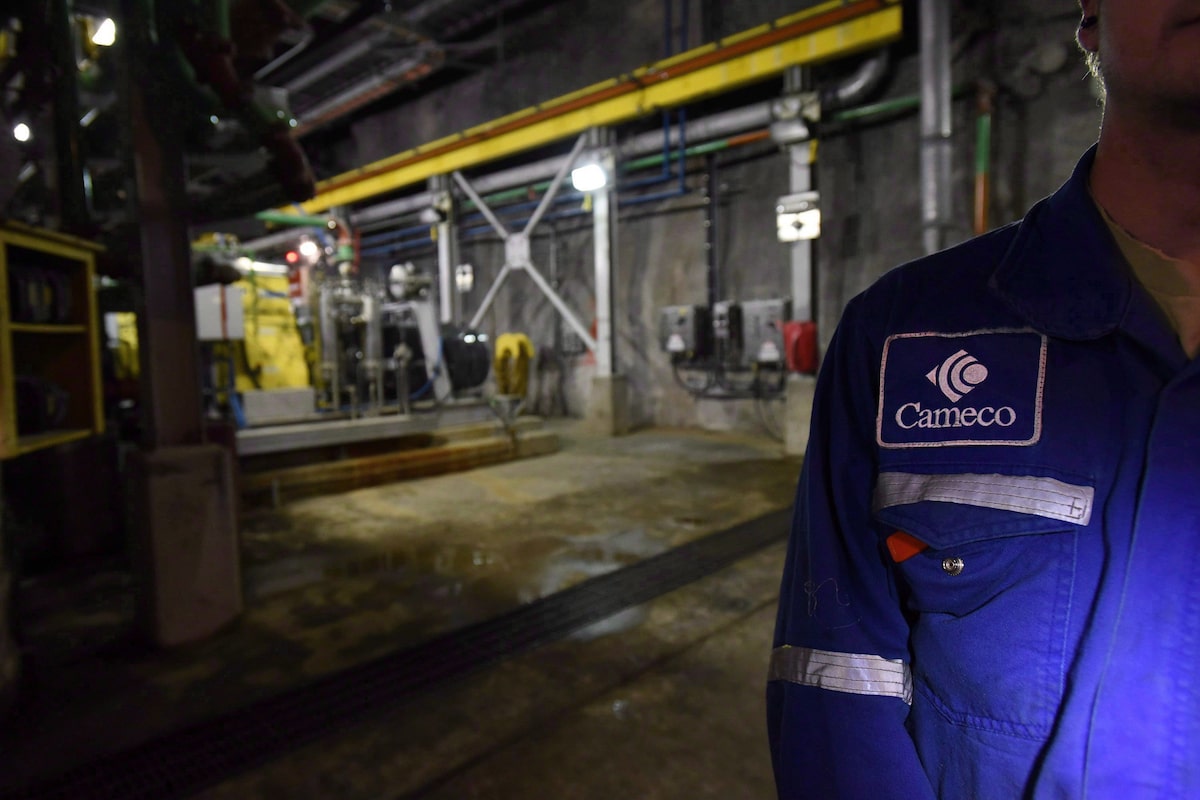
While the third-quarter results from Cameco Corp. (CCO-T) fell short of the Street’s expectations, National Bank Financial analyst Mohamed Sidibé thinks the outlook for the Saskatoon-based uranium refiner remains positive with focus remaining solely on its involvement in a massive US$80-billion nuclear reactor deal with the U.S. government.
“Overall, the 2025 outlook was reiterated and sales outlook into Q4/25 firmed up,” he said in a client note. “The upside potential remains at Westinghouse as evidenced by commentary made on the call and CCO remains disciplined on the contracting front as it awaits for better pricing terms to arise, which it views as inevitable.
“Overall, while our 2025 EBITDA decreases 4 per cent on the back of lower uranium and fuel sales modelled, our 2026 EBITDA remains largely unchanged with the lower contribution from the uranium segment, offset by fuel services and Westinghouse in our model. We also updated our model to reflect lower spot purchase volumes for 2025, a lower cost of sales assumption and revised delivery timing for Inkai, now modelling 3.9 mln lbs delivered from the JV in Q4/25, in line with commentary provided.”
Shares of Cameco slid 1.6 per cent on Wednesday after it reported revenue for the quarter of $615-million, falling short of both Mr. Sidibé’s $816-million estimate and the consensus forecast of $785-million. Adjusted earnings per share of 7 cents also missed expectations (22 cents and 27 cents, respectively), driven by lower sales within the uranium and fuel services segments.
“We revised our 2025 and 2026 production estimate slightly lower at McArthur River, reflecting conservatism tied to the slower-than-expected underground development flagged in August and as Cameco remains disciplined and diligent about its operations,” the analyst said. “Our consolidated production forecast for the year remains largely unchanged for 2025, while 2026 drops 1 per cent to 21.04 million lbs U3O8.
“On the sales front, we now model the bottom end of the 32–34 mln lbs guidance range for 2025 from 33.03 mln lbs prior, with sales of 10.5 mln lbs in Q4. Our 2026 sales forecast is unchanged at 31 mln lbs.”
While he reduced his near-term expectations, Mr. Sidibé expressed optimism after the company’s conference call with analysts, seeing upside to the nuclear deal and potential initial public offering of Westinghouse as well as further clarity on the U.S. government’s involvement in the joint venture.
“Management indicated that there is considerable upside remaining within Westinghouse beyond the US$80-billion target for reactor deployment and the US$30-billion IPO target for 2029,” he said. “The partnership with Brookfield and the U.S. government is expected to accelerate Westinghouse’s growth, with the IPO target serving as a potential milestone. CCO noted that it would not be unreasonable to see the order book grow beyond current expectations once the financing, permitting and long lead items are in place, reinforcing our view that the upside within Westinghouse remains still underappreciated. Cameco stated that it is not opposed to spinning out Westinghouse and will consider all options that maximize value and optionality for shareholders when the time comes.”
“The partnership structure places responsibility on the U.S. government to facilitate financing, permitting and approvals for new Westinghouse reactors. Westinghouse believes it can deliver on these commitments provided it can standardize, sequence and simplify the build process. The company is confident in its ability to initiate construction on multiple reactors simultaneously, such as starting with two pairs of two reactors at a time, mimicking the UAE, or Ontario sequencing.”
Reiterating his “outperform” rating for Cameco shares, the analyst raised his target to $145 from $140 after increasing his project net asset value assumptions for its uranium and fuel services segment as well as his equity value discounted cash flow projection for the Westinghouse segment. The average target on the Street is $138.59, according to LSEG data.
“Cameco remains well positioned to benefit from tightening supply dynamics and higher uranium prices, supported by its long-term contract portfolio and strong balance sheet,” he said.
Elsewhere, Desjardins Securities’ Bryce Adams raised his target to $160 from $135 with a “buy” rating.
“We view the Westinghouse partnership with the US government as a meaningful update for CCO shares,” said Mr. Adams.
=====
“We’ve capitulated and changed our tune for the beat-and-raise juggernaut following yet another impressive quarter,” said Raymond James analyst Michael Barth following the release of Suncor Energy Inc.’s (SU-T) third-quarter financial results.
“We continue to be surprised at how much SU pushes the envelope on upstream performance; that’s true of production, turnaround times, unit cash cost, and capital efficiency, and 3Q25 was no different. We once again find ourselves revising estimates higher, this time around production and unit cost efficiency (which happen to go hand-in-hand),” he added.
Seeing its upstream momentum continue, he raised his estimates for the Calgary-based company, leading him to upgrade his recommendation for its shares to “outperform” from “market perform” previously.
“SU posted a monster Upstream quarter, with Oil Sands AFFO [adjusted funds from operations] coming in 13 per cent above our estimate on both stronger-than-expected production and lower unit opex,” said Mr. Barth. “As a result, the company revised FY25 Upstream production guidance to 845-855 mbbl/d (810-840 mbbl/d prior). Unit opex is also trending to come in at-or-below the low end of previous guidance, which we suspect is a function of both specific efficiencies and fixed-cost absorption. Given the momentum across most assets, we’ve revised our longer-term production estimates higher and reduced our unit opex estimates in tandem.
“Downstream puts up a record operational quarter, and we revise estimates higher here too. Refining utilization broke a new record at 106 per cent of nameplate capacity, with the East region posting an impressive 110 per cent. On the back of higher volume we also saw better-than-expected unit opex. True capacity is clearly higher than nameplate, and while we won’t know what that looks like until SU officially addresses the elephant in the room, we’re sufficiently convinced that our previous throughput estimates were too low and revise them higher (again).”
Seeing an “increasingly compelling” valuation for Suncor shares, Mr. Barth raised his target to $70 from $61. The average on the Street is $63.74.
“In our revised estimates we now have SU trading at a more than 10-per-cent sustaining free cash flow yield, which is the 2ndhighest in the peer group,“ he explained. ”A double-digit sustaining free cash flow yield on a US$60/bbl price deck strikes us as reasonably attractive given the high 2P RLI, low and declining sustaining FCF breakevens, and our fading concern around base mine.”
=====
In a research report titled Is Nuclear the New EVs?, Scotia Capital analyst Jonathan Goldman raised his rating for ATS Corp. (ATS-T) to “sector outperform” from “sector perform” previously, taking a “more bullish” stance on the company following its second-quarter fiscal 2026 results due to a growing nuclear backlog and encouraging comments from its management.
The stock already had two built-in catalysts – the upcoming announcement of a new CEO and deleveraging below more than 3 times by fiscal year-end – all while estimates and valuation seemed appropriately reset,” he explained. “Even after the move up today, shares still lagged the TSX by wide margin of nearly 30 per cent. For context, ATS shares are trading below where they were when the company announced the EV settlement.
“What turns us more bullish now is the nuclear backlog build and positive commentary on the call. Nuclear now accounts for 13 per cent of backlog ($275-million) and more than 2 times year ago levels ($110-million). Management noted the nuclear funnel continues to broaden beyond refurbishment, covering service and new nuclear reactor builds, including SMRs. We see downside risk to top-line estimates this year as company expectations for consolidated revenue growth of HSD% [high single digits] are below consensus (and prior commentary which suggested HSD% was organic alone). Tax-loss selling is also a risk, but we see no need to get cute here when thematic exposure is the play du jour (see TIH re. AVL and ATRL).”
Shares of the Cambridge, Ont.-based automations solutions provider surged 10.5 per cent on Wednesday after it reported sales and adjusted basic earnings per share of $728.5-million and 45 cents, respectively, exceeding the Street’s expectations ($721.5-million and 43 cents). Its revenue guidance for the current quarter also met the consensus forecast, while ATS reaffirmed its other full-year targets, included revenue and margin expansions.
While Mr. Goldman cut his full-year 2026 and 2027 earnings expectations after acknowledging his previous revenue assumptions were “too aggressive relative to consensus,” he raised his target for ATS shares by $4 to $49. The average on the Street is $48.09.
“We are comfortable around the remaining risks, namely: 1) slowing Life Sciences bookings, as investors seem to understand the company is lapping tough comps on large enterprise orders last year and funnel commentary remains strong; 2) lack of operating leverage (costs came down quarter-over-quarter and the company announced restructuring); 3) higher w/c investment/lower FCF generation (our estimates are more conservative than management targets); and 4) a new CEO that may not fit the mold of investors,” he added. “On the latter point, we think the Board will pursue a candidate with a continuous improvement background and M&A pedigree similar to Andrew Hider. Moreover, we believe thematics will continue to dominate market trading.”
“We view ATS as a core long-term holding as the company is a direct beneficiary of the long-term trend towards automation. An inflection in 3Q results and strong order bookings (TTM [trailing 12-month] book-to-bill 1.18 times) provides good visibility on a better sales trajectory in F26. But, larger orders are causing a disconnect between backlog and revenue conversion. We expect a slower cadence to drive lower SG&A leverage than modeled by the Street and have margins returning to 15 per cent exiting F26, three quarters after the Street. We sit 10-15 per cent below for F1Q-F3Q. A slower margin recovery and elevated working capital due to the EV customer dispute will delay deleveraging and keep M&A on pause in the near term, prerequisites for a re-rate, in our view. While the stock has pulled back, expectations are still high per our below-consensus estimates, and we think revisions represent a catalyst to the downside.”
Elsewhere, RBC’s Sabahat Khan raised his target to $51 from $49 with an “outperform” rating.
“Looking ahead, we believe the company’s near-record backlog positions it well for continued growth,” said Mr. Khan.
=====
Following weaker-than-anticipated third-quarter results and outlook that accentuated “challenging” market conditions, ATB Capital Markets analyst Chris Murray expects trade headwinds to continue weigh on Cargojet Inc.’s (CJT-T) top-line, however he now sees “value in the shares at current levels, given the stability of the domestic network and expectation that lower CapEx supports stronger FCF generation and deleveraging.”
Shares of the Mississauga-based company plummeted 13.9 per cent on Wednesday after it reported quarterly revenue of $219.9-million, a drop of 10.5 per cent year-over-year and below both Mr. Murray’s $253.3-million estimate and the Street’s forecast of $237.9-million.
“The revenue and EBITDA miss was driven by softer-than-expected revenue generation within ACMI and Charter, with total block hours down 16 per cent year-over-year,” said the analyst. “Margins came in ahead of ATB estimates, reflecting the Company’s flexible cost structure. Management reaffirmed its cautiously optimistic outlook while acknowledging increasing levels of uncertainty around trade patterns. The Company announced that Co-CEO Jamie Porteous intends to retire at year-end, with Co-CEO Pauline Dhillon set to become the Company’s sole CEO. CJT expects to deliver some growth in Q4/25, albeit likely below historical levels and driven entirely by the domestic network.”
Mr. Murray is now expecting “more muted peak season growth,” but he did emphasized Cargojet’s “ability to adapt.”
“While management expects volumes to strengthen off Q3 levels across all three segments in Q4/25 on seasonality, it is anticipating a more muted peak season. CJT believes Domestic can deliver 10 per cent growth in Q4/25, given strengthening demand from Amazon (AMZN-O, not rate) with All-in charter facing a challenging comp due to outsized growth in Q4/24 (Asian ecommerce volumes), which has since moderated,” he said. “Management was cautious on its outlook for ACMI and is not expecting growth to reaccelerate in 2026.
“CJT reported a 32.5-per-cent Adjusted EBITDA margin in Q3/25 despite the weaker top-line, reflecting a variable cost structure and rightsizing efforts in recent years, which position it to maintain margins in a lower growth environment. Management confirmed expectations for minimal growth CapEx in 2026 and plans to leverage sale and leaseback transactions to manage its capital and asset base. CJT intends to add one aircraft in Q4/25 as it sees its fleet as appropriately sized for current market conditions while maintaining optionality.”
After reducing his forecast for fiscal 2026, Mr. Murray dropped his target for Cargojet shares to $110 from $145, keeping an “outperform” rating. The average is $124.71.
“Our PT is based on our valuation period for the four quarters ending Q3/27 (+1Q) and our estimate for shares outstanding and net debt as of Q3/26 (+1Q),” he explained. “We have lowered valuation multiples to reflect increased uncertainty around growth rates, particularly in the Company’s charter business and ACMI, given increasing global trade uncertainties.”
Elsewhere, others making changes include:
* Desjardins Securities’ Benoit Poirier to $117 from $149 with a “buy” rating.
“After [Wednesday’s] selloff, CJT trades at just 1.4 times book value (below its three-year average of 2.3 times) and 6.5 times our materially reduced 2026E EBITDA, close to precedent ACMI/airline deals (ATSG, Atlas, WestJet acquired at 5.5–6.0 times EV/EBITDA and 1.0 times P/B). While management changes amid a pilot contract renegotiation may add uncertainty, new CEO Pauline Dhillon’s commitment to minimal growth capex and ongoing cost efficiencies is encouraging. If the depressed valuation persists, CJT could become a privatization candidate,” said Mr. Poirier.
* TD Cowen’s Tim James to $120 from $160 with a “buy” rating.
“While weaker-than-forecast Q3 doesn’t suggest material change in long-term earnings power, in our view, it does imply lower than previously assumed visibility into the impact of macro factors on CJT’s revenue drivers. We expect evidence of recovery required before stock moves towards our target in 2026. Encouraged by capacity restraint, low valuation, and other positive investment attributes,” said Mr. James.
* Scotia’s Konark Gupta to $105 from $135 with a “sector outperform” rating.
” Although we agree short-term fundamentals are weak, we are encouraged to see CJT protecting margins and showing strong fleet discipline. Stock has fallen 50 per cent over the past year as valuation remains depressed at 6 times EV/EBITDA, which is similar to some expensive airlines and some low-quality trucking companies. This surprises us the most considering CJT generates high margins (more than 30 per cent), has a solid moat (greater than 90-per-cent share in Canada), and has long-term contracts that recently renewed (expiring 2029-2037, annual rate escalators, and minimum guarantees). We understand the market penalized the stock not just due to the miss against tempered expectations but also due to the timing of CEO transition. However, we expect status quo for the business under Pauline Dhillon as CEO and continue to view the valuation as unsustainable. Potential catalysts could be re-acceleration in growth as geopolitical noise settles down and global trade normalizes; new contract wins; or strategic outcomes (e.g, takeover),” said Mr. Gupta.
* Raymond James’ Steve Hansen to $95 from $132 with an “outperform” rating.
“Despite these near-term concerns, we have elected to maintain our Outperform rating based upon CJT’s: 1) leading market position in the domestic Canadian market; 2) proven ancillary growth strategy; & 3) attractive (near trough) valuation,” said Mr. Hansen.
* CIBC’s Kevin Chiang to $106 from $132 with an “outperformer” rating.
=====
After shares of Maple Leaf Foods Inc. (MFI-T) dropped 5.3 per cent on Wednesday as the Street expressed concern over upcoming headwinds from rising commodity costs, Stifel analyst Martin Landry recommends “investors take advantage of the price weakness to accumulate shares,” seeing the issue as “temporary.”
“Pork prices have risen significantly recently with a 40-per-cent increase in pork belly and a 50-per-cent increase in pork trim year-over-year,“ he explained. ”This is expected to create a headwind in the coming two quarters given the lag to pass on price increases, especially at retail. Price increases at retail will take effect in the first week of February due to a black-out period in effect at retailers, leaving Maple Leaf exposed in the near-term from a margin standpoint.”
Before the bell, Maple Leaf reported third-quarter results deemed to be “good” by Mr. Landry with revenues rising 8 per cent year-over-year to $1.356-billion, exceeding his estimate of $1.324-billion. Adjusted earnings per share jumped 172 per cent to 49 cents, topping his 47-cent expectation, driven by higher sales.
“It is difficult to compare to consensus estimates as some excluded Canada Packers from their estimates,” he noted. “Results from continuing operations were also strong with adjusted EBITDA up 19 per cent year-over-year year-over-year …. Management indicated that given a black-out period at retail, price increases will only be implemented in February. Hence, MFI could see margin pressure year-over-year in Q4/25.”
After cutting his revenue forecast to reflect the impact of higher commodity prices, Mr. Landry lowered his target for Maple Leaf shares to $32 from $40.50, keeping a “buy” rating and expressing valuation concern. The average target on the Street is $34.25.
“Confusion on valuation and double counting? Maple Leaf shares have been under pressure since the spin-off of Canada Packers,“ he said. ”In most platforms, Maple Leaf’s historical share price has been restated downward by $4-5, which we believe has created confusion among investors. Immediately prior to the spin-off, shares of Maple Leaf were traded at $36.00, and the value of the Canada Packers shares spun-off are approximately $4.00-5.00, which technically should imply a post spin-off price of $30.00-31.00 all else equal. However, shares of Maple Leaf traded around $28.00 immediately post spin-off suggesting that there may have been double counting given the historical share price has been restated.
“Our valuation now reflects MFI’s continuing operations. We are making limited changes to our forecasts for MFI’s continuing operations. The reduction in our target price reflects MFI without Canada Packers as we had not revised our valuation post the spin-off.”
Elsewhere, others making target adjustments include:
* National Bank’s Vishal Shreedhar to $34 from $36 with an “outperform” rating.
“MFI is a company undergoing transformative change, and we are intrigued by the prospects,” said Mr. Shreedhar. “We acknowledge heightened risk, predominantly due to execution (given a long-term track record of underperformance) and commodity volatility. We believe that MFI can re-rate higher if it demonstrates stable sales growth and EBITDA margin improvement over time.”
* TD Cowen’s Michael Van Aelst to $42 from $43 with a “buy” rating.
“PF revs/EBITDA were up 8 per cent/19 per cent, but conference call Q&A was mostly spent explaining commodity movements (fresh meat costs jumped as much as 70 per cent) and steps being taken to pass on, rather than MFI’s excellent revenue growth (sector leading) and brand strength. Price hikes already communicated but didn’t get done before grocer-mandated holiday price freeze (Nov-Jan), so margins will be pressured until early Feb,” said Mr. Van Aelst.
* RBC’s Irene Nattel to $33 from $34 with an “outperform” rating.
“Teasing through the noise and focusing on Maple Leaf Foods RemainCo operations, profitability essentially as forecast with higher input costs moderating margins, planned pricing action should improve cadence during Q1/26,” she said.
* Scotia’s John Zamparo to $27 from $32 with a “sector perform” rating.
“MFI’s previous 100-per-cent ownership of CPKR provided a natural hedge against pork costs. The absence of this now presents a headwind, as MFI experienced “rapid and sustained” inflation, which takes 1-2 quarters to pass on. Net, margin pressure from Q3 persists for Q4, and, we expect, into Q1. The next potential catalyst—of uncertain direction for now—is likely a strategic update early next year which could provide 2026 guidance and possibly longer term targets. The new MFI is not immune to margin pressures from commodity prices; they merely take a different shape now. We believe it may take some time for investors to contemplate what this means for EBITDA generation,” said Mr. Zamparo.
* CIBC’s Mark Petrie to $35 from $36 with an “outperformer” rating.
=====
Desjardins Securities analyst Jerome Dubreuil sees CGI Inc. (GIB.A-T) “sizing the moment with capital deployment” as it forges its place in the artificial intelligence race.
“CGI appears to have taken note of skepticism around the ROI generated thus far by some AI use cases,” he said. “In response, it is positioning itself as an ‘AI-to-ROI’ partner, consistent with its historical focus on value-driven technology deployment. We believe this messaging may not be enough to shift near-term investor attention away from the current AI narrative. However, management is seizing the moment and deploying capital more aggressively—perhaps large-scale M&A could crystalize a positive sentiment shift.”
Shares of the Montreal-based firm jumped 5 per cent on Wednesday after it reported adjusted diluted earnings per share for its third quarter of $2.13, up 10.8 per cent year-over-year (from $1.92) and 4 cents above the Street’s expectation. It also said it will now pay a quarterly dividend of 17 cents per share, up from 15 cents per share.
Mr. Dubreuil said AI and the impact of the ongoing U.S. government shutdown dominated focus in the post-earnings conference call.
“CGI’s management grabbed the bull by the horns and discussed the transformative impact of AI during the earnings call,” he noted. “There was no denying that some adjustment is required and the company argued that it is well-positioned to support clients in deploying and integrating new solutions. We appreciated the colour on AI, which reflects management’s proactive stance on the matter. CGI’s ‘AI-to-ROIC’ approach and outcome-based pricing suggest confidence in its capabilities and a willingness to share value creation with clients. While management stated that IT budgets are not expected to shrink due to AI, we believe this view does not fully address investor concerns around the potential for AI-native players to capture a growing share of future spend.
“U.S. federal government makes it unlikely that we see meaningful near-term progress. During the earnings call, management quantified the impact of the ongoing U.S. government shutdown, estimating a $70-million revenue headwind in 1Q FY26 — roughly 2 per cent of quarterly revenue— with an associated margin impact of $15–22-million (assuming the shutdown ends mid-November). Management also noted that the H-1B visa review is not expected to materially affect results. Despite these near-term disruptions, we remain confident that U.S. federal IT spending will continue to grow in the future, given its alignment with broader goals around efficiency and modernization. However, considering the current US federal backdrop as well as the unchanged demand trends in SI&C and discretionary spending, we believe a sequential improvement in organic growth next quarter is unlikely.“
With modest reductions to his full-year 2026 expectations, the analyst trimmed his target for CGI shares to $157 from $160, keeping a “buy” rating. The average is $156.08.
Elsewhere, other changes include:
* Stifel’s Suthan Sukumar to $160 from $185 with a “buy” rating.
“CGI continues to demonstrate their ability to drive stability amidst macro/AI uncertainty, underscoring our thesis for management’s ability as disciplined operators to navigate challenging environments and grow market-share gains, revenues, and earnings with a differentiated managed services-led model, which is playing quite nicely into clients’ heightened cost-cutting priorities. With healthy forward visibility given the surprising book-to-bill strength, we see a durable growth outlook, particularly with a growing pipeline of global public-sector modernization, defence, and sovereign data/AI initiatives (especially in Canada with Carney’s ‘Buy Canada’ policy), and see potential upside given elevated M&A priorities with beat-up sector valuations. With CGI being a highly defensive, blue-chip name sitting at 52-week lows with valuation at 5-year trough levels, we see an attractive risk-reward,” he said.
* RBC’s Paul Treiber to $165 from $175 with an “outperform” rating.
“Amidst a challenging market environment, CGI delivered a $0.03 adj. EPS beat. Bookings were solid, but new managed services bookings will take time to ramp, so organic growth is likely to remain soft in the near term. M&A is a potential catalyst for the stock, as the environment is “fantastic.” We maintain our Outperform rating and adjust our price target from $175.00 to $165.00, given the compression of valuation multiples across IT services peer,” said Mr. Treiber.
* Raymond James’ Steven Li to $168 from $171 with an “outperform” rating
=====
In other analyst actions:
* JP Morgan’s Bill Peterson upgraded Lithium Americas Corp. (LAC-T) to “neutral” from “underweight” with a $7 target. The average is $7.83.
* Citing valuation concerns after in-line third-quarter results, ATB Capital Markets’ Frederico Gomes downgraded Curaleaf Holdings Inc. (CURA-T) to “sector perform” from “outperform” with a $4 target (unchanged). The average is $3.94.
“The Company reported neutral Q3/25 results with in-line revenue and a slight adj. EBITDA beat,” he said. “However, after a 210-per-cent gain in six months, we believe the stock now fairly reflects our base-case growth expectations (which, it is important to note, do not include near-term federal reform, adult-use legalization in key states like Florida or Pennsylvania, or further legalization in international jurisdictions).
“While we believe Curaleaf’s scale and international exposure deserve a premium, the stock already trades at 9.6 times 2026 estimated EV/EBITDA, which is a 71-per-cent premium to the 5.6 times Tier 1 peer average. We believe this valuation reflects the current regulatory status quo in our base-case, while significant upside remains if reform materializes, reflected in our C$13.00 bull-case fair value estimate.”
* CIBC’s Krista Friesen raised her Air Canada (AC-T) target by $1 to $23 with an “outperformer” rating. Other changes include: Scotia’s Konark Gupta to $25 from $26 with a “sector outperform” rating and JP Morgan’s Jamie Baker to $26 from $27 with a “neutral” rating. The average is $25.07.
“AC delivered a slight EBITDA miss in a labour-impacted Q3 but once again significantly beat FCF expectations,“ said Mr. Gupta. ”Full-year guidance was slightly tweaked (positive), but, more importantly, total 2025-2029 capex was reduced by $740-million, not related to potential sale/leaseback. While we wait for 2026 guidance, it appears that capacity growth could exceed 5 per cent as AC receives a record number of aircraft, and margin could expand slightly despite CASM [cost per available seat mile] inflation in a fairly stable fuel/FX environment. FCF should ramp up heading into 2027 as capex plateaus and earnings rebound. Stock’s continued attractive valuation at 3.7 times EV/EBITDA on 2026E should enable AC to execute on the renewed NCIB for up to 30 million shares, possibly at a more gradual pace than last time, in our view.”
* CIBC’s Dean Wilkinson reduced his target for Boardwalk REIT (BEI.UN-T) to $80, below the $82.95 average, from $84 with a “neutral” rating. Other changes include: Raymond James’ Brad Sturges to $80 from $82 with an “outperform” rating, TD’s Jonathan Kelcher to $88 from $87 with a “buy” rating, Scotia’s Mario Saric to $78 from $81 with a “sector perform” rating and RBC’s Pammi Bir to $82 from $88 with an “outperform” rating.
“We remain constructive on BEI but lower our target in the context of weak sentiment on the broader apartment sector. BEI’s FFO growth this year is sector leading and while it should decelerate next year, we do not see any alarming signs to justify current discounted valuation. Indeed, tone of the call was quite bullish. Occupancy is holding well, incentive levels have trended down and blended lease spreads have been tracking at 3 per cent lately. Moreover, we are positive on its asset recycling strategy which is proving out to be additive both financially and qualitatively,” said Mr. Bir.
* National Bank’s Zachary Evershed raised his Dexterra Group Inc. (DXT-T) target to $15.50 from $15 with an “outperform” rating, while ATB Capital Markets’ Chris Murray bumped his target to $12 from $11.75 with an “outperform” rating. The average is $12.51.
“The integration of the Right Choice acquisition and expansion efforts, particularly in the U.S. through the PVC partnership, remain key strategic priorities. Management expects Right Choice’s integration to be fully completed by Q1/26, creating opportunities to reallocate equipment and maintain flexibility for potential Nation Building initiatives and other strategic programs while the ongoing optimization of assets in the Montney/Duverney area is underway, consolidating sites (notably those that share the same customers) to raise camp utilization in the area while freeing up spare assets for redeployment,” said Mr. Evershed.
* TD Cowen’s Sam Damiani bumped his Dream Industrial REIT (DIR.UN-T) target to $14 from $13.50 with a “buy” rating, while Scotia’s Himanshu Gupta bumped his target to $15 from $14.50 with a “sector outperform” rating. The average is $13.98.
“DIR’s operating performance has proven to be highly resilient in the face of this year’s macro uncertainty. While the timing of market rent growth resumption remains uncertain, we are increasingly confident that today’s embedded mark-to-market ensures a sufficiently long growth trajectory. With well above-average SPNOI and AFFO growth vs most REITs, we see further room for DIR’s valuation to recover,” said Mr. Damiani.
* National Bank’s Shane Nagle moved his target for Ero Copper Corp. (ERO-T) to $37 from $35 with a “sector perform” rating. The average is $33.07.
“Cash flow multiples appear more attractive after accounting for incremental gold concentrate sales out of Xavantina; however, the market will need to see evidence of an operational turnaround in Q4, given challenges to date and production below the low end of recently revised guidance,“ said Mr. Nagle. ”We remain cautious on the long-term outlook for the company given a premium P/NAV valuation of 1.18 times (peers: 1.0 times) and declining production profile from existing operations beginning in H2/27 as grades decline at Tucumã. We remain conservative on our 2026 operating assumption, but mention that management noted positive operational momentum after implementation of processing improvements across all of Ero’s operations.”
* National Bank’s Jaeme Gloyn dropped his target for Goeasy Ltd. (GSY-T) to $245 from $264 with an “outperform” rating, while Raymond James’ Stephen Boland reduced his target to $208 from $226 with an “outperform” rating. The average is $229.80.
“We expect a negative share price reaction to the deteriorating delinquency performance, rising provisioning rate, and flat interest receivables balances. Moreover, the additional interest receivable disclosure didn’t really help explain why those balances continue to rise, though we believe increased utilization of borrower assistance programs and tighter collection practices (i.e., not waiving interest payments) are the likely drivers beyond simply portfolio growth. On the other hand, the company reported continued strong loan growth, revenue growth, revenue yields, opex containment, and even stable net charge-off performance. Management’s Q3-25 mini-guidance largely aligned with our prior forecasts as well. Nonetheless, we are compelled to take a more conservative view of credit performance in the near term,” said Mr. Gloyn.
* National Bank’s Gabriel Dechaine bumped his Great-West Lifeco Inc. (GWO-T) target to $59 from $58 with a “sector perform” rating, while TD Cowen’s Mario Mendonca raised his target to $70 from $66 with a “buy” rating. The average is $61.18.
“GWO has been surprising investors this year with a hitherto unseen level of buyback activity,” said Mr. Dechaine. “This trend should continue, with GWO announcing another $500-million share buyback commitment, the third such announcement this year. Total repurchases under the additional commitment will represent approximately 1 per cent of GWO’s total shares outstanding. We do not view buybacks as an impediment to GWO’s broader capital deployment strategy, which includes M&A. We continue to expect it to pursue further consolidation in the U.S. retirement industry, in which it is already a scale player.”
* RBC’s Darko Mihelic raised his IA Financial Corp. Inc. (IAG-T) target to $167 from $151 with a “sector perform” rating. Other changes include: , Scotia’s Mike Rizvanovic to $179 from $159 with a “sector outperform” ratingDesjardins Securities’ Doug Young to $170 from $163 with a “hold” rating and CIBC’s Paul Holden to $175 from $173 with an “outperformer” rating. The average is $174.57.
“Q3/25 was strong though in line with our estimates. Wealth had mutual fund net inflows for the first time since Q1/22 and strong AUM growth which we view as positives. Capital available for deployment remains solid pro forma the RF Capital acquisition/revised CARLI, and we view the NCIB renewal favourably. We believe IAG will comfortably produce ROEs in the range of 17 per cent and even higher when equity markets and interest rates cooperate. A higher multiple is warranted, but the current stock price reflects a historically low risk premium,” said Mr. Mihelic.
* RBC’s Paul Treiber raised his Information Services Corp. (ISC-T) target to $35 from $32 with a “sector perform” rating. Other changes include: Raymond James’ Stephen Boland to $39 from $38 with an “outperform” rating and Acumen Capital’s Trevor Reynolds to $40 from $35.25 with a “buy” rating. The average is $35.85.
“ISC delivered Q3 adj. EBITDA above RBC/consensus estimates, primarily due to strength in the Saskatchewan real estate market, which lifted Registry Operations revenue. In comparison, Services were soft, due to headwinds in the Ontario market. ISC reiterated FY25 guidance, but sees revenue at the lower end and adj. EBITDA at the higher end due to mix. ISC’s strategic review remains ongoing,” said Mr. Treiber.
* Jefferies’ John Aiken moved his Intact Financial Corp. (IFC-T) target to $320 from $317 with a “buy” rating, while RBC’s Bart Dziarski cut his target to $304 from $324 with a “sector perform” rating. The average is $318.69.
“Q3/25 Operating EPS was ahead of both our and consensus forecasts driven primarily by lower combined ratios in Personal Auto and Commercial. IFC’s 12-month industry growth outlook was maintained. IFC’s current 2.6 ti,es P/ B multiple is slightly above 2.5 times 5-year average (a period which includes hard markets in commercial and higher interest rates boosting investment portfolio yields). Accordingly, we continue to think the shares are fairly valued,” said Mr. Dziarski.
* RBC’s Jimmy Shan trimmed her Minto Apartment REIT (MI.UN-T) target to $16.50 from $17.50 with an “outperform” rating, while Raymond James’ Brad Sturges cut his target to $14.25 from $14.75 with a “market perform” rating. The average is $15.65.
“Q3 operating metrics continue to point to decelerating growth. Candidly, there is not much growth to look forward to in next two years (we model 1-per-cent/2-per-cent FFO growth in 2026/2027). That is based on our less optimistic outlook on SP NOI growth of 2 per cent (vs. MI’s expectation of 3-4 per cent). All that said, it feels like valuation is near trough. MI’s implied cap rate of 5.8 per cent is not too far from its (urban-oriented) commercial peers, suggesting that the negative narrative on apartments may have overshot,” said Mr. Shan.
* Touting its “strong competitive position” buy cautioning same-store sales growth is “still challenging to come by,” TD Cowen’s Derek Lessard trimmed his Pizza Pizza Royalty Corp. (PZA-T) target to $16 from $17 with a “hold” rating.
“Q3 was slightly below expectations due to a tough economy and competition for discretionary dollars. We believe that PZA is one of the best placed Canadian QSRs in a soft environment given the capital-light franchise model, attractive value proposition, and consistent execution. However, shares are up 20 per cent year-to-date, and short term, it’s unlikely that it’s going much higher from here given the backdrop,” said Mr. Lessard.
* Mr. Lessard raised his Savaria Corp. (SIS-T) target to $27, exceeding the $26.06 average, from $24 with a “buy” rating.
“With Savaria’s entrenched industry position, tariff mitigation measures, and a healthy balance sheet, we are confident that it can navigate today’s market challenges. The next catalyst we’re looking for will stem from initiatives focused on sales growth which should further drive operating leverage given Savaria’s newly streamlined processes and scale. We expect more details in the coming months,” said Mr. Lessard.
* TD Cowen’s Graham Ryding bumped his target for Sprott Inc. (SII-T) to $130 from $125, maintaining a “hold” rating. The average is $103.50.
“AUM growth and flows in the quarter were very strong, but broadly in-line with expectations. Growth post quarter has been better than expected. Adjusted EBITDA (margins) were better than expected (excludes share based compensation), albeit adjusted EPS missed due to elevated share based compensation. We have increased our estimates. Valuation remains fair and we maintain our HOLD rating,” said Mr. Ryding.
* Desjardins Securities’ Benoit Poirier raised his Stella-Jones Inc. (SJ-T) target to $94 from $92 with a “buy” rating. Other changes include: TD’s Michael Tupholme to $97 from $90 with a “buy” rating and RBC’s James McGarragle to $89 from $87 with a “sector perform” rating. The average is $88.63.
“Overall, we are pleased with the return of positive organic growth in utility poles (first volume growth since 2Q24). Despite minor changes to the 2025 outlook (not a surprise), we continue to believe that utility poles are poised to grow at mid-single digits plus due to strong fundamentals and recent acquisitions (Locweld and Brooks). We see the reduced buyback envelope as a sign of improved growth opportunities, both organic and from M&A. We believe the company is well positioned to tackle these,” said Mr. Poirier.
* Following a third-quarter beat that saw problems south of the border weigh on results, National Bank’s Gabriel Dechaine trimmed his Sun Life Financial Inc. (SLF-T) target by $1 to $93, while TD’s Mario Mendonca cut his target to $99 from $101 with a “buy” rating. The average is $93.54.
“SLF missed our estimate on weak U.S. results. While we did not expect a strong quarter, results reflect weaker experience in stop-loss & higher claims frequency in dental. In stop-loss, SLF also built reserves on the 1/1/25 cohort. The risk is that more claims data in Q4/25 could lead to further charges. Conservative reserving and pricing (on the 1/1/26 cohort) should drive better results in ’26,” said Mr. Mendonca.