
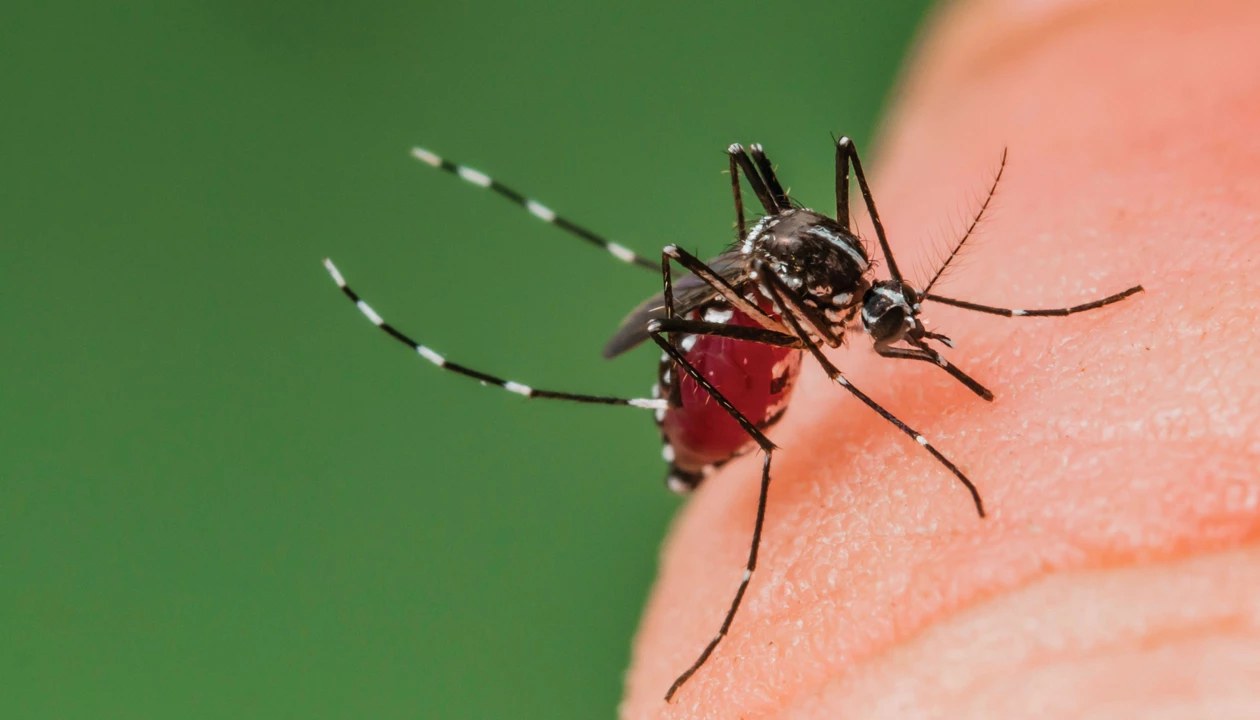
Researchers at Zhejiang University have engineered a fungus to lure mosquitoes in with a scent they can’t resist—and then kill them after they land (Nat. Microbiol. 2025, DOI: 10.1038/s41564-025-02155-9).
Metarhizium robertsii, a pathogenetic soil-dwelling fungus, infects a variety of insects through spores that eventually kill them. Scientists have known that the fungus can spread when a healthy bug meets an infected insect cadaver, but why the bugs were drawn to the corpses wasn’t understood.
A team led by Weiguo Fang found that these dead hosts give off a distinct array of volatile organic compounds. Among the compounds was longifolene, a pine-scented terpene that attracts dengue spreader Aedes albopictus. But the fungus itself produces only trace amounts, which was far too little to lure in mosquitoes.
The structure of longifolene has two rings.

To give the fungus a steady perfume, the team inserted a longifolene-synthase gene from a pine tree into the genome of M. robertsii. The engineered strains can be grown on inexpensive culture materials instead of dead bugs and pump out enough of the compound to be attractive, Fang says in an email to C&EN.
When tested in the lab, both male and female A. albopictus preferred the modified fungus over the unmodified strain. In larger containers with competing scents, they preferred it over humans and a flowering plant.
Once the mosquitoes landed, spores infested their bodies and germinated; within a few days, over 90% of the bloodsuckers were dead. Similar results were seen with other virus-spreading mosquitoes: Anopheles sinensis and Culex pipiens.
Fang says that longifolene is released by many plant species and might be used by mosquitoes to find sugar sources. This also means it’s unlikely the bugs will evolve resistance to the scent, he says.
“These fungal approaches have been used before, and I think this is a significant enhancement,” says Matthew J. DeGennaro, who studies mosquito olfaction at Florida International University and was not involved in the study.
The team plans to test the fungus in the field next. And these tests will be the true show of if this approach could work for mosquito control, DeGennaro says. Real environments are full of competing scents that could influence mosquito behavior, he says.
But another question that needs to be addressed is how safe this is for other insects, DeGennaro adds. While the researchers note in the paper that Metarhizium species are common in soil and are considered low risk to most target insects, DeGennaro says it will still be important to determine the full environmental impact of the method before wider use.
Chemical & Engineering News
ISSN 0009-2347
Copyright ©
2025 American Chemical Society