
In the vast reaches of our solar system, new discoveries are constantly reshaping our understanding of space. One such revelation involves a comet that has unexpectedly turned gold after a perilous pass by the Sun. This comet, C/2025 K1 (ATLAS), has recently captured the attention of astronomers due to its brilliant golden glow and the survival of what was considered a near-impossible journey. But what exactly caused this rare phenomenon, and why did it not meet the fate many predicted?
A Close Encounter With the Sun: The Journey of C/2025 K1 (ATLAS)
Comet C/2025 K1 (ATLAS), discovered in May by astronomers at the Asteroid Terrestrial-impact Last Alert System (ATLAS), embarked on an extraordinary journey toward the Sun. By October 8, it had reached its closest point, known as perihelion, coming within 31 million miles of the Sun—much closer than many comets typically approach. Such close encounters often spell doom for comets, as the intense gravitational forces and heat from the Sun can tear them apart. In fact, many experts expected C/2025 K1 to disintegrate, with the Solar System’s heat and radiation being too much for it to endure.
But remarkably, this comet defied the odds. As astrophotographer Dan Bartlett captured in a stunning image, C/2025 K1 not only survived its perilous pass, but it also emerged transformed—its once faint and unremarkable presence now illuminated with a unique golden hue. Bartlett, speaking to Spaceweather.com, noted,
“This comet was not supposed to survive its Oct. 8th perihelion. But it did survive, and now it is displaying a red/brown/golden color rarely seen in comets.”
What makes this golden glow even more interesting is its rarity. Most comets display white or blue hues due to the sunlight reflecting off their icy surfaces. However, the colors of C/2025 K1 are much more striking, including shades of red, brown, and gold that have rarely been observed in other comets.
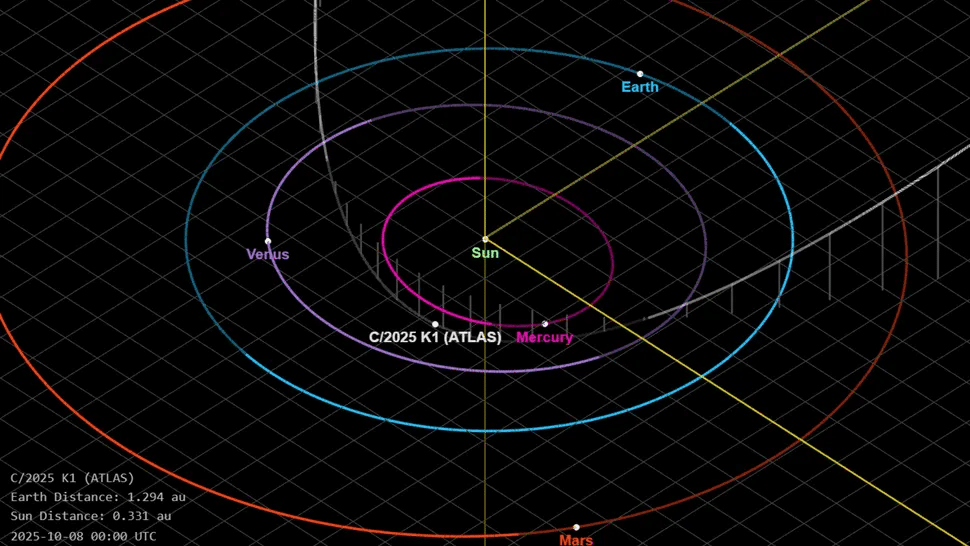 2/2025 K1 (ATLAS) reached its closest point to the sun on Oct. 8, and got more than four times closer to our home star than 3I/ATLAS. (Image credit: NASA/JPL)
The Mystery Behind the Golden Glow
The golden color that now defines C/2025 K1 is not only visually stunning, but also scientifically intriguing. Astronomers have long known that the colors of comets can change depending on the chemicals in their comas—the cloud of gas, dust, and ice that surrounds them. Normally, a comet may appear green due to the presence of certain molecules like dicarbon or cyanide. In some rare cases, comets may even take on blue hues, especially if their coma contains carbon monoxide or ammonia.
However, the golden hue of C/2025 K1 is unlike anything most astronomers have seen before. According to David Schleicher, an astronomer from Lowell Observatory in Arizona, the comet’s coma is lacking many carbon-bearing molecules like dicarbon and carbon monoxide. In fact, he noted that only two other known comets had fewer of these molecules, making C/2025 K1’s color particularly puzzling. Spaceweather.com suggests that this lack of carbon-bearing molecules could be the primary reason behind the comet’s unusual color, although the exact mechanism remains unclear.
As C/2025 K1 continues its journey, scientists are eagerly observing its behavior and trying to unlock the reasons behind its golden transformation. This comet may provide a unique opportunity to study how the chemical composition of a comet can influence its color, a question that could expand our understanding of other icy bodies in the solar system.
Why Didn’t It Disintegrate?
The survival of C/2025 K1 has raised several questions among astronomers, particularly regarding how it managed to withstand such a close encounter with the Sun. Many comets meet their end during such passes, as the Sun’s immense heat can cause their volatile components to evaporate rapidly, leading to a loss of structural integrity. With C/2025 K1’s perihelion coming within just 31 million miles of the Sun, this close brush should have been fatal.
Yet, C/2025 K1 endured and emerged seemingly stronger, albeit with its striking golden color. Some scientists believe the comet’s relatively low ratio of gas to dust might have played a role in its survival. This suggests that, unlike other comets that may have a higher gas content, C/2025 K1 might have been more resistant to disintegration. Others speculate that the comet’s solid core could have remained intact despite the extreme conditions, allowing it to survive a fate that many believed was inevitable.
The comet’s resilience has certainly captured the attention of scientists worldwide.
“This comet’s survival is a testament to the sheer unpredictability of these icy travelers,” says Dr. Amelia Harris, an astronomer studying cometary behavior.
The continued study of such phenomena will undoubtedly lead to a deeper understanding of how comets interact with the Sun, and what factors contribute to their longevity in the solar system.
Where to See C/2025 K1 (ATLAS)
Although C/2025 K1 is not visible to the naked eye, it can still be spotted with a decent telescope or binoculars. As of October 2025, the comet’s apparent magnitude is 9, making it visible in the morning sky, particularly just before sunrise. The comet is located between the constellations Virgo and Leo, offering a convenient position for stargazers to track.
C/2025 K1 will reach its closest point to Earth on November 25, 2025, so this will be the prime time for observers to catch a glimpse of it. The comet is expected to remain visible until early December, giving skywatchers ample opportunity to witness its golden display before it moves further away from Earth.
Whether you are a seasoned astronomer or a casual skywatcher, this rare comet presents an exciting opportunity to engage with the wonders of the cosmos. As more images and observations are collected, C/2025 K1 (ATLAS) is sure to remain an object of fascination for the next few months.