
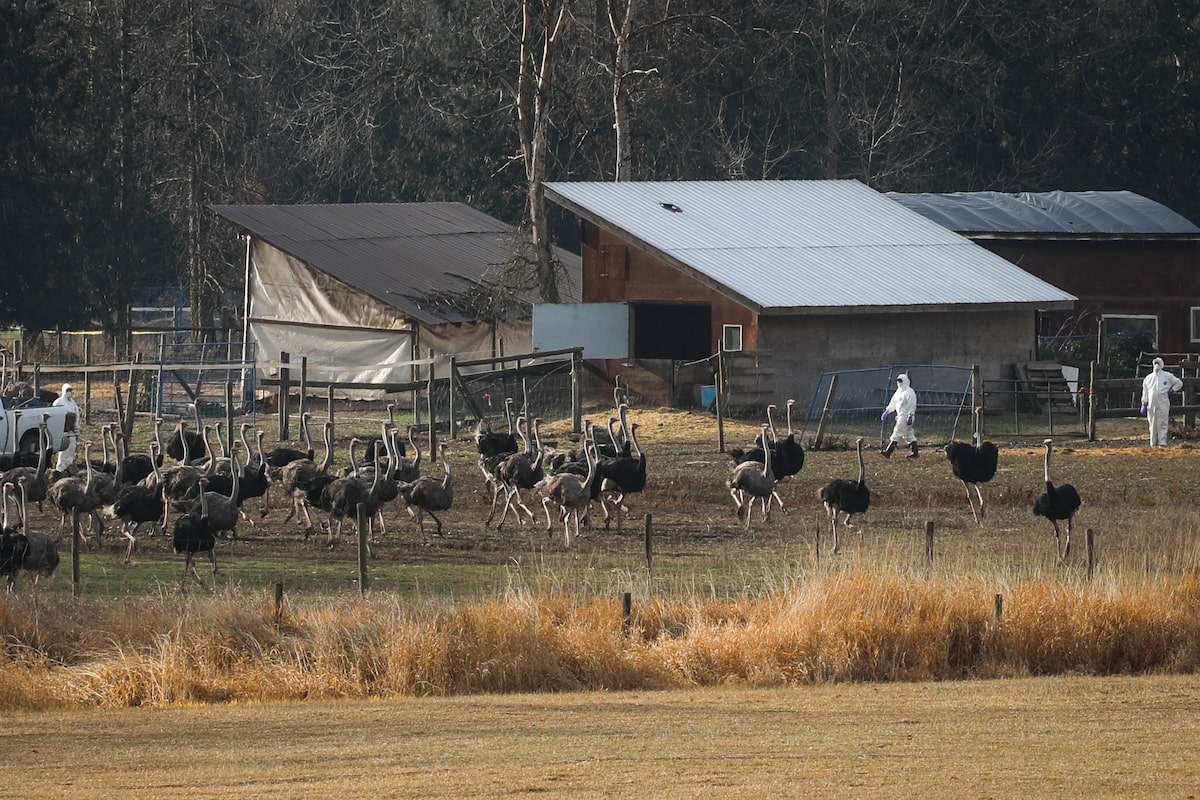
Food-safety agency employees in hazmat suits mind ostriches near a cull enclosure on Universal Ostrich Farms in Edgewood, B.C., on Thursday. The birds were culled overnight after the top court dismissed the farm’s last-ditch effort to save the flock.AARON HEMENS/The Canadian Press
After nearly a year of legal limbo, professional marksmen carried out the controversial cull of roughly 300 ostriches at a B.C. farm that was the scene of a bird flu outbreak last December.
The Canadian Food Inspection Agency said in a Friday statement it had consulted with experts and determined shooting the massive birds would be the “most appropriate and humane option.” The cull began Thursday and was completed by Friday morning.
The agency said it is disposing of the remains.
The cull was allowed after the Supreme Court of Canada dismissed a last-ditch effort by the farmers to save the flock. Universal Ostrich Farms had waged a lengthy legal battle to try and overturn the CFIA’s order to cull the birds as part of Canada’s “stamping-out” strategy, which is meant to contain the highly-transmissible bird flu virus. Scientists are concerned the virus, which has already infected millions of domestic chickens across North America, could infect humans.
Earlier: Cull of B.C. ostriches moves ahead after Supreme Court declines to hear farmers’ appeal
But the cull has attracted support from famous figures such as U.S. Health Secretary Robert F. Kennedy Jr. and former television personality Mehmet Oz, now the administrator for the Centers for Medicare and Medicaid Services.
Dave Bilinski, the farm’s co-owner, said the CFIA blocked all the expert opinions put forth by his camp, in a Friday interview with Rebel News, a far-right media outlet that has had access to the farm’s owners.
“These birds are going to be martyrs, because with the law written the way it is – where a bureaucrat or anybody from CFIA can come on your farm, have a suspicion that you have a disease in your animals and order the slaughter of them – is not Canada,” Mr. Bilinski said.
Katie Pasitney, a spokesperson for the farm, declined an interview request Friday, stating that she was busy caring for her mother Karen Espersen, who co-owns the operation.
During a Friday livestream on social media, Ms. Pasitney said that the cull should call into question the CFIA’s “stamping-out” policy.
She noted she still has to attend court later this month after being briefly arrested under the federal Health of Animals Act for entering the quarantine zone where the ostriches were kept.
Numerous gunshots rang out late Thursday at Universal Ostrich Farms in Edgewood, B.C., where the Canadian Food Inspection Agency says it is moving ahead with the cull of hundreds of the birds.
The Canadian Press
“They want to treat us like criminals. Criminals for caring for your animals, imagine that?” she said during the livestream.
RCMP spokesperson Staff Sergeant Kris Clark said Friday that Mounties would remain on the scene to enforce a perimeter around the active quarantine zone.
Despite an outpouring of anger and grief from the farmers and dozens of their supporters Thursday night, there were no arrests, he said Friday afternoon.
Gary Mason: Canada wants to kill 400 ostriches. Sadly, it’s the right thing to do
The CFIA did not respond to questions from The Globe on Friday, including whether the farmers would be compensated for the destruction of their birds, which the agency says on its website happens on a case-by-case basis.
An official schedule of compensation for such culls states ostrich farmers can expect to receive a maximum of $3,000 per bird.
The agency also declined to answer questions about whether the carcasses would be tested for bird flu to determine if any ostriches still had the virus first detected last December.
Veterinary science experts recently told The Globe that the chance these giant flightless fowl could still spread the virus they contracted nearly a year ago is very low, but remains high enough to have gone ahead with the federal cull.
Earlier: Risk that B.C. ostriches could spread flu is low, but cull is still warranted, experts say
Angela Rasmussen, a virologist with the University of Saskatchewan, said there were massive logistical and scientific hurdles to testing the animals beforehand to see if they still had meaningful levels of the virus.
Testing would require holding down hundreds of these two-metre-tall birds, which are capable of disemboweling a human with a kick, to obtain at least three separate samples. Multiple rounds of testing would be needed to determine if the virus was still present in the animal, Dr. Rasmussen added.
Even if the flu isn’t detected, an ostrich could still be contagious with a “cryptic infection” only found in certain body parts that cannot be tested in the typical ways, she said.
“We don’t know if that could happen in ostriches, but if it did, we would not be able to detect that by testing. So, bottom line is that testing will not conclusively prove that these ostriches aren’t infected.”