
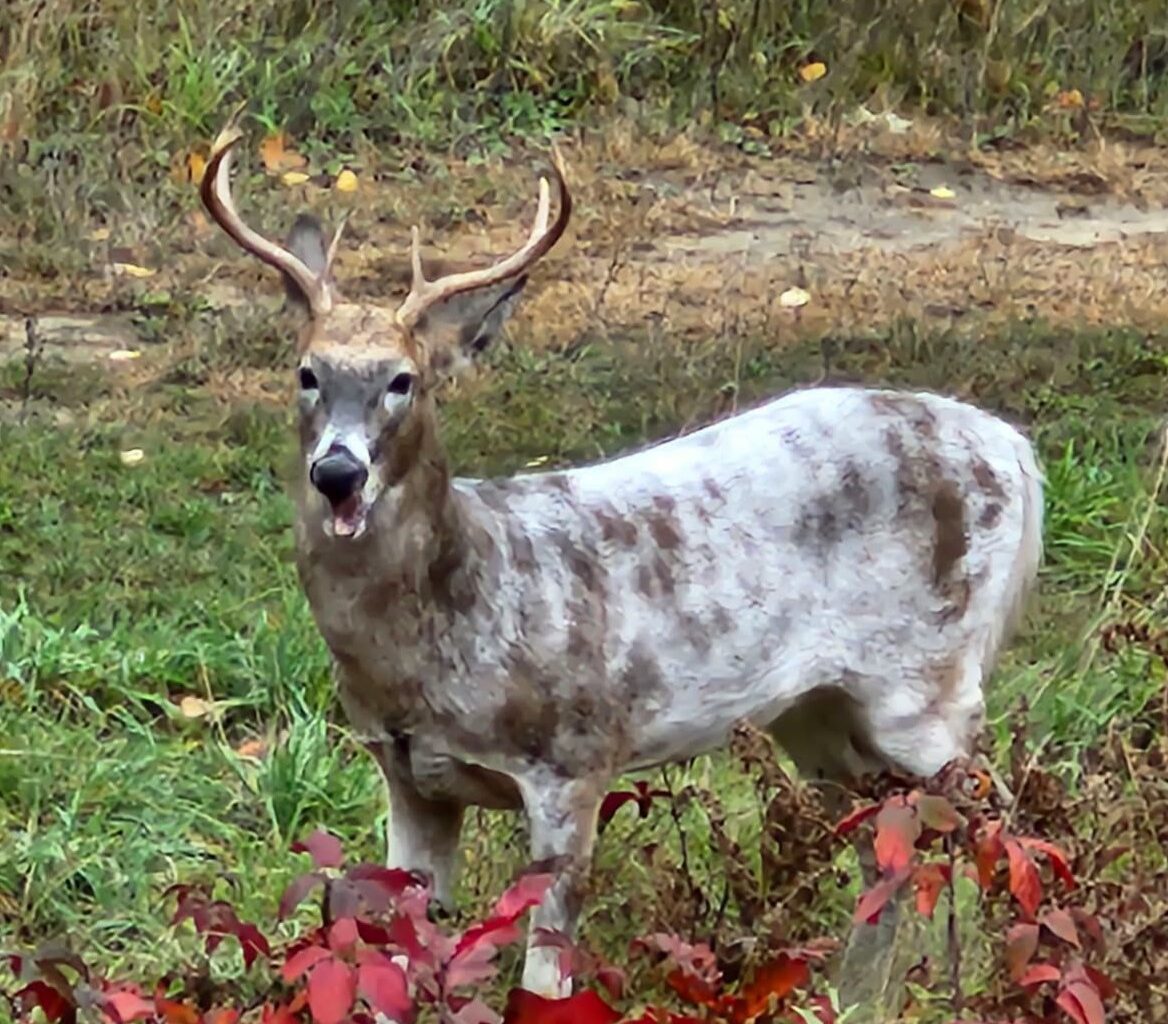
‘I would think he would stand out, he was huge and absolutely breathtaking,’ local resident says. ‘I couldn’t believe what I was seeing!’
Midland residents are abuzz about a special cervid citizen now being seen.
While moose sightings have become more commonplace in recent months throughout north Simcoe, a piebald deer has regularly been spotted in various locations over the past week.
Laurie Chambers says she was taken aback when she first noticed the large buck walking across Highway 93 just outside of Midland.
“I would think he would stand out; he was huge and absolutely breathtaking,” Chambers says. “I couldn’t believe what I was seeing! On Halloween Eve, no less, just before 12 a.m.”
Adds Pamela Harding: “Piebalds are a genetic mishap and super rare, but they are gorgeous. I’ve never seen a deer myself. If you saw it….lucky lucky.”
A piebald deer has a rare genetic mutation that causes patches of white and brown hair on its coat, along with potential physical deformities like a curved spine or short legs.
André Quesnelle, who says he’s seen what is likely the same deer a couple of times while hunting in the area, says they’ve “nicknamed him Lucky.”
According to the Protect the Rare White Deer website, some First Nations cultures hold a deep reverence for deer exhibiting non-traditional markings.
It notes that First Nations’ peoples often find that coming across a deer such as this one has a spiritual meaning that can represent a symbol of transition and new beginnings, a messenger between the physical and spirit worlds, and a harbinger of good fortune or transformation.
While Midland-Penetanguishene Field Naturalists president Bob Codd says that he’s never personally come across a deer with this kind of markings, it appears to be similar to leucism in birds.
Codd adds: “The difference is that the piebald condition is hereditary, whereas leucism can be caused by a variety of factors.”
Midland-Penetanguishene Field Naturalists program director Ken MacDonald says that documentation on piebald deer shows they are born with the recessive gene that causes the condition.
“(They) also suffer from other related defects leading to a poor chance of survival into adulthood, making the sighting of a piebald adult like this one quite rare.”