

Statistics Canada has produced revised estimates that suggest the Northwest Territories’ economic output slipped by 0.7 percent between 2023 and 2024.
GDP, or gross domestic product, measures the size and growth of the economy in each region of the country. It counts the market value of all goods and services produced within each region during a specific year.
Data for GDP comes out twice a year. The first is an initial estimate, then the second is a refined figure later on.
Initial 2024 data came out in May this year and showed the NWT’s GDP falling by 1.1 percent that year, so the revised figure this week marks a slight improvement – though not by much.
The broader Canada-wide picture remains similar to the initial figures. Yukon was the only jurisdiction with a worse economic performance – GDP there dropped by more than two percent. Nunavut was the highest achiever, with growth of almost seven percent.
Advertisement.
Advertisement.
This is the second successive year in which the NWT’s economy has slightly contracted.
Behind the number is a story that has been consistent for some time: the services sector is steadily growing, but the goods-producing sector – including oil, gas and mining – continues to fall.
Diamond mining’s GDP contribution, for example, fell by 11.5 percent in 2024 according to this week’s revised figures. Support activities for the mining sector, including exploration, fell by 25 percent.
On the services side, the NWT Bureau of Statistics reported: “Transportation and warehousing increased by 10.1 percent, largely stemming from an increase in air transportation.
Advertisement.
Advertisement.
“Public administration GDP increased by 1.1 percent in 2024 as rises in federal, local, municipal and Indigenous sub-sectors were partially offset by a decline in territorial public administration.”
Initial figures for 2025 GDP are likely to arrive in May 2026.
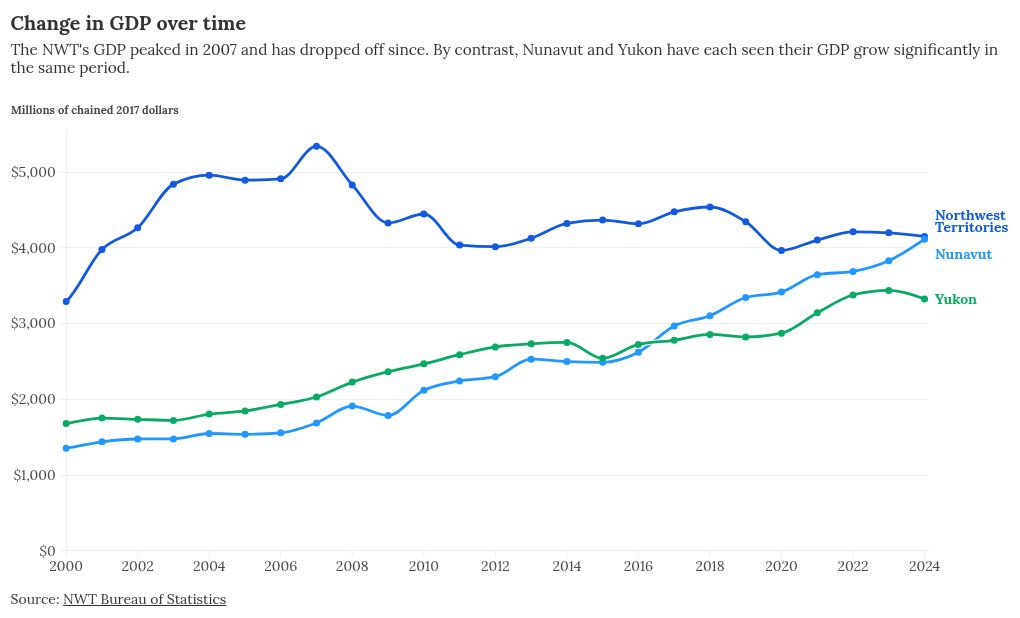
Leaving aside the pandemic year of 2020, this is the first time the NWT has posted back-to-back drops in GDP since 2012.
More broadly, the territory’s GDP – in chained dollars, which means adjusting the figures to account for inflation – is essentially the same as it was in 2002. It peaked in 2007 and has been gradually dwindling since.
By comparison, Nunavut’s GDP is nearly three times what it was in 2002. Yukon’s GDP has almost doubled over the same period.
Related Articles