
The New York Rangers got some good news on Monday night as Vincent Trocheck was back in the lineup for the first time since the third day of the season, having missed four weeks with an upper-body injury. He was back on the second line with Artemi Panarin but is not yet back on the top power-play unit, where Will Cuylle remained.
Also, recent call-up Gabe Perreault was on a line with Mika Zibanejad and J.T. Miller.
Maybe it was Perreault, or Trocheck, or just positive regression, or some combination of the three, but the Rangers broke out of their home-scoring slump in a big way with a 6-3 win against Nashville on Monday. Panarin had two goals on four shots, Alexis Lafreniere had a goal (PP) and two assists with a block and a hit, and Trocheck had a pair of helpers (one PP), a block, four PIMs, and six hits in his return.
Mika Zibanejad and Will Cuylle had the other goals. Cuylle finished with two shots, a block, and six hits in a typical outing for him.
Vladislav Gavrikov posted a goal, an assist, and three shots.
Igor Shesterkin earned his first home win, stopping 26 of the 29 shots faced.
It is unfortunate that the Predators got pasted because Matthew Wood tallied a hat trick for the team, with two of those goals coming on the power play. He finished with six shots and two blocks.
Juuse Saros was pulled after the second period, giving up five goals on 12 shots.
*
Simon Nemec scored a game-tying goal with five seconds left to get the New Jersey Devils a point, but Mathew Barzal tallied the game-winning overtime goal on a breakaway 75 seconds into the extra frame to give the New York Islanders their two points.
Both Bo Horvat and Kyle Palmieri had a goal and an assist in the game. Horvat is up to 12 goals and 20 points in 16 games on the season, posting 55 shots and 12 hits along the way. He may not make the Team Canada Olympic roster, but his play through the first five weeks of the regular season is at least putting him on the radar.
Matthew Schaefer had an assist, three shots, three blocks, and a hit in an excellent multi-cat night.
Ilya Sorokin took the win, stopping 32 of 34 shots. He was the real difference-maker in this one, keeping the Islanders within striking distance all game.
Timo Meier had a goal and an assist with four shots and a hit in the loss. He has 13 points, 51 shots, and 28 hits in 16 appearances.
Jacob Markstrom took the loss in net, allowing three goals on 25 shots.
*
Ryan Nugent-Hopkins was placed on the injured reserve on Monday, so he’ll be out for at least a week. The team did not disclose the cause.
*
Jiri Kulich got some very bad news:
Lindy Ruff said Jiri Kulich will miss significant time because of a blood clot. Thinks he will play again this season. #Sabres
— Bill Hoppe (@BillHoppeNHL) November 10, 2025
Hopefully he can get this under control and return to normal in the coming months. We shouldn’t expect him to return to the ice this season until well into 2026, if at all.
*
The late games will be updated in the morning.
*
With how quickly shot volume has changed in the NHL, from between 30 and 32 shots per team per game in each 82-game season from 2016-17 through 2023-24 to under 28 shots per team per game this season, it is concerning when we see a player who should be piling up the shot totals not doing so. We don’t always need to panic, but sometimes we do, so it’s worth going over which players we should absolutely have concerns about.
To do this, we are going to look at market share of shot attempts, or how many shot attempts an individual player is taking as a percentage of their team’s shot attempts when they’re on the ice, compared to last year. So, if a forward has been on the ice for 200 shot attempts, and they’ve taken 50 of them, their market share is 25%. it helps identify which players are the real shot-volume kings on their teams and which might be supported for other reasons.
Data for this is from Natural Stat Trick and as of the morning of Monday, November 10th. Players in the sample must have at least 150 minutes of ice time and this is at all strengths.
To start, I do want to highlight one player that is excelling here and it’s Tage Thompson:
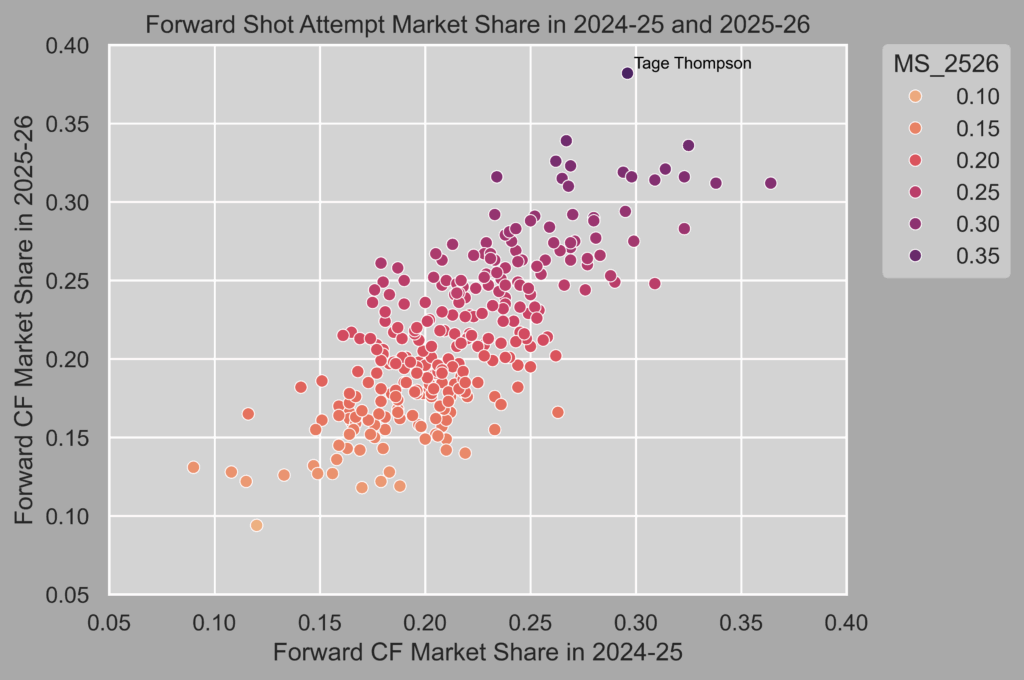
We know Tage has been shooting a lot, but it’s truly preposterous when stacked against the rest of the league: he is taking 38.2% of the shot attempts when he’s on the ice, no other forward in the league is over 34%, and only two (Alex DeBrincat and David Pastrnak) are over 33%. Thompson’s previous career-best rate was 31.5% back in his breakout 2021-22 season, so staying at this level would truly be otherworldly for him. Nonetheless, he is very much in line for at least 30 more goals from here on out.
Brock Nelson (Colorado Avalanche)
At the other end of the spectrum from Thompson is Colorado’s second-line centre:
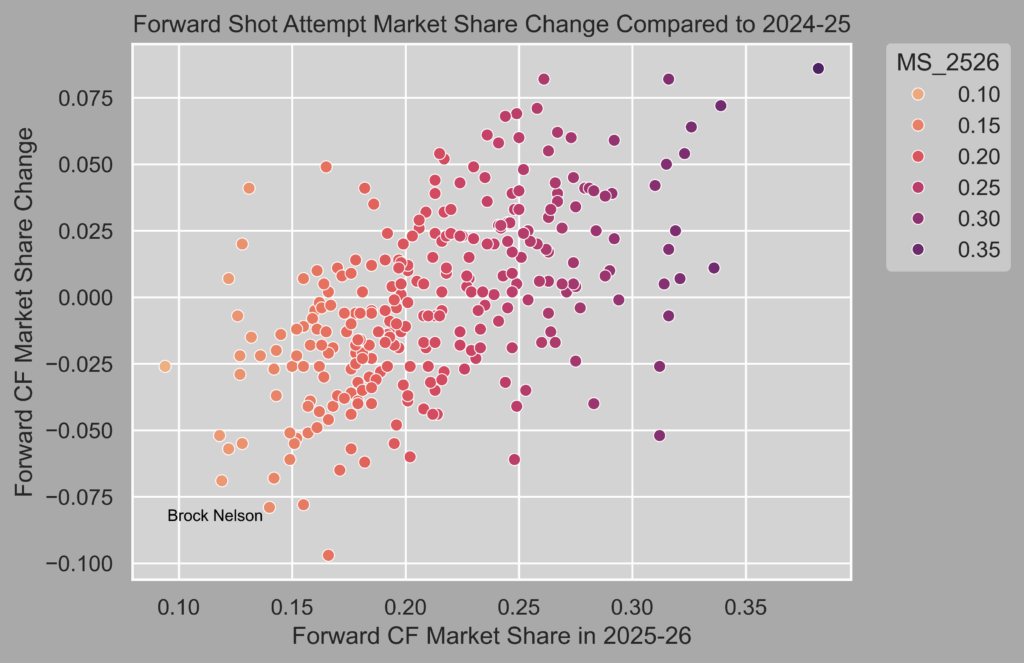
That is Nelson, way down in the bottom-left, taking just 14% of the shot attempts when he’s on the ice, seeing the second-largest drop of any player compared to last year (Brendan Gallagher is the largest).
This is a continued drop from 2024-25 after his trade from the New York Islanders. He was taking 22.8% of the attempts in his last season with the Islanders, a number that dropped immediately to 18.7% when slotted into the Avalanche lineup, and has dropped even further to 14%. The extremely worrying part here is that it’s not due to a loss in power play time, as he’s seeing much more this season (3:20) than last year (2:29 with the Islanders, 2:24 with the Avalanche). The drop is mirrored when looking just at 5-on-5, too, as he took 21.1% of the attempts in his stint with Colorado at the end of last season, a number that is at 15% this season. No matter how we look at it, Nelson is no longer the triggerman on his line, at 5-on-5 or the power play, so with top PP time drying up and without any big changes, he’s un-roster-able outside any deep fantasy format.
Logan Stankoven (Carolina Hurricanes)
There is a bit of good-news, bad-news with Stankoven. The good news is that his shooting percentage has (predictably) rebounded in a big way, sitting at 16.1% after shooting just 7.2% last season. That has him on pace for a 27-goal campaign, nearly double his output from last year (14). Whether he stays over 16%, we’ll see, but it’s heartening, nonetheless.
The bad news is that Stankoven’s market share of shot attempts has dropped considerably:
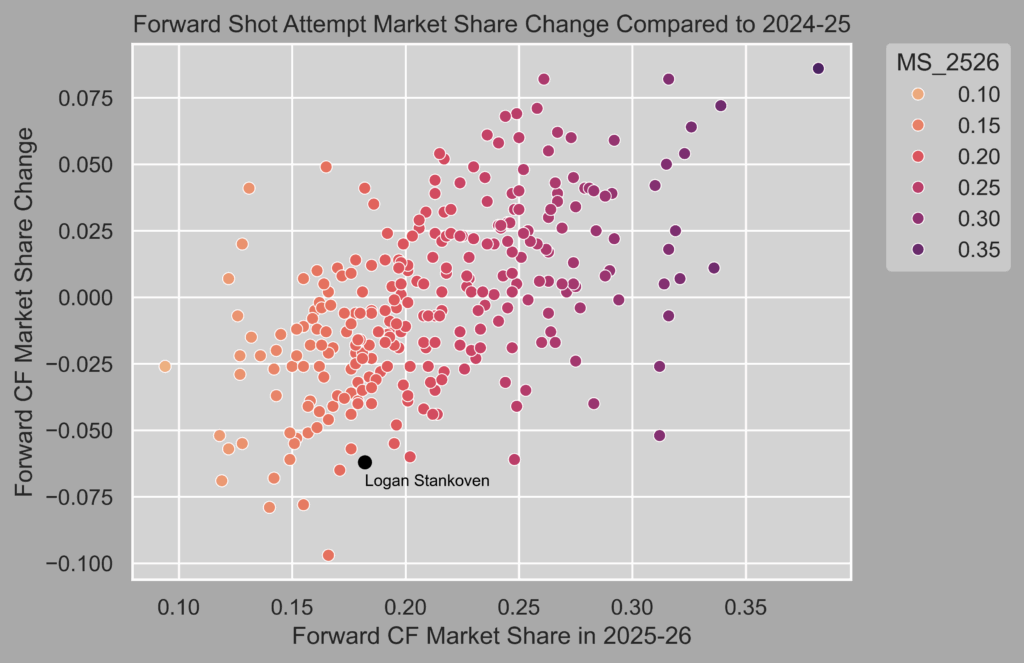
Moving to Carolina has given him a boost in overall shot attempts when he’s on the ice as the team’s shot attempt rate is nearly 9.0 per 60 minutes higher than last year in Dallas. But the large drop in market share of 24.4% to 18.2% more than wipes out that improvement, and it’s a big reason why he’s averaging 0.42 fewer shots per game.
To make matters worse, like Nelson, the drop at 5-on-5 is a big problem as he was at 26.9% with Dallas and sits at 16.9% with Carolina. This is another case where power-play usage is not what’s hindering the shot rate, and with Stankoven having Nikolaj Ehlers on his wing of late, it’s doubtful that it will improve anytime soon.
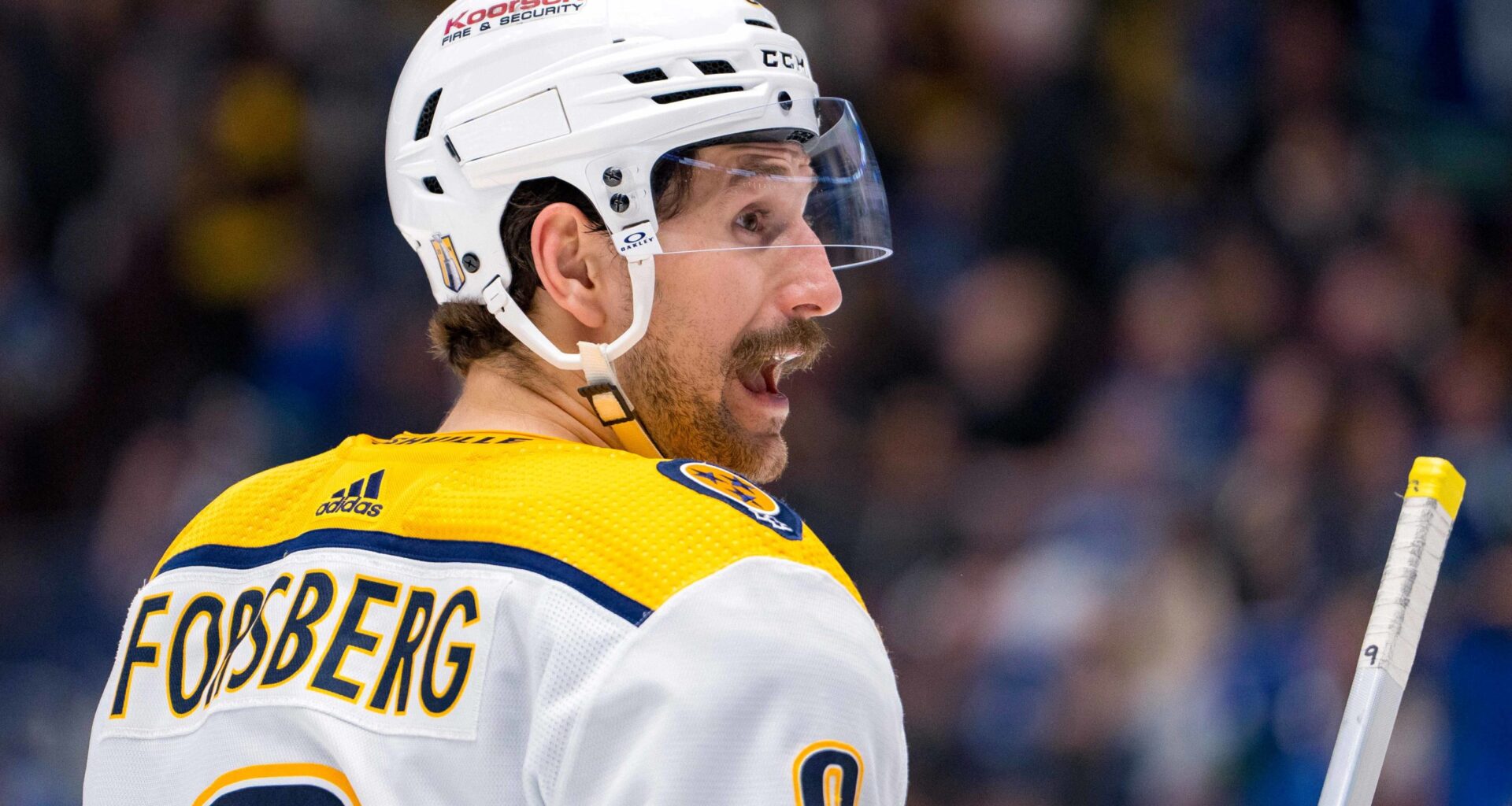
Filip Forsberg (Nashville Predators)
As if it isn’t bad enough that the year after Nashville finished 31st in goal scoring that the team sits 30th by goals per 60 minutes, but Filip Forsberg has seen the eighth-largest drop in market share of shot attempts compared to last season:
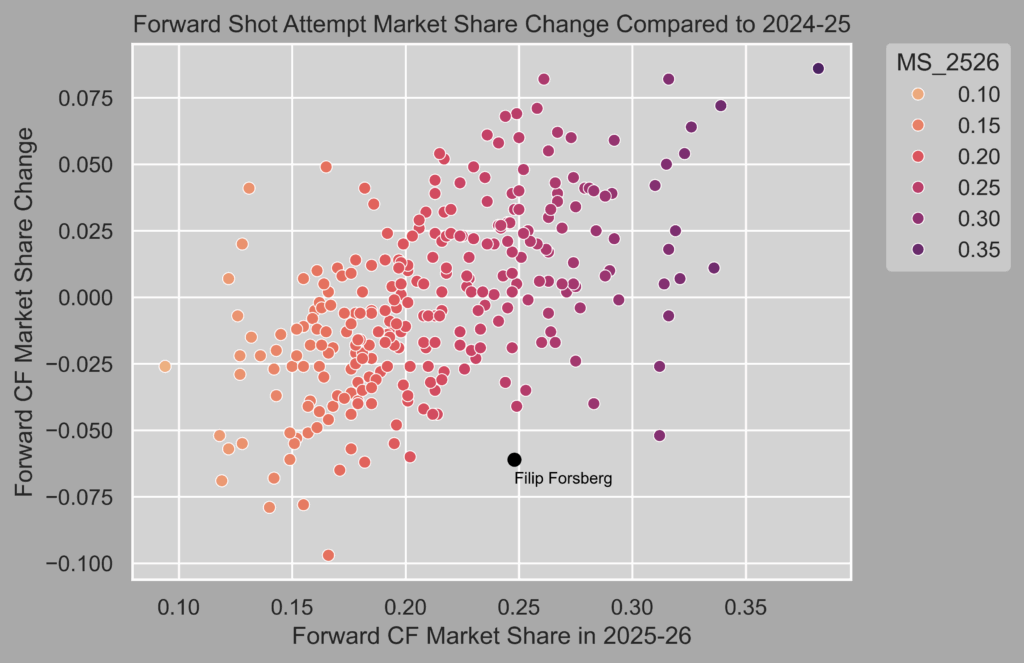
That is Forsberg sitting with a 24.8% market share of his team’s shot attempts. He has never had a season under 25% in his career, had a market share of at least 28.5% from 2021-2025, and he averaged 32.2% across the prior two seasons. For fantasy managers wondering why his shots per game are at their lowest point in eight years, this is why.
Compounding the shot problem is that it’s not as if he’s having trouble hitting the net, because 49.5% of his attempts are on goal, up from 46.7% last year and higher than his three-year average (48.3%). And it’s not as if his team is shooting less with him on the ice, as Nashville is averaging 78 shot attempts per 60 minutes with him on the ice, up from last year (76.6) and in line with his three-year average (77.7). No matter how we look at it, his shot rate is falling because he’s just shooting much less than he has for a long time.
Given Forsberg’s length history of shot volume, this should change. Then again, there’s a lot about this Nashville team that ‘should’ be different, but things are the way they are.