
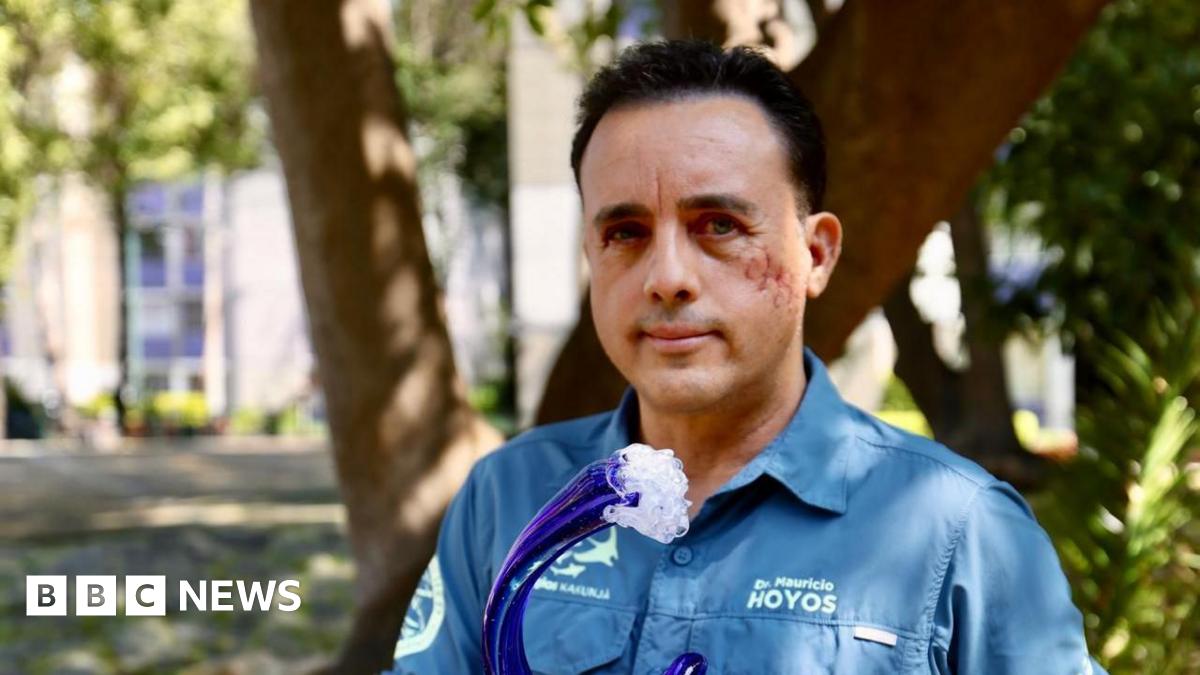
Hoyos says he held the shark’s gaze as it swam away – but then, suddenly, out of nowhere, it lunged at him.
“I lowered my head, and what I felt was its lower jaw digging into my cheek and its upper jaw into my head. I was there, I imagine for a second, no more, inside its jaw, and then it simply opened it again.”
“When it closed it, I felt the pressure of the bite, and then it just let me go,” he marvels.
The Galapagos shark’s 29 serrated teeth not only left Hoyos with deep wounds to his face and head, but also severed the air line of his diving apparatus.
He had survived the shark attack but was still in mortal danger.
In addition, one of the teeth had torn his diving mask, and the blood-tinged water was further blurring his already limited visibility.
“When I realised that no air was coming out of the hose, I grabbed a second one we have, which we call an octopus, that is used to give air to someone else if they need it,” he tells BBC Mundo.
“But then I realised that the regulator wasn’t working and was blowing air instead of regulating it, so I had to remember my training and start regulating it with my lips.”
Bleeding, blinded, and with the air escaping, Hoyos calculated that he had less than a minute to reach the surface.
“Since I couldn’t see anything, what I did was look for the light that I knew was the surface. I started swimming upwards, in a very coordinated manner, because I wanted to avoid erratic movements that would attract the shark.”