
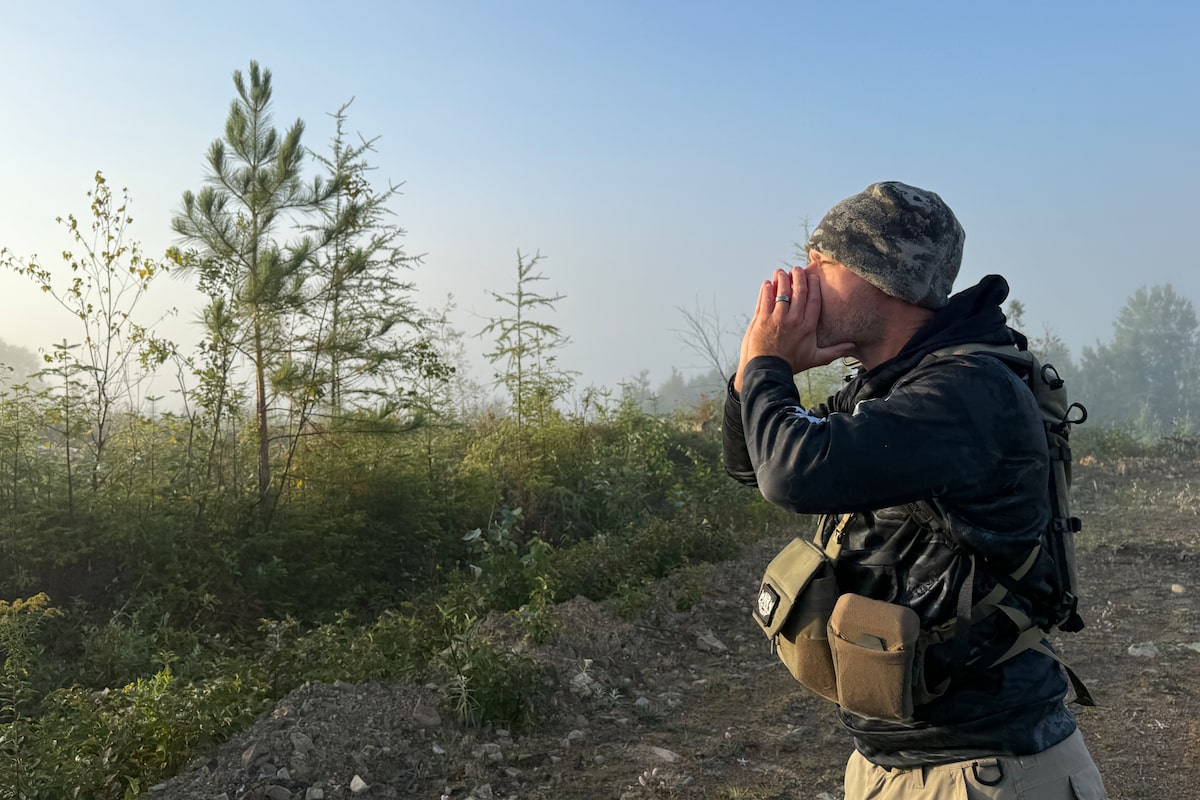
Fredericton native Nathan Robinson makes a moose call to draw out the animals for a photo.JENN SMITH NELSON/The Globe and Mail
JENN SMITH NELSON/The Globe and Mail
At dawn near Plaster Rock, N.B., fog engulfs the remote Acadian forest – it’s still and grey except the peppering of seasonal colour amid the trail’s ditches.
I came to New Brunswick to shoot a moose – not with a gun, but a Canon 200–400mm lens. But I was being led by a hunter. The irony wasn’t lost on me. Before becoming a wildlife photographer and guide, Nathan Robinson regularly hunted moose for subsistence. “I hunt more now,” he says, “just with a camera.”
Raised in a fishing and hunting family, the Fredericton native straddles the duality of two worlds: observer and harvester. Spending six weeks each year guiding photo and wildlife tours, Robinson now enjoys prolonged moose encounters and helping others to experience them.
“You can see moose from a car, but it’s different seeing them in their natural landscape. The beauty up here blows my guests away every time,” he says.
Fluent in silence, a trait I cannot easily claim, Robinson sets a quiet, unhurried rhythm, encouraging me to follow. Our eyes scan the misty landscape, which smells of spruce and damp earth. Gravel crunches underfoot as I mirror his movements in between admiring still-blooming flowers.
Dark-eyed juncos flit from a trailside thicket; the birds signal wildlife’s return to regrown stretches, presenting another paradox as Robinson explains how sections along this trail were clear-cut years ago but the practice, as divisive as hunting, also carries benefits, opening space and light for regeneration.
Robinson rustles branches with a moose scapula bone and mimics wails to attract the animals.JENN SMITH NELSON/The Globe and Mail
“It’s actually good for moose,” says Robinson. “They love young growth – birch, willow, shrubs. It’s like a moose grocery store.” With up to 90 per cent of northern New Brunswick covered by forest, it’s a moose’s dream home. Clear-cuts provide food, and the once-used logging trails allow for wildlife viewing. I wrestle with my feelings but can’t argue the aftermath hums with renewal and advantages.
I follow the self-proclaimed “moose whisperer,” camera slung over his shoulder like a repurposed weapon. I photograph tiny white flowers resembling eyeballs and dew-beaded webs on young pines illuminated by mist. Robinson is fixated on subtler signs: muddy prints, bent branches and stripped leaves.
“What’s that?” I whisper, as he pulls out a pale bone and drags it along branches – the sound reminiscent of a playing card in bike spokes. “It’s a moose scapula,” he says before cupping his hands to his mouth to mimic a cow moose’s mournful wail, hoping his imitation draws out curious bulls.
When you hunt, it’s over in a second. With a camera, the encounter lasts. You learn.
Robinson slows our pace. Walking on tiptoes, we pause frequently to listen and peer. “There’s a moose trail right here,” he says, pointing. Soon after, we spot droppings, more tracks and a flattened area where a moose likely bedded. “That wasn’t there yesterday morning,” Robinson says.
It feels like moose are all around, hidden behind the fog’s murky curtain. “Oh, they know we are here,” he whispers. “Moose don’t have great eyesight, but a deadly sense of smell and hearing.”
A fleeting encounter with two bulls and two cows led to mutual elation between writer and guide.JENN SMITH NELSON/The Globe and Mail
We creep on. Robinson channels his inner moose, raking and calling the guttural grunts of a bull. It’s not long again, before he stops, camera raised. “There,” he hushes, excitedly. I see it – the foggy silhouette of a bull moose! I stay put taking pictures as he walks ahead. When he lowers his camera, he grins and holds up four fingers.
Another bull is metres from the first, and behind it, two more shapes emerge – cows.
I aim for invisibility, shadowing Robinson, stepping over branches and through bushes, scapula extended like an antler. We pause, still a safe distance away, when almost magically, the fog lifts for a few minutes, revealing the animals before they vanish, silent as ghosts slipping back into the forest’s haze.
Though a fleeting encounter, mutual elation lingers as we walk, and our conversation deepens. He says he wasn’t sure how he’d be perceived by fellow hunters as someone who now shoots with a camera as well as a gun. “But it’s amazing the amount of respect I’ve been given from hunters,” Robinson says. A fellow hunter even joined him on a photo safari one day. He told Robinson that his photo truly captured the animal in its wilderness.
“I’ve learned more in one year photographing moose than in 10 years hunting them,” Robinson said. “When you hunt, it’s over in a second. With a camera, the encounter lasts. You learn.”
JENN SMITH NELSON/The Globe and Mail
When Robinson tells me about a bull named Kirby he’s photographed for years, I sense empathy. Kirby was killed this year by a friend’s father. “It hurt a little, but I understood,” he says. “He was older, past his prime. He’ll be honoured and respected.”
Becoming a wildlife photographer has increased Robinson’s respect and profound appreciation for these animals; however, he still carries a moose tag, the license required to hunt them.
I tread carefully with my next question. I could never hunt, yet I want to understand how he still does it after his experiences with these animals from behind the camera. He nods before I finish speaking. “I get that,” he says. “Both sides can learn from each other. I was, and am, a hunter and still enjoy being around hunters. There are wildlife photographers who don’t respect hunters, and hunters that don’t respect photographers,” he adds. “But I’ve learned from both. I try to bridge that gap.”
I mull our shared instinct to observe, anticipate and appreciate. His world, like this forest, carries an uneasy balance. His experience has been an evolution, rather than a rejection of hunting.
Clear-cuts and regenerating forests allow moose to thrive, and regulated hunting can keep the population in check for a species that, once mature, faces few natural predators. None of it is tidy or ideal, but it is true.
I respect his choice, however, I remain a flower and wildlife-loving, Canon-shooting spectator.
What began as a pursuit of a sighting, an image, a story, became something quieter. Understanding.
Sections along the trail were clear-cut years ago but the practice, as divisive as hunting, also carries benefits, opening space and light for regeneration.JENN SMITH NELSON/The Globe and Mail
If you go
New Brunswick has one of the highest moose densities in Eastern Canada, with an estimated 30,000–35,000 moose.
Wildlife photographer and guide Nathan Robinson leads half- and full-day wildlife and photography tours, and photography workshops in northern New Brunswick. $600 for a full-day photo tour for one person.
Late August through mid-October is prime season for sightings, with the rut when bulls are most active, peaking in late September and early October.
Pack waterproof hiking shoes or boots, layers for cool mornings, binoculars or a telephoto lens, insect repellent, and a thermos for early starts. Quiet movement and patience are essential.
The writer was a guest of Tourism New Brunswick. The agency did not review nor approve this story before publication.