
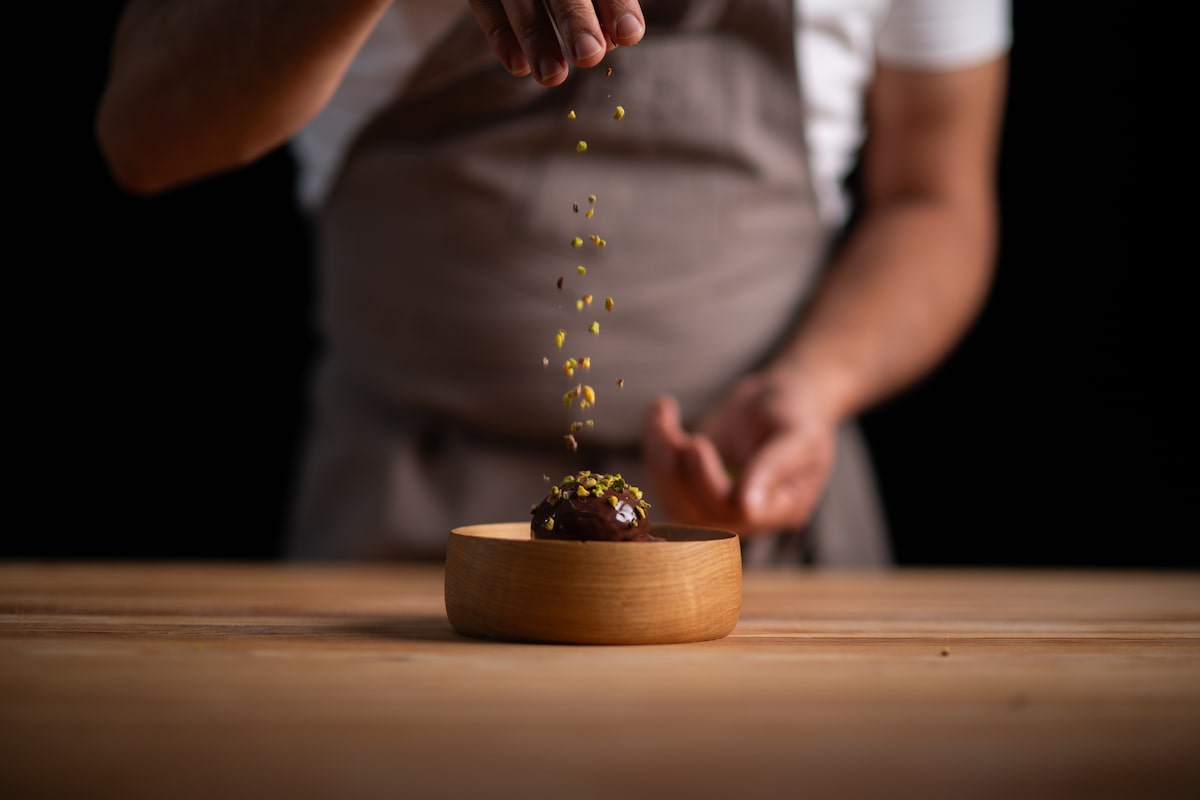
Artificial intelligence is becoming a new ingredient in the culinary world, shaping how chefs design menus, develop dishes and imagine flavour.GETTY IMAGES
At Prime Seafood Palace, the sleek, wood-lined Toronto restaurant from Matty Matheson’s Our House Hospitality Company, chef Coulson Armstrong fine-tunes the menu daily to showcase ingredients at their peak.
“We’re reprinting the menu weekly because we’re so seasonal and the vegetables are constantly changing,” he says.
Until recently, menu updates were mainly communicated internally through handwritten notes. Now, Armstrong photographs his kitchen notes and plated dishes and uploads them to ChatGPT, along with other key details, to transcribe, organize and summarize everything for his team.
“There’s so much information happening throughout the week that we need to document and share with our colleagues,” Mr. Armstrong says. “AI can take all that information and shorten it so that everybody’s aligned with everything that’s happening in the restaurant daily.”
He says it’s one of the many ways AI has been a game-changer in terms of efficiency at Our House H.C.’s restaurants.
“When you become both a chef and a leader of a business, basically every two hours you need to bang out some admin stuff,” he says. He notes that AI has reduced the time he spends on tasks such as emails, food costing and competitor analysis. “The more that we don’t need to be on our laptops and can be in the kitchen benefits us greatly.”
Across Canada, chefs and culinary leaders are finding new ways to bring artificial intelligence into their craft – raising the question of how far this digital sous-chef should go.
AI isn’t just changing how chefs like Armstrong manage their kitchens, it’s also influencing the menu. At the global level, companies such as Tastewise, a consumer intelligence platform for food brands, are using AI to analyze how and why people eat the way they do.
According to Miriam Aniel Oved, head of integrated marketing, the company’s platform tracks billions of data points from recipes, menus and social media to reveal how consumer preferences are evolving in real time. Restaurants and brands use those insights to develop dishes that align with current tastes, reducing time lost to research and guesswork.
“Our role is to help culinary teams understand which ideas will resonate and why,” Ms. Aniel Oved says.
The platform is designed to support innovation, however, not replace intuition.
“For example, a chef might feel that umami-forward flavours are ripe for exploration,” she says. “Tastewise can show that black garlic is up 64 per cent year-over-year in plant-based sauces, especially among flexitarian consumers. That validation empowers chefs to move forward with confidence.”
Ms. Aniel Oved believes the best results come when technology and human judgment meet.
“Data may point to a direction, but it’s the chef’s instincts that determine what belongs on the plate,” she says.
The same technology that helps chefs and food brands track emerging taste trends is also helping scientists understand the mechanics of flavour. At the University of Guelph, assistant professor Biniam Kebede and his team are using machine learning to study how sustainable processing techniques, such as fermentation and enzymatic treatments, can improve the flavour, texture and nutritional value of foods, particularly plant-based proteins.
The goal, he explains, is to predict how different inputs can achieve a desired flavour outcome.
“For example, if you’re interested in adding an umami flavour, then we could predict what is the best ingredient or processing fermentation condition to achieve that,” he says.
AI’s strength, Dr. Kebede notes, lies in its ability to handle vast amounts of data and spot correlations faster than humans can. “It will shift product development from trial-and-error into a more data-driven, predictive approach, which will save a lot of time and money.”
He sees the technology as something that complements human perception rather than replaces it.
“You can narrow it down to some really specific ingredients, but then your expertise will come in at that point,” Dr. Kebede says.
The same spirit of experimentation extends beyond kitchens to cocktail bars.
Jacob Martin, bar director of Liberty Entertainment Group, says AI-generated cocktails are entering mainstream mixology. As part of his work with the Diageo World Class bartender competition, he’s had the chance to sample creations from mixologists around the world. He says he can usually spot when an algorithm has designed a drink.
“I’ve tasted hundreds of cocktails made using artificial intelligence – you always know,” he says. “A cocktail is a formula in terms of the ratio of ingredients that goes into it, but those ingredients, except for the spirits, are constantly changing in flavour.”
Mr. Martin says standard recipes often need to be adjusted based on how the ingredients taste at the moment.
“One of the things you’ll often notice is people will use an AI recipe, but the drink itself will be crazy unbalanced because maybe you were working with super unripe watermelons that particular day,” he says. “There still needs to be a feedback loop of tasting it.”
He thinks the rise of AI-generated cocktails comes down to the fact that it’s difficult, even for experienced mixologists, to create something truly original.
“Drinks are harder to invent than you might expect,” Mr. Martin says. “There’s a huge intimidation factor in terms of taking that first step to invent your own recipe, and I think artificial intelligence is a way for people to have a sense of confidence that they are going off of something proven.”
For his part, Prime Seafood’s Mr. Armstrong admits his team sometimes turns to AI for quick research when developing new dishes. “Maybe we’re dreaming up a dish featuring a chermoula, and it can give me that direction of what are the ingredients I should have in front of me before I start cooking,” he says.
Still, the AI-only results rarely meet expectations. “It will generate something, but then when you taste it, something’s off about it and you really have to go back to your own senses.”
Mr. Armstrong says AI’s endless database of information doesn’t equate to discernment.
“There are millions and millions of recipes for any given dish on the internet that AI has access to, but are all of them good? No.”
Mr. Armstrong sees cooking as learned through touch and time, rather than something that can be programmed. “Cooking is repetitive; it’s emotional; it’s physical,” he says.
“AI can provide a base point, but then as a chef or home cook, you have to take your past experience and really dial in.”