

In February, I noticed this article from Harvard Business School titled, “Women Are Avoiding AI. Will Their Careers Suffer?“
The article, which was written by Michael Blanding and featured research by Harvard Business School associate professor Rembrand Koning, says women are reluctant to use AI in their workplaces. From the article:
In many cases, the research suggests women are concerned about the ethics of using the tools and may fear they will be judged harshly in the workplace for relying on them, Koning says in a recent working paper, “Global Evidence on Gender Gaps and Generative AI.” Koning coauthored the paper with Nicholas G. Otis and Solène Delecourt of the University of California, Berkeley, and Katelyn Cranney of Stanford University.
Businesses could miss out on major productivity gains if women continue to shun generative AI, and women might fall behind in building valuable skills they need to succeed. That could widen the persistent gender gap in wages and career opportunities, Koning says.
“It’s important to create an environment in which everybody feels they can participate and try these tools and won’t be judged for [using them],” he says.
Ah, I see. Yet another reason for women to be judged in the workplace, not that there aren’t many reasons already: what we wear, what we say, for having children, for not having children, for being married, for being single, and so on.
I am a writer who loves to write, as I wrote in this Morning File last week. But I am a woman who knows what other women want in their workplaces. It’s not AI; it’s fair pay, benefits, and to not have to deal with harassment.
While some researchers are asking why women are reluctant to take up AI in their careers, that same AI is actively working against women.
Here’s another article from the Stanford Report in which researchers uncover an AI bias against older women in the workplace. The report focuses on research done by Douglas Guilbeault, an assistant professor of organizational behavior at Stanford Graduate School of Business, Solène Delecourt, with the University of California, Berkeley, Haas School of Business, and Bhargav Srinivasa Desikan of the University of Oxford/Autonomy Institute.
From the article:
To understand how these biases about women in the workplace are propagated by generative AI, Guilbeault and his colleagues prompted ChatGPT to generate more than 34,500 unique resumes for 54 occupations using typical male or female names.
The results were stark. When ChatGPT produced resumes for hypothetical women, it generated work histories that portrayed them as younger and less experienced. The researchers then asked ChatGPT to evaluate the quality of the resumes. When it considered the experiences and ages it had woven into these imagined resumes, it gave older men the highest ratings – even when they were based on the same initial information as women’s resumes.
This suggests that AI-based tools employers may use to review resumes may give older men an advantage while putting older women and younger job seekers at a disadvantage. Where older women and younger people may have already experienced discrimination in hiring, the LLM not only reflects but actively reinforces this bias.
How did these stereotypes and distortions make their way into ChatGPT’s algorithm? When asked to create a resume, “it’s drawing on countless ideas about what a person is, what a particular job requires, what makes a good candidate, and which skills are relevant,” Guilbeault explains. “And within that process, there are countless opportunities for stereotypes to slip in.”
On Monday, I attended an event hosted by the Halifax Chamber of Commerce and featuring Minister of Justice and Attorney General Sean Fraser as the keynote speaker. Some of the talk revolved around the federal budget released last week. That budget includes almost $1 billion to spend on AI to build “sovereign” public AI infrastructure in Canada. Here’s the story I wrote.
In a scrum, Fraser had this to say about that money for AI: “Left to its own devices, we’re going to see data centres, we’re going to see AI, deployed by businesses and countries that do not have the best interests of Canadians at heart.”
Earlier in his conversation with Patrick Sullivan, president and CEO of the Halifax Chamber of Commerce, Fraser spoke about affordability, and recalled talking with a mother at a Sobeys in New Glasgow. From the story:
Fraser said the mother told him she no longer takes her daughter inside the grocery store in case she doesn’t have enough money to pay for her order or if she has to put items back on the shelves.
“She doesn’t want her to be embarrassed,” Fraser said. “If anyone tells you they can snap their fingers and suddenly everyone has enough money to cover all the things they need overnight, they’re not being honest with you.”
I have thought about that mother since Fraser mentioned her in his conversation. There are a lot of mothers like her. Will AI help them at home or in the workplace? No.
In the comments to that story, Ken Kohler had this to say:
[Mark] Carney and Fraser et al are snapping their fingers to subsidize “nation-building” projects that will not help that lady in the grocery store parking lot. I believe that this is a matter of priorities, and those at the bottom of the socioeconomic ladder simply are not a priority.
This is true. There’s simply no political will to help that young mother or other women in the workplace or elsewhere. The AI industry is led by men, and AI really feels like yet another fool’s dream led by men while women are left behind doing the work that matters, and who don’t get the pay or credit for it.
When the AI bubble bursts, I wonder who will be the ones to clean up the mess?
This is another in the Halifax Examiner’s series looking at AI, which is the hook for our November subscription drive. Previous articles in the series are:
What is ‘artificial intelligence,’ anyway? The confusion is the point
Resisting the AI push into education
Ed Zitron calls bullshit on AI hype
I’m with Emma Thompson. I don’t want AI to ‘fucking rewrite what I’ve just written’ either
Teresa Heffernan on how AI is shaped by fiction
The New York Times gets ‘AI in the newsroom’ completely wrong
Therapist, romantic partner, babysitter: Outsourcing our personal relationships to AI
You can support our work with a subscription or donation knowing that a woman, not a robot, wrote this Morning File.
Thank you!
(To send or post this item, copy the website address at the top of this page.)
NEWS
Province approves Mount Uniacke quarry expansion
 Northumberland Capital Corporation Inc.’s quarry in Mount Uniacke. Credit: Contributed
The province has approved the 10-times expansion of a quarry in Mount Uniacke. On Wednesday, the Department of Environment and Climate Change sent out this press release regarding the expansion approval. The quarry is owned by Northumberland Capital Corporation Inc. (NCCI).
From the release:
An expanded quarry near Mount Uniacke, Hants County, will supply the essential materials needed for roads, homes, schools and other buildings that support local communities.
Northumberland Capital Corporation received environmental assessment approval for its expansion project today, November 12. The four-hectare site can now expand to 40 hectares.
The quarry supplies aggregate for local construction projects and the building and maintaining of roads in the area.
The expansion must meet strict environmental terms and conditions, including the requirement to maintain a community liaison committee.
“My role as regulator is to allow sustainable development to take place while protecting the environment.” said Timothy Halman, Minister of Environment and Climate Change. “Nova Scotia’s environmental assessment process provides a clear, transparent way to evaluate projects and ensure they meet our high environmental standards.”
I wrote about the community’s opposition to the expansion in this article published Friday. Residents, including Stephen Marsh who I interviewed, have been fighting against the expansion since 2022. The quarry opened in 2015.
After the province made the announcement yesterday, I asked Marsh for comment on the decision. He sent me a statement on behalf of the community and residents who have been fighting the expansion:
From what we understand, there is no opportunity to appeal Minister Halman’s decision today. This, in itself, is both baffling and speaks volumes about the way this process is being handled.
Our main concern is ensuring that the NSECC EA [Nova Scotia Environment and Climate Change environmental assessment] addresses each of the community’s eight outstanding concerns in writing, as these issues have been on record for weeks. Despite numerous requests and reminders, the NSECC EA has yet to provide direct responses. Additionally, they have failed to present any evidence verifying the investigation of the identified non-compliances. It is crucial that they respond in writing to each concern, clearly explaining how each issue will be addressed—whether by clarifying its irrelevance or outlining the steps taken to mitigate it.
At the 27-Oct CLC meeting (Community Liaison Committee), NCCI openly admitted to failing to properly conduct the blast monitoring, which is a serious violation. This oversight not only undermines the community’s trust but also raises concerns about the safety and environmental impacts of their operations.
Marsh also sent me this document that includes direct responses to some of what Halman wrote in the press release.
Joan Baxter wrote about Nova Scotia’s history with quarry operators in this piece in her award-winning series Fool’s Gold.
(Send this item: right click and copy this link)
RECENTLY IN THE HALIFAX EXAMINER:
1. Advocates urge government to build non-market housing, call rent supplement a ‘Band-Aid’
 Celine Porcheron, who lives in Ocean Breeze in Dartmouth, at the housing rally on Thursday, Oct. 12, 2023. Credit: Suzanne Rent
Madiha Mughees reports:
Opposition members and housing advocates criticized the government’s response to the affordable housing crisis and the lack of non-market housing in Nova Scotia during Wednesday’s public accounts committee meeting.
The meeting’s agenda item was Rent Supplements – Canada Housing Benefit, with officials stating they are making progress.
Chris Morrissey, deputy minister at the Department of Growth and Development, said that since 2021, the government has spent a total of $73.9 million on rent supplements, enabling approximately 9,500 Nova Scotians to afford rent.
“And we are continuously looking at ways to enhance and improve this program and many other programs, such as lobbying the federal government to match our needs so we can help as many people as possible,” Morrissey said.
Morrissey also said that since 2021, the provincial government has invested $283 million in the community housing sector, “creating or preserving more than 3,000 affordable and deeply affordable homes.”
“For the first time in more than 30 years, we’re building 515 new public housing units that will help 1,300 individuals and families,” Morrissey said.
Click or tap here to read “Advocates urge government to build non-market housing, call rent supplement a ‘Band-Aid.’”
(Send this item: right click and copy this link)
2. Save Dartmouth Cove group rallies for support as it awaits Nova Scotia’s decision on infilling bylaw
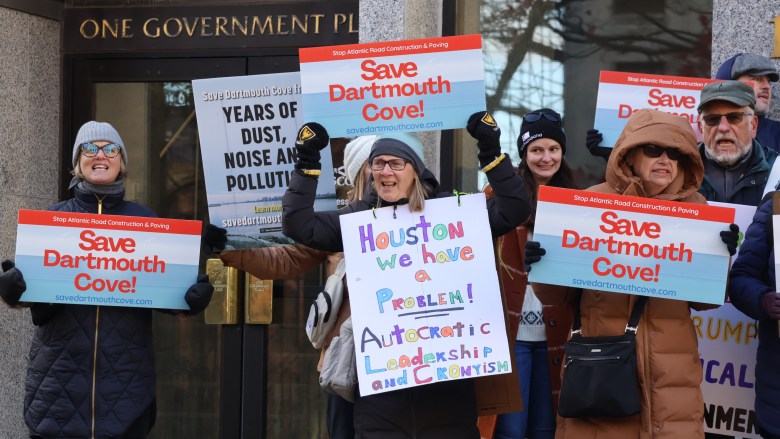 Protesters at the Save Dartmouth Cove rally on Nov. 12, 2025. Credit: Suzanne Rent
On Wednesday, I met up with members of Save Dartmouth Cove, the group that has been working since the spring of 2022 to prevent Dartmouth Cove from being infilled.
The group hosted a rally in front of Province House. They are waiting for word from the Minister of Municipal Affairs John A. MacDonald, who is reviewing a municipal bylaw approved by Halifax regional council to restrict infilling in Dartmouth Cove. The decision will be released by or on Nov. 28.
Premier Tim Houston, who is “personal friends” with Tom Hickey, co-founder of Atlantic Road Construction and Paving (ARCP), already made his thoughts on the bylaw clear. Here’s what he said during a cabinet meeting as reported by Jennifer Henderson:
My understanding is that there is a lot of thought the motion itself is ambiguous. It’s not actually clear…The other reason it would be referred to the minister for a serious look is there is a real concern over the jurisdictional approach. The federal government is going through a scientific detailed process, whereas the process at HRM seems to be pretty political.
At Wednesday’s rally, Jill Brogan, one of the founders of Save Dartmouth Cove, had some words regarding Houston’s comments. She called them “insulting.” From the story:
“Leave the bylaws for Dartmouth Cove alone, just as they left the bylaws for Northwest Arm alone,” Brogan said. “Stand back and stop having so much overreach. There’s no reason for Premier Houston to be involved in a bylaw that affects one area of Dartmouth. He’s got bigger fish to fry.”
Click or tap here to read “Save Dartmouth Cove group rallies for support as it awaits Nova Scotia’s decision on infilling bylaw.”
(Send this item: right click and copy this link)
IN OTHER NEWS
Unheard and unserved
 Credit: Contributed
Ella Macdonald at Global has been working on a series of stories about women and health care in the Maritimes.
Today’s article is about women with endometriosis, a debilitating condition where lesions grow outside of the uterus. The condition causes heavy menstrual bleeding, fertility issues, and more.
Macdonald interviewed Cairista MacIsaac, who developed endometriosis when she was 13, but the condition went misdiagnosed for years. She now supports other women struggling with the condition. From Macdonald’s story:
“The doctor more or less told me, here’s birth control, this is a woman’s issue, you’re just gonna have to deal with it,” MacIsaac says. “I remember my mom teaching me how to layer pads in my underwear so I could make it through a school day when I did go.”
“Why do we keep normalizing pain? Why do we keep normalizing heavy bleeding? These are things that are impacting young women’s lives to the point, some of which, they don’t even know if they’re gonna be able to graduate school.”
MacIsaac recalls being bullied and struggling to keep up with schoolwork in her teen years due to her endometriosis.
“I remember at one point, I was out for a few days. And when I came back, one of the boys in my class looked at me and said, ‘You’re always sick. Why don’t you just go die already?’ And that stayed with me to this day because I thought I was crazy,” she says.
Macdonald’s other articles in the series include:
(Send this item: right click and copy this link)
Government
City
Appeals Standing Committee (Thursday, 10am, City Hall) — agenda
African Descent Advisory Committee (Thursday, 6pm, online) — agenda
Province
Health (Thursday, 1pm, One Government Place and online) — committee business
On campus
Dalhousie
Terry Anders Memorial Lecture (Thursday, 11:30am, details) — Katie Birnie, from the University of Calgary, will present “Mobilizing Pain Science in Psychology: From Lab Research to Health Systems Change”
Group Read – Reclaiming Power + Place: The Final Report (Thursday, 12pm, details) — repeats weekly to Apr. 30
Guest Seminar (Thursday, 12:30pm, details) — Dennis Adu-Gyasi, Kintampo Health Research Centre discusses the leadership role that the KHRC played to bring the RTS’S Malaria vaccine to licensure, now one of the EPI vaccines in Ghana and other African Countries
NSCAD
Time Will Remember Us (Thursday, 12pm, details) —exhibition until Nov. 29
Saint Mary’s
Thursday
No events
Friday
Secularism through the Prisms of Lived Religion and Ethnography (Friday, 12pm, details) — Jennifer Selby from Memorial University will talk
Literary Events
Book Club With Local Author Talk (Thursday, 1:30pm, Tantallon Public Library) — with Halina St. James
OC Publishing Author Meet & Greet (Thursday, 6:30pm, Dartmouth Book Exchange) — meet Jill MacLean, Julie Strong, and Anne Louise O’Connell
Book launch (Thursday, 7pm, Writers’ Federation of NS) — Vicki Grant launches Death by Whoopee Cushion
Countryside Literary Arts Series (Thursday, 7pm, Maple Creek Centre, New Germany) — new work by Michelle Elrick, Jan Fancy Hull, and Alison Smith
In the harbour
Halifax
04:30: Zenith Lumos, container ship (149,525 tonnes), arrives at Pier 41 from Colombo, Sri Lanka
05:30: Don Carlos, car carrier, arrives at Autoport from Southampton, England
08:00: AP Revelin, bulker, sails from Pier 27 for sea
08:00: Ezra Sol, tug, sails from Pier 26 for sea
09:30: Nolhan Ava, ro-ro cargo, arrives at Pier 26 from Saint-Pierre
10:30: Atlantic Sail, ro-ro container, arrives at Fairview Cove from Norfolk
11:30: Don Carlos sails for sea
12:00: Pictor, container ship, arrives at Pier 42 from Portland
13:30: Zenith Lumos sails for sea
16:30: AlgoScotia, oil tanker, arrives at Imperial Oil from Sydney
21:30: Atlantic Sail sails for Liverpool, England
22:00: Nicobar, supply vessel, arrives at Pier 9 from Providence, Rhode Island
Cape Breton
04:00: Penelope, oil tanker, sails from EverWind for New York
18:00: Nordnes, bulker, arrives at Fiddle Berth from Lower Cove, Newfoundland
22:00: Nordnes sails for sea
Footnotes
A Bluesky follower pointed me to this newsletter titled, “How birds got human names.” Did you know magpie is short for Margaret Pie? The article explains it all.
I really love great blue herons. Here’s what the article says about the other names for a heron:
The heron was Jenny Longlegs, Craigie Heron, Jack Hern, and apparently also simply “Ralph”