
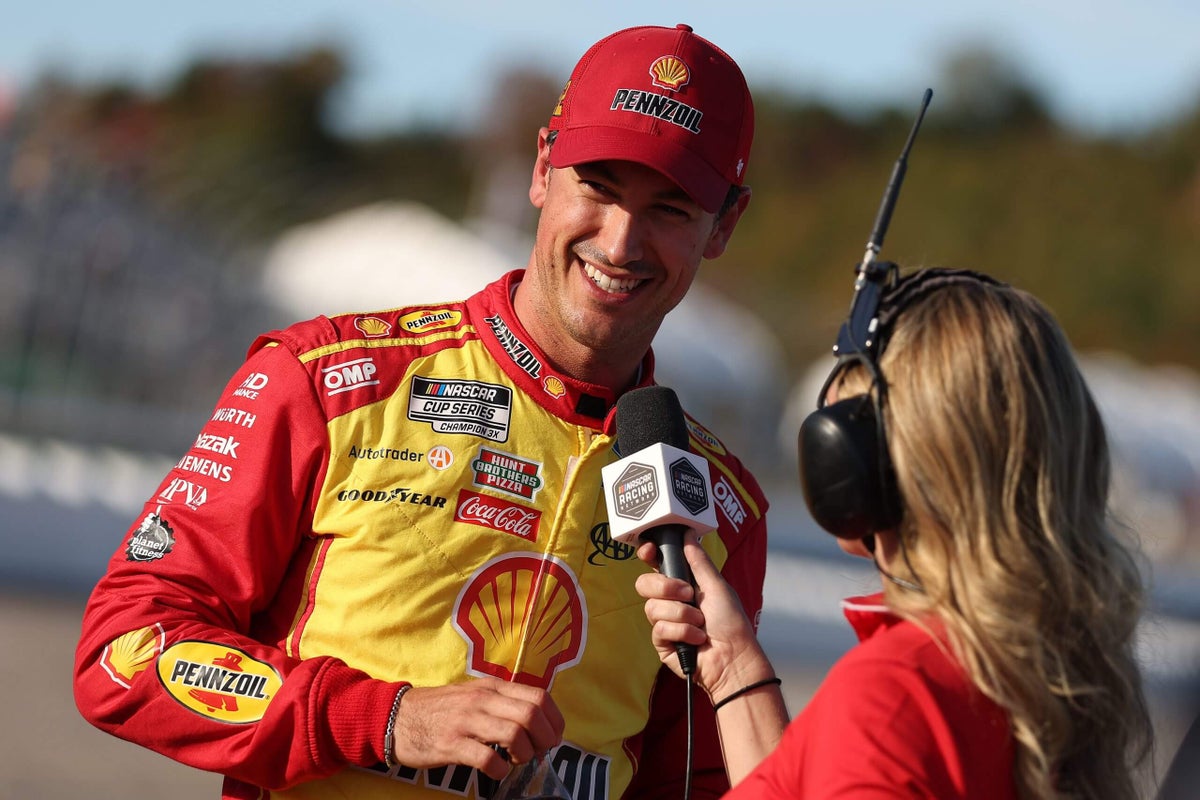
When eventual 2025 NASCAR Cup Series champion Kyle Larson was preparing for his Indianapolis 500 attempt in May, he put on a headset to do an interview with the Fox Sports booth.
Inside the commentary box was a guest — Larson’s fellow Cup Series competitor Joey Logano — who had flown to Indianapolis to watch that day’s practice session.
But when the booth announcers welcomed Larson into the program and asked him a question, Larson first had a question of his own.
“I’m just curious if Joey is getting some DAP points today,” Larson said.
“DAP” is short for NASCAR’s Driver Ambassador Program, which recently concluded its first season with successful results. Modeled off a now-defunct PGA Tour program, NASCAR incentivized drivers to promote stock car racing in scores of media appearances by creating a points structure and payment plan.
Logano won the first half of the DAP competition — pocketing a cool $1 million in June — and Ross Chastain won the second half, taking home the same prize. Drivers were paid out at every position rather than it being a winner-take-all program and found themselves almost as competitive with each other as they were on the track.
“Definitely, maybe,” Logano responded to Larson’s televised question that day in May.
“That’s not fair, NASCAR!” Larson replied, looking into the camera. “That’s not fair.”
The public exchange about a relatively private system underscored one reason the program worked so well. Drivers and their representatives each had access to an app that showed an updated scoreboard in real time, and the wide-open nature of race car drivers meant some went to great lengths to either score more points or try to keep their plans secret from the others (to avoid spurring their DAP rivals do more promotion in response).
“It’s tremendously moved the needle for me, personally,” Brad Keselowski said. “You have to make a lot of sacrifices to be a part of the sport, whether that’s on the competition side or the promotional side, and you just want to feel like it matters.
“(The DAP) has some short-term effects that are positive, but more so has significant long-term healthy effects for the sport I’m proud to see us undertake.”
Keselowski said he felt that way in part because of past experiences. When he won the Cup Series title in 2012, he went out to do countless unpaid appearances on behalf of NASCAR without so much as a thank-you or acknowledgment for his efforts, he said. He became “totally disenfranchised, totally disconnected” with wanting to promote NASCAR as a result.
“That’s not healthy, and that needed to change,” Keselowski said. “(DAP repaired) drivers’ willingness to work to promote the sport, and NASCAR’s willingness to reward them for that was sorely missing.”
It’s funny what a bit of money will motivate people to do. Keselowski and Kyle Busch, longtime rivals dating back to the late 2000s, appeared together in a NASCAR-produced, cinema-quality “Back to the Future” skit to promote Homestead-Miami Speedway’s return to the season finale slot in 2026.
Seeing the two put aside their bad blood to crack jokes and exchange high-fives in the skit was jarring, but as Busch explained it: “DAP program, let’s just leave it at that.”
Drivers earned one point for each 15 minutes spent promoting NASCAR, but they were given multipliers based on a variety of factors (the biggest names earned more multipliers). And NASCAR’s internal numbers, provided to The Athletic, show drivers responded in a significant way: Nearly four million earned media mentions for the drivers who participated in the program, which was up 17 percent over last year.
“That is huge for us,” NASCAR commissioner Steve Phelps said. “They’re building our brands. They are the face of NASCAR. The more opportunities we give to them, the more opportunities they step up and take, the better it is for the growth of this sport.”
Overall, drivers spent more than 6,300 hours promoting NASCAR this year. That included hits as diverse as “The Pat McAfee Show” (Larson and Busch), “Sesame Street” (Bubba Wallace) and “Jimmy Kimmel Live!” (Logano).
While the financial benefits were a plus, some drivers said the DAP program went beyond the monetary motivation by creating opportunities they might not otherwise receive. Ricky Stenhouse Jr., who drives for a smaller, single-car organization at Hyak Motorsports, said NASCAR’s promotional group secured various appearances at sporting events a team like his might not be able to get on its own.
In Phoenix before the season finale, for example, seven drivers attended the Phoenix Suns game and were shown on the scoreboard to promote NASCAR’s presence in town.
“Those fans aren’t used to seeing NASCAR drivers coming to events like that,” Stenhouse said. “But when I first got into the sport, the Cup guys were everywhere and it was huge. … When you walk around and people are stopping you at sporting events, we want to get back to that.”
In total, NASCAR’s data shows 5,569 driver opportunities were completed in 2025 — 58 percent of those being NASCAR or racetrack requests and 42 percent driver-generated submissions. It’s no wonder Christopher Bell called it “the busiest year of my life, being out and traveling and trying to promote the sport.”
Even so, the extra effort felt worth it to the drivers — and so did the incentive.
“It’s funny how that stuff works,” Ryan Blaney said. “If you get the option to make money going and taking time out of your week to go do stuff, you’re probably going to go do it. And if you don’t want to do it, fine. You weren’t mandated to do it.
“But if you said yes to a lot of things or go find some stuff on your own … then that’s on you, and you can do it. So it was good, and I’m happy to be a part of it.”
Top five finishers
First half
Joey Logano
Kyle Larson
Ryan Blaney
Ross Chastain
Daniel Suárez
Second half
Chastain
Logano
Suárez
Christopher Bell
Kyle Busch