
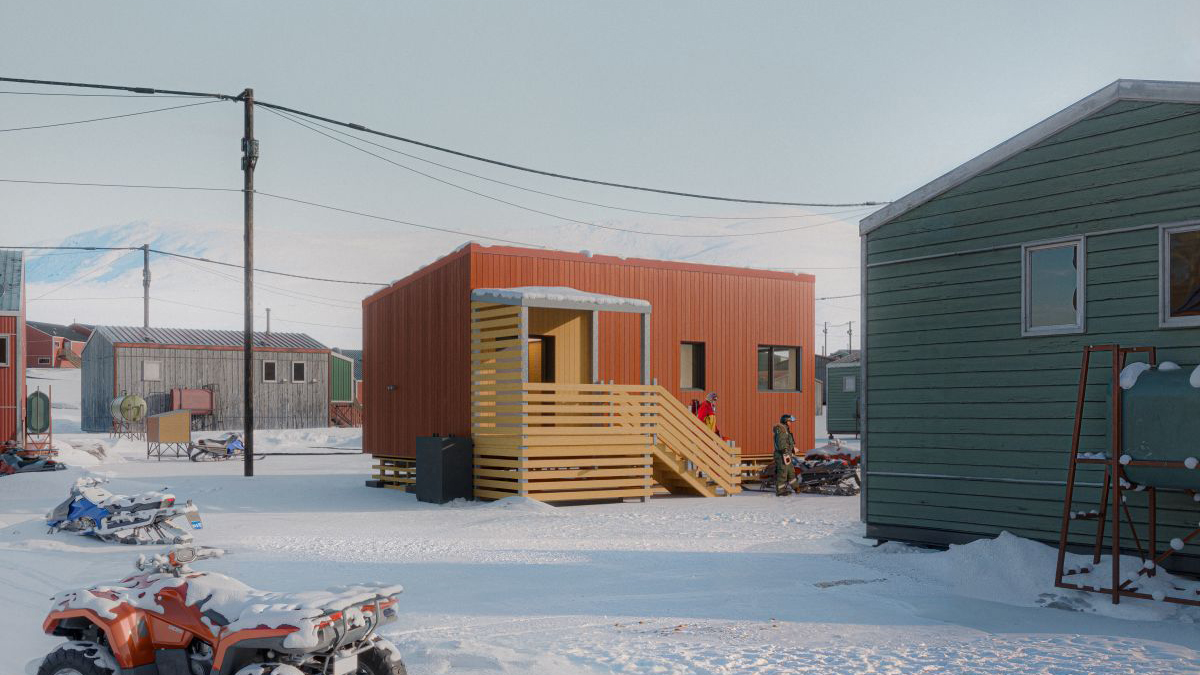
For the first time since the 1970s, the federal government has released a housing design catalogue intended to speed up the process of building dense housing and make it more affordable.
The Canada Mortgage and Housing Corporation catalogue, released last month, includes renderings and floor plans from which anyone interested in building a home can either draw inspiration or acquire technical specifications.
While housing specifically designed for the North is included in the catalogue, some question how encouraging the price tag associated with those designs will be for developers.
In the past, post-World War Two iterations of the catalogue had a big impact on homebuilding, with many of the designs appearing in cities, towns and villages across the country.
Claude Gautreau, a CMHC senior manager, said the focus of past catalogues was building single-family homes.
Advertisement.
Advertisement.
For the most recent edition, the goal has changed to dense housing, including fourplexes, sixplexes and accessory dwelling units, sometimes referred to as “granny” or “garden” suites.
“The other objective was to reduce construction costs, reduce timelines when it comes to approvals,” said Gautreau.
“When you want to build something, if you can have your building permit quicker, obviously you can start your construction quicker.”
CMHC worked with architecture firms to create housing designs for seven regions of the country.
Advertisement.
Advertisement.
“The designs for each specific region fundamentally take into account the needs for housing in that given region,” said Gautreau.
“That can go from aesthetics to the actual structure of the building, snow load, climate conditions and so on.”
 From left: Feven Fishatsion, Ksenia Eic and Sajeda Al-Bdour of Taylor Architecture Group worked on the northern designs in CMHC’s Housing Design Catalogue. Claire McFarlane/Cabin Radio
Taylor Architecture Group, which has offices in Yellowknife, Whitehorse and Ottawa, designed the northern housing plans, which are intended for use in the Yukon, the Northwest Territories and Nunavut.
Architect Ksenia Eic said part of the challenge was designing quality homes that are affordable to build and will work for the lives of northerners in both cities and smaller communities.
She said this included designing homes on both tanked and municipal services that are energy-efficient and have good insulation values.
In addition to the technical aspects, Eic said the team wanted the homes to be livable for people in the North, with a good amount of storage and space for people coming into the house to remove snow-covered gear in the winter.
While the designs were partially informed by a consultation conducted by the federal government in 2024, Eic said she drew on her own experience designing for the North.
She said the team included elements such as two exits in case of a fire. Community members had previously expressed a need for that, despite the building code only requiring one exit.
Advertisement.
Advertisement.
The overall look of the homes was another balancing act, Eic said. While wanting to keep them affordable and straightforward to build, Eic said the buildings should have visual interest and fit within the northern context.
For the municipal fourplex and sixplex, Eic said, the team included things like an overhang and a pitched roof to offer a “homier” feel.
Eic said she’s curious to see how the designs might be adapted to suit the needs of the builders.
“Would people take this and adjust it as well to suit what works for them? Or would they just straight-up take it and build it exactly as-is? That would be interesting to see,” said Eic.
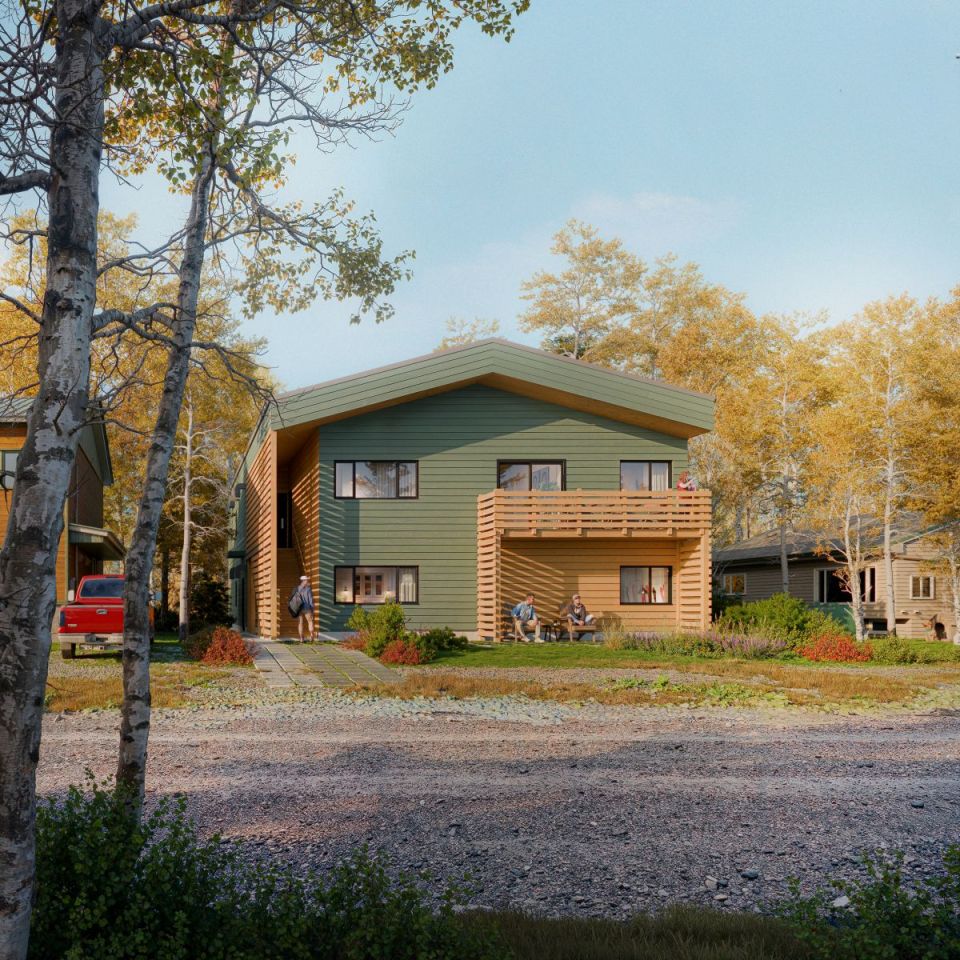 A rendering of a municipal fourplex intended to be built in the North, courtesy of CMHC.
Presenting to Yellowknife city council last month, former NWT MLA Rylund Johnson described himself as an aspiring developer.
“Yellowknife is in a housing crisis and we have a supply problem so, morally, I think we all have a bit of imperative to try and build some housing for our residents,” Johnson told Cabin Radio.
In front of council, he spoke about some of the barriers people face while trying to bring more housing to market.
He pointed to the high cost of procuring land and building stick-built homes, the more conventional alternative to prefabricated modular buildings.
Advertisement.
Advertisement.
Citing cost estimates for the designs in CMHC’s catalogue, Johnson said the math wouldn’t be appealing to professional developers and might be unattainable for most regular builders.
“Anyone who looks at just the construction costs immediately sees you building something that is not worth that much on the market,” said Johnson.
“It’s almost impossible to build stick-built construction in Yellowknife these days. I mean, it was very, very difficult before, but it’s becoming impossible.”
The estimates presented by CMHC range from $352,000 to $502,000 – for an accessory dwelling unit connected to municipal services – to between $4.5 million and $5.7 million for a tanked sixplex. The estimated cost per unit for the tanked sixplex is between $763,000 and $954,000, or about $576 to $720 per square foot.
Gautreau of CMHC said these costs are only estimates and anyone interested in building some of these designs would need to engage housing professionals to fit them to the desired site and foundation – and get a more accurate idea of cost.
He said there are also opportunities to modify the finishes of the homes, which could affect the price tag.
“There are options with each design, whether it’s cladding type, roofing type,” said Gautreau. “There’s certain things you can do to change the design based on what you would want to do, and based on what your goals are.”
Johnson said while they might not be appealing for private developers, the northern designs presented in the catalogue still have plenty of applications.
“There’s a lot of CMHC programs flying around right now and there’s Indigenous governments trying to build housing, there’s non-profits trying to build housing, ” said Johnson.
“The entire affordable housing sector benefits from having pre-designed plans that they can get funding with.”
Related Articles