
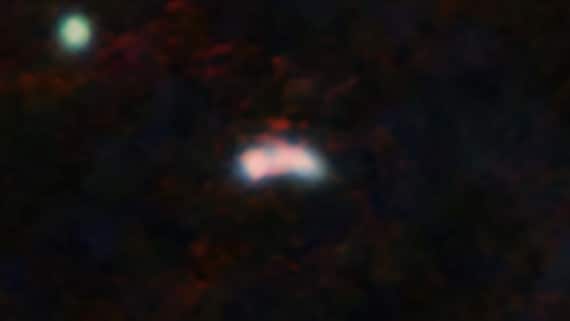
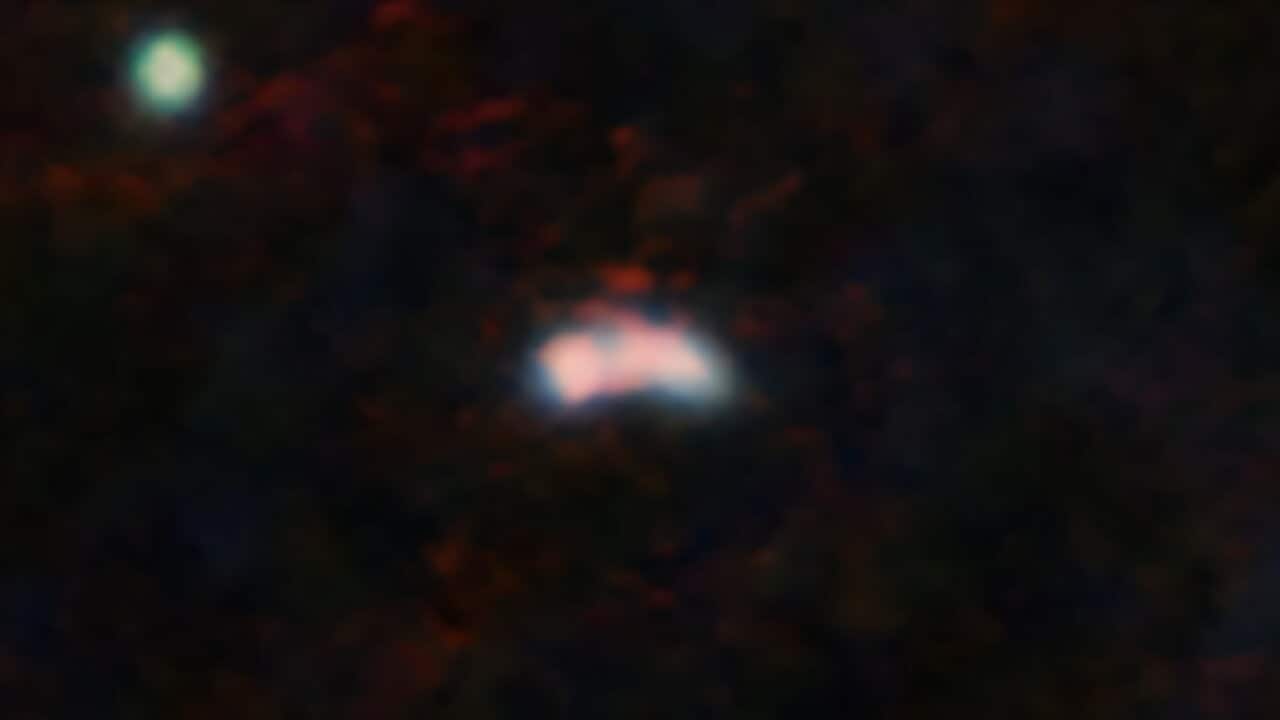
In the Y1 galaxy there is a “star factory” that produces at a very rapid pace: here stars are born 100-200 times faster than in the Milky Way.
Astronomers have detected an extraordinarily active “star factory”: star birth in a remote galaxy is proceeding 100-200 times faster than in our Milky Way, a fact that could help solve the puzzle of how galaxies in the early Universe grew so quickly.
The protagonist is the galaxy indicated as MACS0416_Y1 (sometimes abbreviated to Y1), located at a redshift of around 8.3 (redshift is the shift of light towards longer wavelengths, caused by the moving away of cosmic objects): in this specific case this means that we see its light as it was over 13 billion years ago.
Inside the “hot” galaxy. Using the Atacama Large Millimeter/submillimeter Array (ALMA) radio telescope – a 66-antenna radio telescope located in the Chilean Andes, designed to observe the Universe in millimeter and submillimeter waves – the team led by Tom Bakx (of Chalmers University of Technology, Sweden) measured, among other things, the temperature of cosmic dust inside the galaxy – dust that is “superheated” compared to galaxies similar.
cosmic laboratory. The study reports a dust temperature of around 90 K (-180 °C), which is far from cold by cosmic standards and decidedly higher than that typical of distant galaxies observed so far. One of the reasons why this discovery is so significant is that the environmental conditions in which the first generations of stars formed were very different from those observed today in the local Universe: density of gas and dust, intensity of radiation fields, chemical composition were all completely different compared to the current state. In this sense, MACS0416_Y1 provides a very rare “laboratory” for studying those first cosmic moments.
A very active nursery. According to the data, Y1 generates stars at an estimated rate of more than 180 solar masses per year, a rate that places it as one of the most extreme star factories known. For comparison, the Milky Way produces an estimate of about 1 solar mass per year. The research team believes that these episodes of strong star formation, while brief, may have been much more common in the first hundreds of millions of years after the Big Bang.
It is not only the formation rate that attracts attention, but also the amount of dust and metals (elements heavier than hydrogen and helium) present: in Y1 the estimated dust mass reaches several million solar masses, a surprisingly high value for such a young galaxy.
This leads to questioning some standard models of galactic evolution, which do not predict that a galaxy, in a few tens of millions of years, can produce so much dust and metals.
A look at the early Universe. One scenario proposed by the team led by Yoichi Tamura (Nagoya University, Japan) is that Y1 already had a previous stellar generation, barely visible today, which generated the observed dust. In other words: to explain the amount of dust and metals, the current episode is not enough — there must have been a “pre‐burst” or early and intense stellar activity.
Thanks to ALMA’s high-resolution observations, it was confirmed that Y1 is not an ordinary object, but belongs to an extremely active class, perhaps typical of the “first generation” galaxies in the Universe. Researcher Bakx said: “We are looking back to a time when the Universe was producing stars much faster than today.”
Other implications. Finally, this discovery – in addition to describing a single exceptional object – could have broader implications: if galaxies like Y1 were relatively common in the early Universe, they could explain the rapid growth of galaxies observed at high redshift and help solve the problem of “excess dust” compared to standard models. A small amount of hot dust can in fact be as bright as much larger amounts of cold dust, which could alter our perception of star formation and chemical evolution in ancient galaxies.