
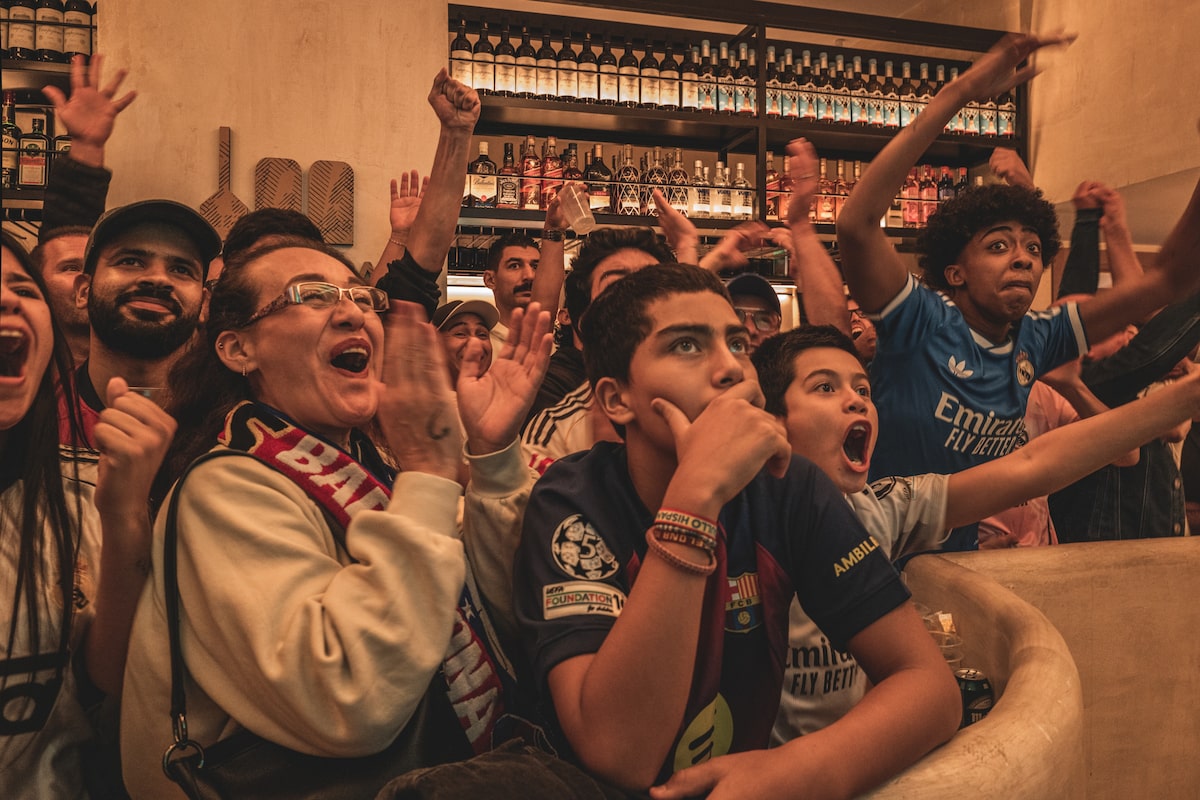
From nine rows up, Beltran Diaz looks out on one of soccer’s most coveted turfs and considers what has changed since his grandfather first bought Real Madrid season tickets a half-century ago.
It was only recently that cigarette smoke still gathered in cumulus billows around the lights, while those below guzzled cups of Mahou beer.
And it also hasn’t been long since soccer here, like everywhere in Europe, was plagued by the furies of the hooligans, the politically-inflected violence of the men known locally as ultras, who occupied prominent seats and often whipped the game into a frenzy. Here in Santiago Bernabéu Stadium, rowdy fans famously knocked down goalposts in 1998.
Open this photo in gallery:Open this photo in gallery:
Real Madrid fans cheer at Oct. 26’s game, where star player Kylian Mbappé basked in the adulation.Susana Vera/Reuters
Today, when Mr. Diaz joins with the 80,000 fans who leap from seats to jeer the entry of the visiting Barcelona squad, the feeling remains blood-red, the sound still deafening enough to light up smartwatches with noise warnings. It is an “El Clásico” match, one of the annual meetings between Spain’s bitterest soccer rivals.
But it all quickly subsides. Mr. Diaz and his fellow aficionados take their seats to watch. Fathers sip bottles of water along with their children, since booze is now banned for most fans.
Also gone are the crowd of ultras, who have been largely booted from the Bernabéu, the newly-renovated citadel of Real Madrid football, after years of effort by the club’s president, Florentino Pérez.
“In the past, there was, like, more ambiente, you know,” Mr. Diaz says – more atmosphere.
Today, “it’s more chill. Usually there’s no trouble.” And, he says, “that’s really good as well.”
The crowds are still here, with their shriek of whistles whenever an opponent touches the ball. The trophy cases continue to expand. And the Bernabéu regularly holds some of the most fiercely contested matches in soccer.
Yet it has become rare for there to be more than profane chants or an on-field scuffle.
Slogans such as odio eterno, or ‘eternal hate’ – which this Real Madrid fan has on a shirt with a crossed-out Barcelona symbol – speak to the intense feelings around soccer in Europe.
Why and how that transformation happened are questions that inform a decades-long arc of soccer in Europe, during which team executives decided violence during matches was no longer in their best financial interest – with some major football clubs beating hooliganism into retreat through the application of strict laws and police on horseback.
The ways this has been done also offer something for Canada to study as it prepares to host its own major matches. The first-ever World Cup games in Toronto and Vancouver are scheduled for mid-June next year. Between the two cities, FIFA has planned 13 games in Canada. It won’t be clear until a final draw in early December just who those teams will be.
Nonetheless, they promise to be the biggest matches ever staged on Canadian soil, a generational moment for spectators – as well as those responsible for keeping out the hooligans.
The RCMP has already “been in touch with Spanish authorities ahead of the FIFA World Cup,” spokeswoman Robin Percival said in a statement. “These relationships are fundamental to our ability to ensure Canada responds to globalized threats and major events.”
The police interest merely confirms what any serious fan already knows: there are few places better to learn about the game than a country where high-profile soccer is neither unusual nor extraordinary.
Here in Madrid, it’s just another Sunday in October.
Soccer coach Jeff Valcius, right, is outside the stadium with his friends. His hometown, Toronto, will play host to six World Cup matches next year.
El Clásico is the kind of game the world gathers to watch. Real Madrid is an international sporting colossus – only 2 per cent of its fan base lives in Spain – and its adherents circle the globe to watch a Clásico. “This is Lakers versus Celtics. This is Patriots versus the Colts, when Manning and Brady were at their peak. This is the pinnacle of two great sporting organizations clashing,” says Jeff Valcius, a Toronto high-performance soccer coach who attended the most recent event, in late October.
It was only a few years ago that El Clásico was the stage for Messi against Ronaldo. It is, in other words, “the biggest game in Europe,” says photographer Alberto Palmisciano.
Mr. Palmisciano is an unusual figure in soccer. A skilled linguist, he works as a language teacher. But for half a century, he has made himself into one of Europe’s most accomplished documentarians of hooligans, the tattooed cast of characters that brought drama, violence and, occasionally, death, to matches across the continent. He was there in 1985 when fans in Brussels tossed exploding oranges studded with nails and pieces of glass, in a disaster that killed 39. He was on a train in Italy that was attacked by Molotov cocktails four years later.
“Going to football in the eighties was never a safe experience,” he says. Ultras were wont to attack regular fans, demanding, “‘Give me your wallet, give me your shoes,’” Mr. Palmisciano recalls. “It was mayhem.”
“But it has completely changed.”
Mr. Palmisciano lives in Madrid, a city with few equals in the soccer world. With seven million people, a population roughly the size of greater Toronto, the city is home to two major La Liga teams, Atlético de Madrid and Real Madrid, the latter of which boasted the highest revenue of any soccer club in history in 2024. “They’re world clubs, big institutions,” Mr. Palmisciano says. “They don’t want the guy showing the swastika on the grounds. They can’t afford that.”
Atlético is the other La Liga team in the capital. Its matchups with Real are known as El Derbi Madrileño, the Madrid derby.Juan Medina/Reuters
Agustín Guardiola, a Universidad de Alcalá scholar who specializes in sports safety management, thinks of soccer fans as a distinct subspecies of Homo sapiens, whose blood flows so hot that Spanish legislators have drafted special anti-violence laws to govern their conduct at sporting events.
“The level of passion in football here, and in other parts of the world, is just different,” says Prof. Guardiola, who has worked for the Madrid City Council and advised local sports facilities.
“It’s much more intense.”
After the emergence of violent fan groups in the 1980s, many of them directly supported by football clubs who shared their politics and valued their energy, Spain strengthened laws dedicated to reducing violence and intolerance in sport. It created a National Commission Against Violence at Sporting Events that rates the risk of major matches – higher risk events prompt a larger police presence – and punishes bad behaviour, including displaying objects or making gestures that glorify terrorism or the Holocaust. Fines can reach nearly $100,000.
And every week brings new worries.
Days before each Sunday match in Madrid, planners are summoned to a Thursday meeting, which typically involves multiple levels of police, private security and the security co-ordinators of both the home and visiting clubs.
“What we have to try to do is stop it before that happens,” says David Ferrero, who co-ordinates private security at the Metropolitano Stadium where Atlético de Madrid plays.
That starts with questions that might not typically be asked in North American sport. A political analysis, for example, can spot potential points of conflict between two different sets of supporters and determine the level of necessary police response.
But one issue ranks above all others: What are the numbers?
“How many people are going to travel here? How many are radicals? How many are violent?” says Víctor Brocate, director of security and civil protection for the Madrid Metro.
Most of that information comes from the person who knows those fans best, the security director of the rival club. Clubs that are sworn enemies on the field co-operate in security meetings, sharing the identities of known troublemakers. For the home club, the generational nature of most season ticket-holders makes it easier to know who is in attendance.
Police may start keeping tabs on fans as soon as they reach Madrid’s airport, which now has biometric scanners that most non-EU citizens must use to enter the Schengen zone.Juan Medina/Reuters
As match day nears, the greater objective is to build a security bubble around spectators from the visiting team.
Elsewhere, heads of state might expect the coddling of a protective detail. In Spain, it’s a treatment shared by soccer fans.
Often, they travel with their own hometown police escort. When they arrive in Madrid, they are met at airports and train stations by local police, who begin a co-ordinated dance to ensure they can travel through hostile sporting territory without injury. The same is true for Madrid fans who travel elsewhere.
“You go with motorcycles and police cars in front and behind you, and you get to the stadium in no time,” says Gerardo Tocino, who is president of La Gran Familia, one of the largest Real Madrid fan supporter groups. “It’s not something you could ever hope to experience in normal life.”
The co-ordination is so thorough, Mr. Tocino said, that security overseers in cities he visits will ring with updates about areas where opposing fans have gathered and suggest his group steer clear. That’s in addition to the royal treatment.
Gerardo Tocino is president of La Gran Familia, whose trips to the Bernabéu have been made easier with police escorts.
In Madrid, the local metro system will dispatch special subway trains open only to visiting fans, picking them up and then whisking them without stop to the stadium – a test of logistics complicated by the need to herd people whose capacity to follow instructions tends to be hampered by beer and loud singing.
“The problem is, people are unpredictable. So 90 per cent of the time they tend to follow instructions, but there’s 10 per cent who ignore the meeting point and ignore everything else,” says Mr. Brocate.
The ability to isolate fans in dedicated subways can mean the difference between war and peace. Still, when soccer is on, violence is never far away.
“Even when they go with the police, sometimes they urinate on the trains,” Mr. Brocate says. “They put stickers on the cameras. They break windows. They scratch the carriage walls. I’m telling you, they’ve done everything to us,” he said.
For Madrid, he said, the way to respond is with extensive deployment of force.
It is an operation that rises up from the ground and peers down from the sky, blending calvary-age technology with the glass-screened wizardry of the digital age.
Police officers and horses are at the stadium to keep rivals apart as the players’ buses arrive.
On El Clásico day, crowds begin to fill the streets around the Bernabéu hours before kickoff. Only the most fortunate have tickets. But everyone can gather for the busiana, a crush of people who gather for a glimpse of the player arrivals by bus.
Somewhere deep in the mass of people, a drumbeat breaks out. The crowd responds with a throaty “¡Ey, ey! ¡Puta Barça!” It is a profane refrain against Barcelona, but one lustily embraced by older men and children alike, the youngest pumping their arms as they yell from atop their dads’ shoulders.
Police on horseback clatter into place, pushing the gathered masses back onto sidewalks, clearing the streets for what is to come. As the buses drive up – first Barcelona, then Madrid – they are greeted with boos, cheers and plumes of coloured smoke.
In the midst of it all, a trio of officers in blue berets peer at a tablet screen, a police anti-drone unit that can track unauthorized flying objects in the stadium area and use a jamming device to interrupt its flight. Those charged with protecting stadiums say they worry they are vulnerable to violence delivered from above.
“If someone wants to attack or, let’s say, wants to make a political or ideological statement of some kind, they can do it by air,” says José Luis Tucho, the security co-ordinator for Atlético de Madrid.
Atlético’s home stadium, the Metropolitano, has grappled with radical fan groups similar to those across town at the Bernabéu.Isabel Infantes/Reuters
Real Madrid declined interview requests. But Atlético operates in the same city and in the same league. Mr. Tucho has spent nine years as security co-ordinator for the club, which will host the 2027 Champions League final.
It’s a position that has inclined him to worry.
“More and more fans are aware that if they contravene the current regulations, they will be very badly affected,” he says. “But it is also true that the ultras world, far from disappearing, is gaining strength.”
He has watched the growth of a new generation of hooligans, some of them trained fighters who use soccer as a backdrop for planned violence. One group of radical fans, Frente Atlético, has even renewed itself, with people as young as 15 and 16, Mr. Tucho says. “And they’re adding more.”
The group has interrupted games by throwing objects onto the field and gained attention for provocative gestures such as Nazi salutes. Last year, ultras made up 10 per cent of the Atlético fans who gathered to attend one Real Madrid match, he says.
“We had to separate them from the rest of the so-called normal fans,” Mr. Tucho says.
Some ultras can still be found in the bars around the Bernabéu. At this one, most fans are in a good mood because Real Madrid has just scored.
At the Clásico match, groups of ultras still gather in bars outside the stadium, tattooed and downing beers. Some warned a Globe and Mail photographer that her equipment could be broken if she kept taking pictures.
The continued strength of such groups, Mr. Tucho says, should be of concern to anyone hosting a major soccer match. “Canada should be in contact with the national police information centre in each country so they can get information about the fans who are going to travel,” he said.
The national teams that compete at the World Cup aren’t followed by the same organized hooligan groups that are attached to city clubs. Still, other issues can easily emerge.
“There are historical confrontations over many centuries that can be transferred to the soccer pitch,” Mr. Tucho says. “These are political problems that can lead to violence.”
Oct. 26’s Clásico was one of hundreds the teams have played since 1902. Madrid has won slightly more often than ‘Barça,’ which tried hard to reverse that trend this time around.
Susana Vera/Reuters; Bernat Armangue/AP
For the biggest name in European soccer, however, the ultras are no longer a principal concern. In 2013, Real Madrid president Florentino Pérez cleaned house, evicting from the Bernabéu most members of the hard-right Ultras Sur fan club, which had since the 1980s occupied a highly visible place in the stadium’s stands.
Today, “they don’t really exist in any meaningful way,” said a senior official with Real Madrid. The Globe is not using the official’s name, because they were not authorized to speak publicly. What it all means, the official said, is that on a Real Madrid game day, security is no longer top of mind: “We worry about winning.”
None of this is by accident.
The Bernabéu stands not merely at the forefront of European soccer, but at the vanguard of stadiums designed as a blend of theme park, shopping centre and field of play, says Xavier Ginesta, a professor at University of Vic – Central University of Catalonia who has written extensively on the history, politics and identity of soccer in Spain. Its multibillion-dollar renovation has remade it into a stainless steel-wrapped centre for entertainment, whose living football heart – the manicured turf of its pitch – can be folded into underground storage to make way for a Taylor Swift performance.
“Football is facing a Disney-ization process,” Prof. Ginesta says.
“They have understood that if they build stadiums where family audiences are comfortable instead of hooligans or hard core fans, this will maximize their revenues.”
Organizers try to keep fans at the Bernabéu enthusiastic but disciplined. Their chants are vetted to make sure they are not offensive.Angel Martinez/Getty Images
In some ways, asking what Canada can learn from European soccer is the wrong question, when Europe has been hungrily studying North American sporting facilities that long ago transformed themselves into entertainment hubs, Prof. Ginesta says.
At the Bernabéu, soccer is not merely a game. It is a carefully-managed show. Visiting fans are tucked in a corner of upper seating, kept at a physical remove. Alcohol has been banned from all but VIP boxes. And the Ultras Sur members who once created boisterous havoc have been replaced by a disciplined group of fans all clad in white, clapping in unison and shouting chants screened to ensure they do not offend. They may not match the ambiente that once electrified this place, but they could offer something to emulate.
Having a stadium approve some groups of fans to enter with drums and flags brings “the energy,” said Cesar Augustus, a Miami soccer fan who has come to Madrid for the game against Barcelona. “That’s what you guys need to learn in Canada.”
On this particular night, El Clásico lives up to its name. Real Madrid’s Kylian Mbappé lashes the ball into the net twice. One is pulled back for an offside violation, and he then misses a penalty. Real Madrid still wins 2-1.
As the final seconds of the match ticked away, the players broke out into angry shoving. Police, stationed around the stadium to keep fans in check, ran instead to separate the superstars. In the stands, meanwhile, 80,000 people filed out with little sign of disturbance.
Prof. Ginesta isn’t personally enamoured with the synthetic strains of the modern game, with soccer as spectacle rather than blood sport. “Football in the eighties was more real, more pure,” he says.
But he knows there’s little point in pining for the past.
“A lot of fans will say, ‘I’m against this globalization, this hyper-commercialization,’” he says. “But when Mbappé scores and Real Madrid Madrid beats Barcelona – they are very happy.’”
Open this photo in gallery:Fields of interest: More on soccer from The Globe Ahead of the Game podcast
Before he joined Real Madrid, Kylian Mbappé and his fellow Frenchmen went toe to toe with Argentina in a World Cup thriller for the ages. You can relive it with The Globe’s limited-series podcast from Qatar 2022, which looked at Team Canada’s return to the competition after more than three decades.
Canada’s soccer scenes
Northern Super League brings women’s pro soccer dreams to life in Canada
Walking soccer offers a new pace for players to enjoy the beautiful game
Cathal Kelly: World Cup 2026 will be Canada’s chance to show the world how much fight we have in us