
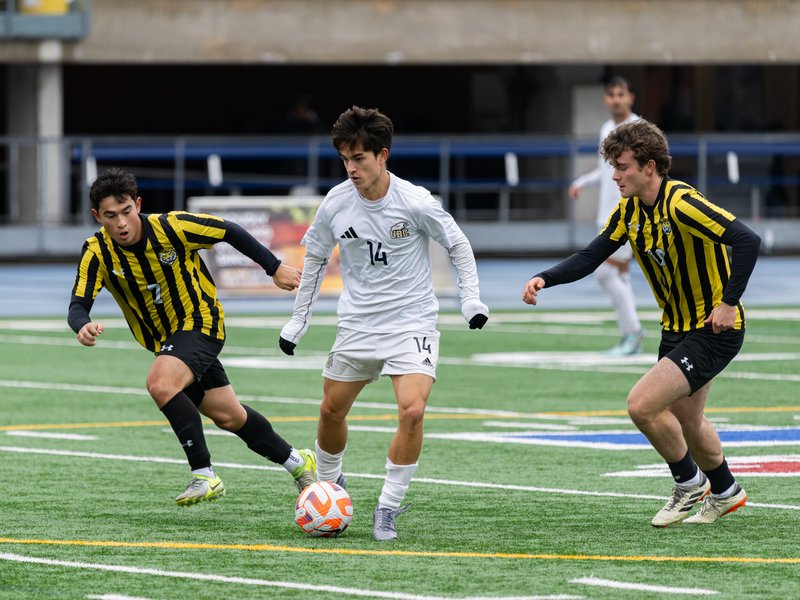
When you, as a team, face a soul-crushing, season-ruining loss like UBC did against Montreal in the quarterfinals of the U Sports Men’s Soccer Championship, you have two options. The first option is to crumble. Nobody would blame you. After all, following a 15–0–1 regular season — the first time such a record has ever been achieved in Canada West — no matter how things go in the consolation bracket, the playoff performance is a disappointment.
Because of the T-Birds’ loss in the quarterfinals, the best the team can finish is fifth. For a team that went undefeated in the regular season, fifth is not good enough. So, if the spiral were to continue, if UBC was to bow out quietly in the consolation semifinal, what would it matter? The damage has already been done.
The second option is to choke back the loss, show up the next day, and beat the living daylights out of a clearly inferior opponent — taking out all the frustrations from the quarterfinal out on some poor, unsuspecting team. Unfortunately for the Dalhousie Tigers, the ‘Birds chose option two.
In a game that UBC controlled from the kickoff, the ‘Birds humiliated the Tigers — barely letting them even touch the ball in a 3–0 win that wasn’t nearly as close as the score indicates. Dalhousie didn’t muster a single shot on net throughout the match, with any chances they had in the UBC end either being swiftly snuffed out by a stout Thunderbirds defence, or brought to a halt by self-inflicted errors — panicked shots that flew wildly off course, passes that went askew, avoidable turnovers and more.
Perhaps it is unfair to judge the Tigers this harshly. For Dalhousie, even getting to this point is a major accomplishment. This is the second time this century that the Tigers have qualified for the U Sports championship, with their most recent appearance coming in 2008, where they lost in the consolation final. While they were a men’s soccer powerhouse in the 1990s, consistently making noise in the tournament — even winning it all in 1995 — Dalhousie has been nothing close to that since. This season was potentially the first glimpse back into sustained soccer success.
With an 8–2–2 record in the regular season, the Tigers secured their best campaign since they last qualified for nationals in 2008, and while they finished second in the Atlantic University Sport (AUS) standings behind the Cape Breton Capers, the Tigers got the last laugh, beating the Capers in the AUS finals 3–2. This was no small feat, either. Since 2012, the Capers had won the conference seven times, including a stretch where they won six straight conference titles, and this season, they were nearly unbeatable in the regular season, going 9–1–2. While perhaps becoming the national champion was a bit too lofty a goal this early in the turnaround, they could maybe scare a couple teams, or maybe even sneak out a win.
Those dreams were quickly dashed. Against the York Lions in their quarterfinal game, they were down 2–0 before even 10 minutes had passed, and before they knew it, they were the victims of a 5–1 beatdown that included an own goal and zero saves. Going into the consolation semifinals would not be a reprieve, either. By losing their quarterfinal against York, the Tigers would be gifted a game against the defending national champions, an angry UBC team looking to blow off some steam. Dalhousie’s Cinderella run was over.
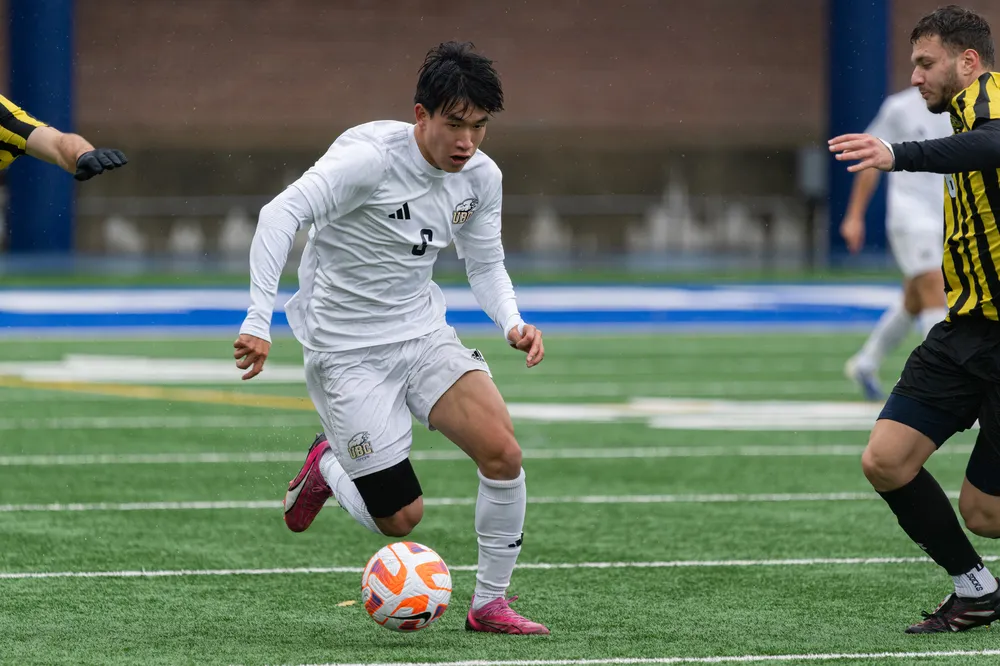
UBC midfielder Yu-Hsuan Yuan cuts through the Dalhousie defence. While the Tigers had a great season for their program’s standards, they still have a ways to go before they’re on the level of a team like the T-Birds. Courtesy Toronto Varsity Blues
It was clear the clock had struck midnight on the Tigers only a couple minutes in. The Thunderbirds took the ball off the opening kick, and immediately got off some solid chances, looking to echo York’s early 2–0 lead against these Tigers a day earlier. Off a through pass that led him into wide open space just off the Dalhousie net, UBC midfielder Nicolas Nadeau launched a cross that found defender Joshua Tomé with time to get full power on the shot.
While Tome’s shot was partially blocked by a Tigers player before being corralled by Dalhousie keeper Sinclair Astridge, the ease with which UBC moved the ball through the Dalhousie zone — finding copious amounts of space in dangerous areas — was an early positive sign for the T-Birds’ offence.
Even when the Tigers closed in on the ‘Birds attack, UBC still found room to shoot. On an incredible individual effort just a couple minutes later, T-Birds striker Henri Godbout cut through four Dalhousie defenders, keeping the ball on a string as Tiger after Tiger failed to knock the ball away from him, with his momentum only being stopped when his shot from close-range whistled just wide.
After surviving these early chances by the ‘Birds, however, Dalhousie managed to keep the score even, at least for the first 20 minutes. Yet, that wasn’t really because of the Tigers cracking down on defence. Instead, while UBC continued to dominate possession, finding tons of open space for passing, even in the attacking zone, they couldn’t turn that into points. For the ‘Birds, there had to be at least some initial worry about complacency. If they couldn’t turn up the pressure and get some chances on the Dalhousie net, there was always the possibility of the back-breaker. Even in a game where you control the ball for almost the entire 90 minutes, if you can’t convert on offence, one bad break can sink you.
That was what Dalhousie had to be hoping for. To stave off a UBC goal at one end, and break through with a quick goal off a T-Birds’ lapse — a turnover, a missed assignment, something to give them a window. The issue for the Tigers was that, even if they were given that opportunity, they had to convert. They didn’t seem ready to do so.
Countless times throughout the match, when the Tigers found themselves with the ball in UBC’s end, they looked jumpy, as if they didn’t know what to do with the ball once they got close to the T-Birds’ net. In the 19th minute, as Dalhousie got a break down the left sideline, with a chance to send the ball across to a teammate with a decent amount of space in front of the net, the eventual cross didn’t even come close to landing in the field of play. It soared far over the T-Birds’ crossbar, and while the intended receiver of the pass attempted to make a play on the ball, he was already out of bounds as he leapt to get a foot on the ball.
This would not be the only time something like this happened in the game. While Dalhousie managed to get plenty of shots off in the general vicinity of the net, rarely were they close to connecting. Of the 12 shots they took in the game, none were on net.
That was the difference in this game, more than anything. While you can point to the difference in talent, team chemistry or coaching — UBC clearly looked like a team that had been here before, while Dalhousie did not. While Dalhousie was anxiously waiting for chances to come their way, UBC made their own luck.
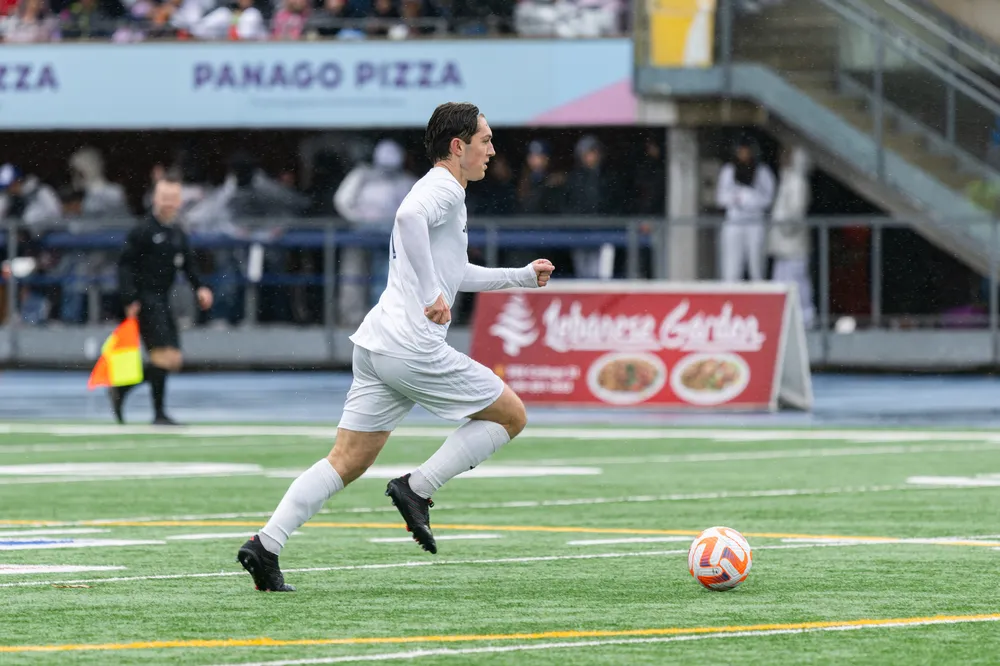
T-Birds midfielder Brennen Fuerst runs with the ball. Some misdirection from Fuerst and Luke Norman on a UBC free kick confused the Tigers, leading to the game’s first goal. Courtesy Toronto Varsity Blues
In the 25th minute, with UBC being given a free kick just outside the box on the far left sideline, they set up a nifty set piece that was almost clinical in its precision. With T-Birds midfielder Brennen Fuerst lined up to take the kick, Nadeau stood just off to the side of the ball, with his hands on his hips, waiting for Fuerst to shoot. Yet, as Fuerst stepped towards the ball, he stepped back at the last moment, opening a window for Nadeau to spring into action, catching the Tigers defence off guard by taking the shot himself.
The trickery worked. Nadeau’s shot was placed perfectly into the box, with midfielder Luke Norman sliding in untouched to deflect the ball into the back of the net. It was a remarkable little gadget play — putting them in the lead 1–0. While the Tigers looked stunned, even immediately after the goal, the T-Birds looked like they didn’t even really notice the goal. They came together to celebrate, but it was muted. Calm high-fives and fist-bumps exchanged — but with little joy on their faces. Perhaps the loss to Montreal was still on their minds. Or, perhaps, it was that even with a goal, there was little to celebrate. This was what they were supposed to do.
With a one-goal lead, the status quo from earlier in the game re-established itself for the remainder of the half. UBC controlled the ball, and while Dalhousie got a few chances, they would slam the window shut on themselves. When Tigers striker Mohammed Tolba set up an odd-man rush with a beautiful touch pass around two T-Birds, Dalhousie immediately squandered the chance, with the subsequent pass in the box having no power behind it, being easily intercepted by UBC. Two minutes later, the Tigers got another odd-man rush — with the same result. Almost overadjusting for the prior mistake, an attempted through pass was sent with way too much juice on it, rolling clear out of bounds, sending a wide open Tiger chasing after it to no avail.
The first half ended with UBC being up only 1–0. Technically, Dalhousie was a shot away from tying the game. It didn’t feel like that. Finally, in the second half, the T-Birds started to pull away.
After a Tigers’ throw-in deep in the UBC zone, the T-Birds reversed the field in an instant. With an aggressive defensive play, the combined efforts of Norman and Max Comsia stripped Dalhousie’s Reese Weatherston of the ball, with Comsia flipping the ball to a streaking trio of T-Birds attackers, who quickly made their way up the field.
At the other end, it was again Comsia and Norman who would connect. With Norman getting the ball on a two-on-one, he made the smart play to instead play the ball back to the trailing Comsia, who was all alone at the top of the box, with all four Tigers defenders having overpursued the other T-Birds who had rushed into the zone. With a near eternity to take his shot, Comsia made no mistake, painting the top left corner to put the ‘Birds up two.

UBC midfielder Luke Norman shields the ball from multiple incoming Dalhousie defenders. After opening the scoring for UBC, Norman made a smart play to set up Max Comsia for UBC’s second on the day. Courtesy Toronto Varsity Blues
There was more than a third of the game left at this point, but it was over. The pace of play slowed to a crawl, and at times, it seemed like UBC was just trying to wind the clock down — just passing the ball between defenders in their own end. Dalhousie didn’t pressure them, and UBC didn’t look to push the ball upfield. Both teams were resigned to the result.
The T-Birds would add a third goal in the final 10 minutes, with Godbout setting up forward Markus Rukavina off the rebound for an easy one, but it was little more than salt in the wound. Dalhousie’s season was over, and UBC was headed to the consolation final.
For the powerhouse that was the Thunderbirds this year, this game was little more than a formality — and while they certainly deserve credit for playing so dominant after such a stinging defeat — they clearly weren’t playing up to their full potential. They did their job, and they moved on.
They won’t be able to do that in their next game, however. While the consolation bracket usually isn’t a place to expect heavyweight bouts, the consolation final between UBC and the tournament’s host, the University of Toronto Varsity Blues, may well be one.
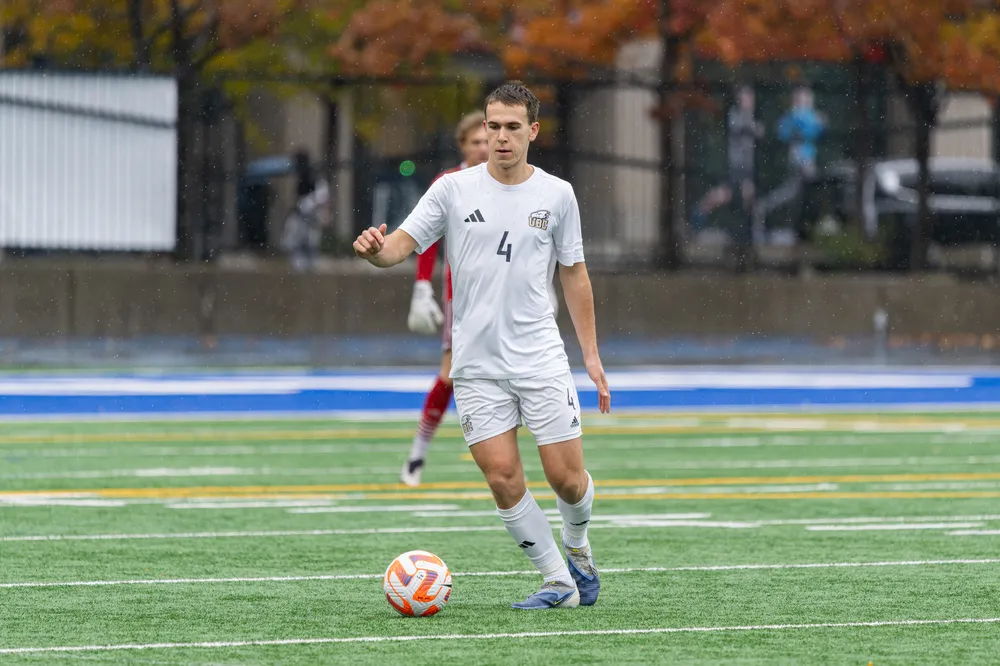
UBC defender Marcus Puhlaj handles the ball. For Puhlaj and UBC’s other senior players, the consolation final against Toronto will be their final game as a Thunderbird. Courtesy Toronto Varsity Blues
The Varsity Blues, similarly to the T-Birds, also endured a shocker in the first round. After an impressive 10–1–1 regular season, Toronto emerged from the Ontario University Athletics (OUA) playoffs as the conference champion, beating York 2–0 to come into the U Sports championship in the best possible position, as the host and the number one seed.
Then, against L’Université du Québec à Trois-Rivières (UQTR), it all collapsed. Despite UQTR being down a man after a 77th minute red card, the Varsity Blues gave up the game-winner in extra time, ending their season on a 3–2 loss. Toronto also had an easy get-right game against an AUS foe in Cape Breton in the consolation semifinals, beating up on the Capers 5–0, setting up a battle for fifth place. It’s an unexpected matchup — both UBC and Toronto had better regular season records than the two teams in the gold medal game, York and Mount Royal — but that makes it an exciting one.
For both teams, the season ended in disappointment with a quarterfinals loss. But by taking down a titan to secure fifth, whomever wins can at least take back some of their pride.
First online Nov. 15, 2025, 11:07 a.m.
Share this article