
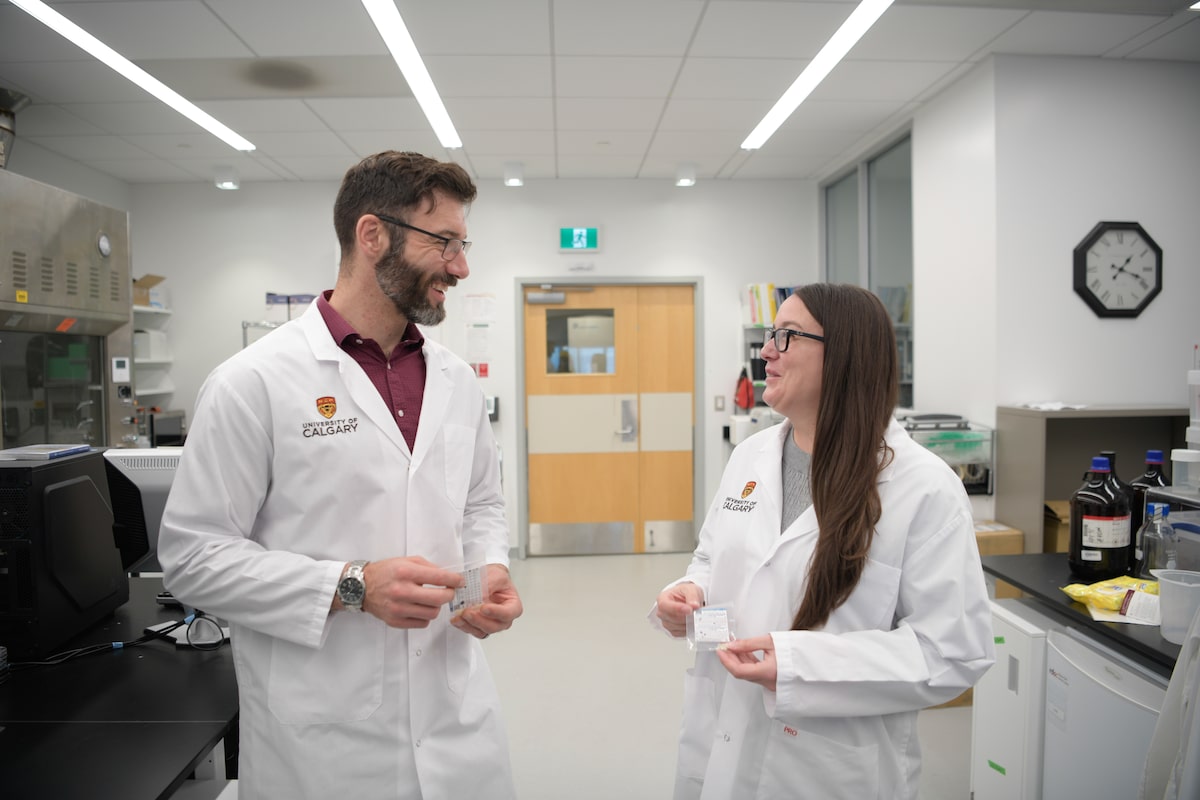
Dr. Dustin Pearson and Dr. Kerri Miller of the University of Calgary’s Cumming School of Medicine are part of a team examining toenail clippings to measure long-term radon exposure and its link to lung cancer.https://secure.tgam.arcpublishing.com/resizer/KHnnZrB7XJnHhNOgB2psx-i0vk0=/arc-anglerfish-tgam-prod-tgam/public/MJIHABG7TVAPBCUKSJ75EY5TQE.JPG/The Globe and Mail
Researchers are asking thousands of Canadians to clip their toenails and store them in small, plastic bags for shipping to a Calgary laboratory.
There, the slivers will be carefully cleaned of any grime before being melted into a chemical soup that is tested for radon.
This radioactive gas is a leading cause of lung cancer but exposure to it is nearly impossible to measure – at least until now.
The research team, including Dr. Dustin Pearson, back left; lead researcher Dr. Aaron Goodarzi, back right; Dr. Kerri Miller, front left; and Dr. Michael Wieser, front right, believe toenails contain crucial data about radon exposure.Sarah B Groot/The Globe and Mail
University of Calgary researchers conducting the study expect to confirm that toenails hold crucial data that can be used as part of an equation to estimate the risk of lung cancer.
“This is, theoretically, going to be magic,” said lead researcher Aaron Goodarzi, a professor of biochemistry at the University of Calgary’s Cumming School of Medicine.
“Most people, when you say those two words, ‘lung cancer,’ they think it’s a killer,” he said. “They’re correct but it doesn’t have to be. That’s the magic this promises, because if we can diagnose it soon enough, we just cut it out and you go on with your life.”
Radon is the leading cause of lung cancer among non-smokers, killing more than 3,000 Canadians each year. Yet, exposure to radon is not part of screening criteria for lung cancer. To qualify for most lung cancer screenings, you must meet certain age requirements, between 50 and 75, and have a moderate to heavy history of smoking.
An estimated one in five Canadian homes have dangerous levels of radon but many people are unaware that they are breathing in the odourless, colourless gas that seeps into dwellings through openings in the foundation. After inhalation, radon decays into a radioactive lead, or lead 210, that settles in the lungs.
A 39-person pilot study, which Dr. Goodarzi and his team completed last year, found higher exposure to radon corresponds to higher levels of lead 210 in toenails.
Dr. Goodarzi also noted that the study would not have been successful if they had not also considered each participants’ activity patterns – how much time is spent at home, at work and in other settings. These details are crucial to an accurate exposure calculation.
Think of the growth in toenails, he said, like the rings of a tree, providing a history of a person’s exposure to toxins. The base of the nail is the youngest ring, while the tip is oldest. Clippings, the pilot study showed, contain up to a 15-year archive of radioactive lead.
Now comes the much larger validation trial expected to conclude in 2028 and funded by the Canadian Cancer Society. This study will determine if the results seen on 39 people remain true for a sample size of up to 10,000.
The research team hopes its data can provide evidence to expand screening eligibility, especially for those with little to no history of smoking.
Toenails act the the rings of a tree and can provide a history of a person’s exposure to toxins.Sarah B Groot/The Globe and Mail
Squeamishly, you might be asking, why toenails?
Well, fingernails grow too fast and are exposed to too much. It’s also harder and unrealistic to get people to donate other bodily matter, such as skin, blood and bone.
Besides, those items are more difficult to collect and store. The toenails, though, will be filed away in a cabinet.
This is where co-researcher Dustin Pearson takes centre stage. He’s the point person for people interested in or committed to donating their nails, answering any number of wacky, unexpected or standard questions about the process.
Some of the questions he’s received: I was just diagnosed with a fungal infection and now I have to treat it, can I still participate? (No.) Will filings of my toenails work? (Also, no.) I’ve collected 20 years worth of my toenails in pill bottles and I was wondering if you could make use of them?
Dr. Pearson did send that last question to his colleagues. If the 20-year collection had been dated alongside radon readings, it might have been the “perfect sample,” he said, but those details weren’t available. The research team had two inquiries of this nature.
So far, about 5,000 people have signed on to the study and have been sent kits that include a radon detector for their home, four toenail collection bags, a return envelope and instructions.
The directions are pretty simple. People are reminded to shower – yes, really – and to continue their regular grooming schedule. Nail polish must be removed at least two weeks before the first collection.
Each month’s nail bounty is then to be stored and dated in one of the baggies, which will eventually make its way to the $4-million Calgary laboratory at the Heritage Medical Research Building, built specifically for this type of cutting-edge research.
Gabriella Gelinas, a PhD student, adds acid to toenail samples in the Metal Free Clean Laboratory. Toenail prep takes place in a room that minimizes the chance of exposing the clippings to other lead.Sarah B Groot/The Globe and Mail
This is also where you’ll find co-principal investigator Michael Wieser, a physics professor at the University of Calgary.
He explained that toenail prep takes place in what he calls “Magneto’s prison,” a metal-free room that minimizes the chance of exposing the toenails to other lead.
The “fun part” comes after the samples are gently cleaned with organic solvents, said Dr. Wieser. All of the toenail clippings from a single participant are combined in a Teflon vessel with a cocktail of nitric acid and hydrogen peroxide before being zapped in a fancy microwave.
Out comes a small vial of pale yellow goop, which is moved through a drive-through-like window to another room. Here, the sample is placed in a mass spectrometer that separates the lead so it can be analyzed for lead 210.
And there you have it: toenail data.
This research could also serve as the blueprint to test for exposure to other dangerous substances, said Dr. Goodarzi, such as arsenic and wildfire smoke. There’s no money to do that work yet but his team is hopeful that they’ll be able to leverage what’s already being done.
“It all ends up in the toenails,” he said.