
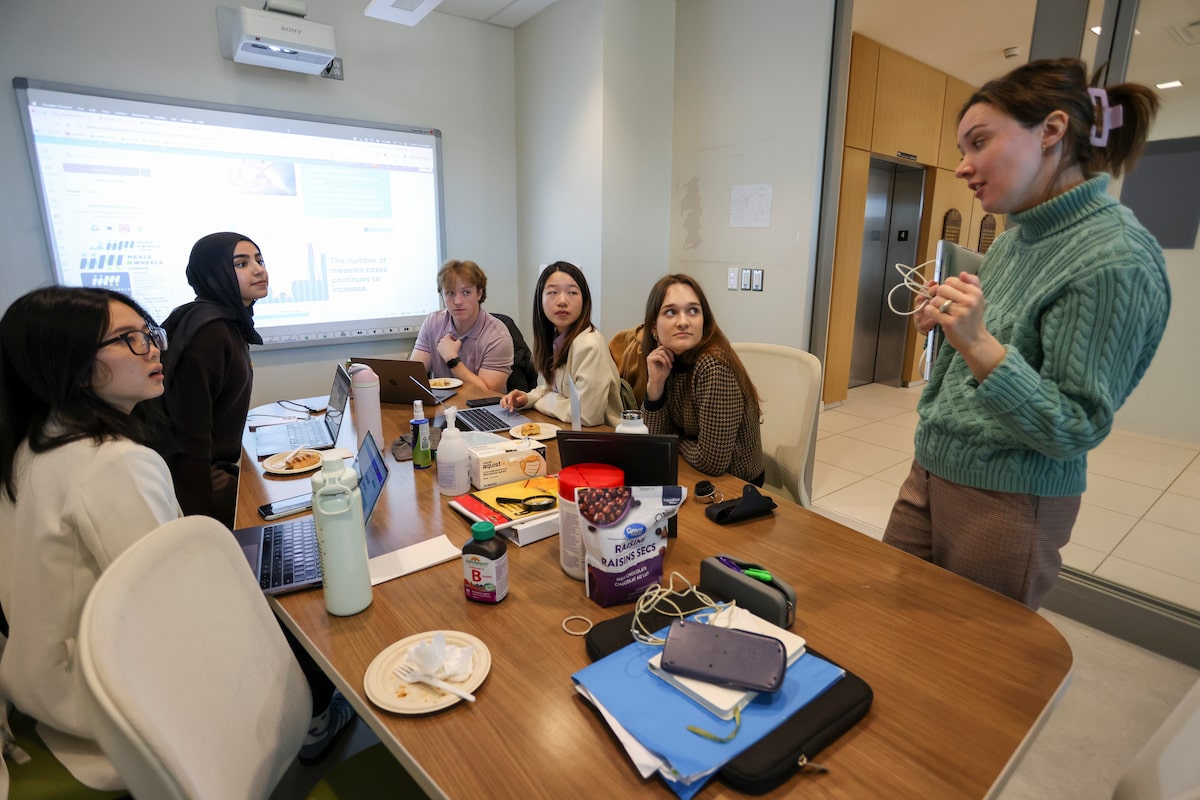
Doctoral candidate Emily Dawson assists students during a measles outbreak simulation workshop at Western University in London, Ont., on Thursday.Photography by Nicole Osborne/The Globe and Mail
In a classroom at Western University on Thursday, 58 masters of public health students were being trained as measles outbreak detectives.
This was not just a theoretical scenario.
Three days earlier, Canada lost its measles elimination status after failing to curb an outbreak that started in October, 2024. The country had been free of endemic measles for nearly three decades prior.
The interactive workshop was led by Ava John-Baptiste, an associate professor at Western’s Schulich School of Medicine and Dentistry and member of the Ontario Immunization Advisory Committee. She said it’s important her students learn how to operate in the context of real-world scenarios.
The measles workshop was led by associate professor Ava John-Baptiste. She says it’s important her students learn how to operate in the context of real-world scenarios.
“In this day and age, one of our responsibilities as faculty members and as instructors is to teach our students how to continually learn, because the landscape is continuously changing,” Dr. John-Baptiste said in an interview.
Canada’s outbreak has surpassed 5,100 cases, concentrated in Ontario and Alberta, and led to the deaths of two premature babies. Ontario managed to quell its provincial outbreak last month but scattered cases continue to crop up in Alberta and other provinces, such as British Columbia, Manitoba and Saskatchewan.
On Thursday morning, students in the year-long Master of Public Health program at the London, Ont., university were asked to dress professionally. They filed into assigned seats that formed a U-shape wearing collared shirts, dress pants and blazers. Each seat had a double-sided name plate, part of the classroom design to facilitate discussion.
Explainer: Canada has lost its measles elimination status. Here’s what you need to know
The day-long simulation began with Dr. John-Baptiste setting the scene.
In October, 2024, some Ontario residents travelled to a wedding in New Brunswick where they were exposed to a travel-related case of measles. Those attendees then brought the highly infectious virus back home, where it jumped from person to person, igniting a nearly year-long provincial outbreak.
“This origin story of the measles outbreak is true,” she told her students. “Today, we’re simulating the outbreak using synthetic data, but that data approximates very closely to the actual measles outbreak that we’ve experienced in Southwestern Ontario.”
This part of the province was the epicentre of Ontario’s outbreak. The virus concentrated in close-knit Mennonite communities where vaccine hesitancy is prevalent.
The class was divided up into teams and each group was assigned to a Southern Ontario public-health unit.
Students were then broken up into small groups, each of which was assigned to a Southern Ontario public-health unit and given a trove of measles data. It included such characteristics as the age, vaccination status and gender of cases, in addition to hospitalizations and whether cases were probable or confirmed.
Each team was asked to analyze the data and deliver a mock presentation to Public Health Ontario.
Emma Cornell, 22, was assigned Wellington-Dufferin-Guelph. Her group came to the same conclusion as working public-health professionals have: undervaccination is a serious concern.
Master of public health student Emma Cornell.
“Almost all of the cases that we were seeing hospitalized were those who either had only one dose or no dose,” Ms. Cornell said.
She said her class was looking into other diseases at the start of the semester that were more theoretical than practical in the Canadian context, such as the Ebola outbreak in West Africa.
“It feels more real for us, here in Canada, to be working with this measles outbreak case, because it is actually currently a major issue for us in this province and the country as a whole,” she said.
The group presentations all touched on insufficient uptake of the measles, mumps and rubella, or MMR, vaccine as a lightning rod for measles spread, an issue that laid the foundation for their second exercise.
The Editorial Board: The return of measles requires an outbreak of persistence
Dr. John-Baptiste, again, delivered a prologue.
The outbreak in Southwestern Ontario has been declared over, but the threat of future outbreaks remains. “One of the greatest challenges facing public-health practitioners now is vaccine hesitancy,” she said.
Each group was assigned one of two tasks aimed at investigating and confronting the issue. Students either had to conduct a rapid review proposal, a plan to quickly gather and summarize existing evidence on a topic, or prepare a survey proposal to discern the reasons for vaccine hesitancy.
Each group in the class was asked to analyze the measles data from their public-health unit and deliver a mock presentation to Public Health Ontario.
Inside David Daudu’s team room, time seemed to pass quickly as the group rushed to submit their PowerPoint presentation in time. One group member put her head in her hands while the student sitting next to her gestured a prayer.
During their presentation, however, the stress did not show as Mr. Daudu, 24, and his classmate, Abby Springham, presented a rapid review proposal aimed at understanding vaccine hesitancy in rural communities.
“Individuals that lived in rural or underserved areas were more likely to be hesitant,” he explained to his peers. “Over all, hesitancy is shaped by a mix of personal risk perceptions, social context and trust.”
Master of public health student David Daudu.
Other presentations focused on reducing hesitancy among parents of young children and religious communities, both of which are key demographics being targeted in real life for vaccination by public-health professionals.
After class finished, Mr. Daudu, in an interview, said the class works well under stress, noting that collaboration mimics the relationship between public-health professionals and other allied health care workers.
For him, Thursday’s exercise was a “full-circle moment,” after witnessing the impact of the measles outbreak while doing research at the London Health Sciences Centre this summer and now studying it through the lens of public health.
“The thing is, we have to be on our toes, like what’s next?”
Dr. John-Baptiste, who will grade the students pass or fail, said there are two more workshops planned for the students, but wants to keep the topics a secret.
“Our goal is definitely skill development, to ensure they’re prepared to adapt to any public-health challenge,” she said. “It’s an uncertain public-health future.”