

Listen to this article
Estimated 5 minutes
The audio version of this article is generated by text-to-speech, a technology based on artificial intelligence.
LISTEN | November 15, 2025 episode of Quirks & Quarks:
Quirks and Quarks54:00Making snake bites less deadly, and more…
On this week’s episode of Quirks & Quarks with Bob McDonald:
A powerful explosion from another star could blast away nearby planetary atmospheres LISTEN | Joe Callingham describes a stellar explosion:
Quirks and Quarks8:12A powerful explosion from another star could blast away nearby planetary atmospheres
For the first time, scientists have spotted a stellar explosion coming from another star that’s powerful enough to strip away the atmospheres of any planets in its orbit. Radio astronomers spent years pouring through petabytes — a million gigabytes — of data to find it. This discovery may be bad news for our hunt for interplanetary life, as events like these could create barren rocks of the planets in their path. Joe Callingham, from the Netherlands Institute for Radio Astronomy and the University of Amsterdam, reported the cosmic-needle-in-a-haystack find in Nature.
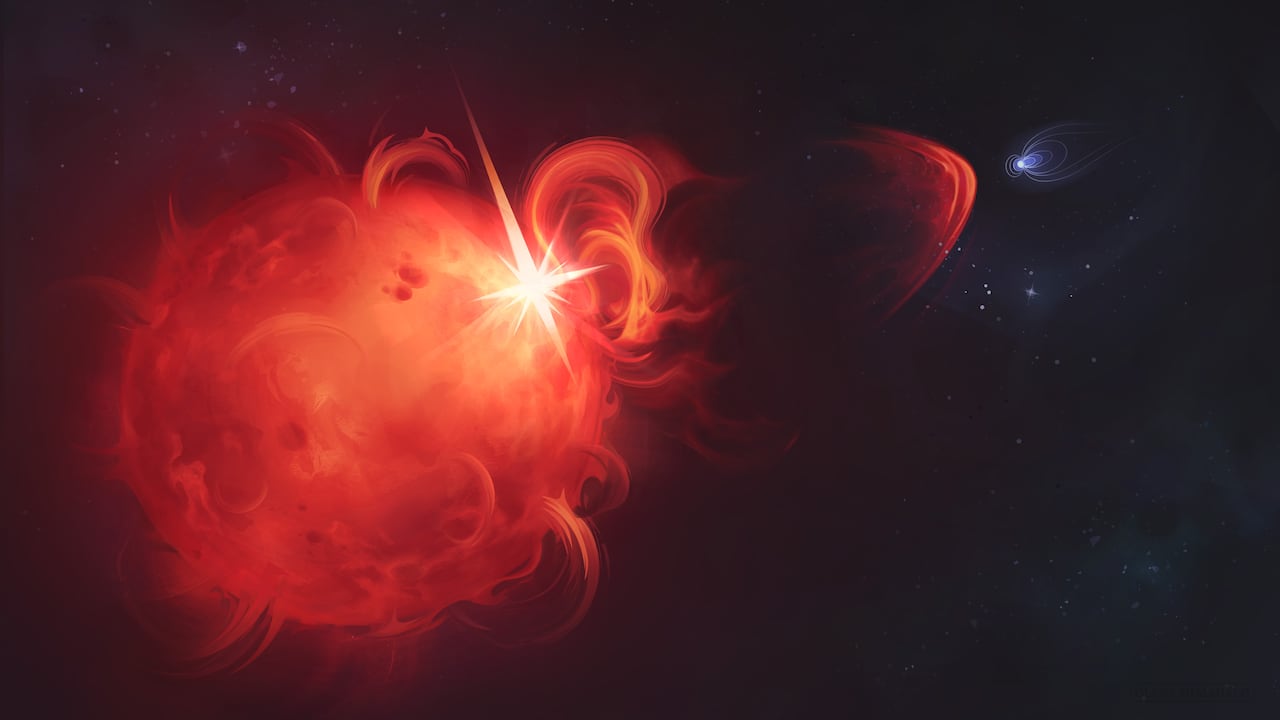 An artists’ drawing of a coronal mass ejection around a nearby star. (Olena Shmahalo/Callingham et al.)We’re the frog in the pot of boiling water — when it comes to climate change LISTEN | Rachit Dubey explains why people feel apathetic towards climate change:
Quirks and Quarks8:37We’re the frog in the pot of boiling water—when it comes to climate change
The calls to ramp up our efforts to reduce global warming are taking on a sense of urgency, most recently at COP30 in Brazil. But despite the intensifying natural disasters we’ve been seeing due to climate change, many people seem to be tuning out the climate crisis. A computational cognitive scientist who had to evacuate during the L.A. wildfires studied the “proverbial frog in a pot of boiling water” effect says we may be able to break through that apathy by presenting stark contrasts instead of highlighting the gradual change. Rachit Dubey, from the University of California, Los Angeles, published his study in the journal Nature Human Behaviour.
 A huge globe representing the earth hangs at the COP30 UN Climate Change Conference premises in Belem, Para State, Brazil on November 10, 2025. (MAURO PIMENTEL/AFP/Getty Images)Arctic fox play an important role in Canada’s northern food web LISTEN | Sean Johnson-Bice describes how central the arctic fox is to the food web on the tundra:
Quirks and Quarks7:50Arctic foxes play an important role in Canada’s northern food web
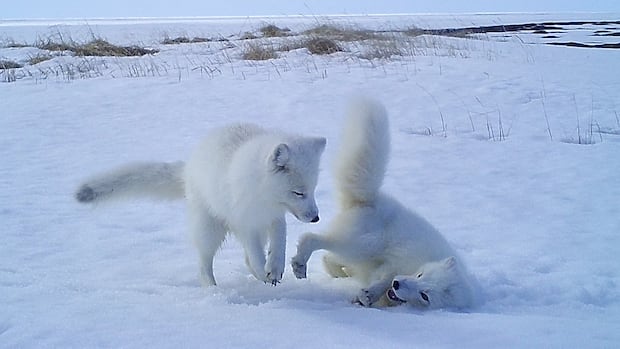
The arctic fox is considered the polar bear’s best friend because of its critical role in linking the tundra and sea ice food webs. In the winter, the arctic fox hunts baby ring seals and scavenges the carrion left behind by the bears. In the spring it moves to the tundra where it hunts rodents such as lemmings and moles, even geese. But our warming climate threatens to unravel this food chain, with far reaching consequences for animals of the North. Working on the coast of Hudson Bay out of Churchill, Manitoba, Sean Johnson-Bice, from the University of Minnesota, led this research that was published in the journal Ecology.
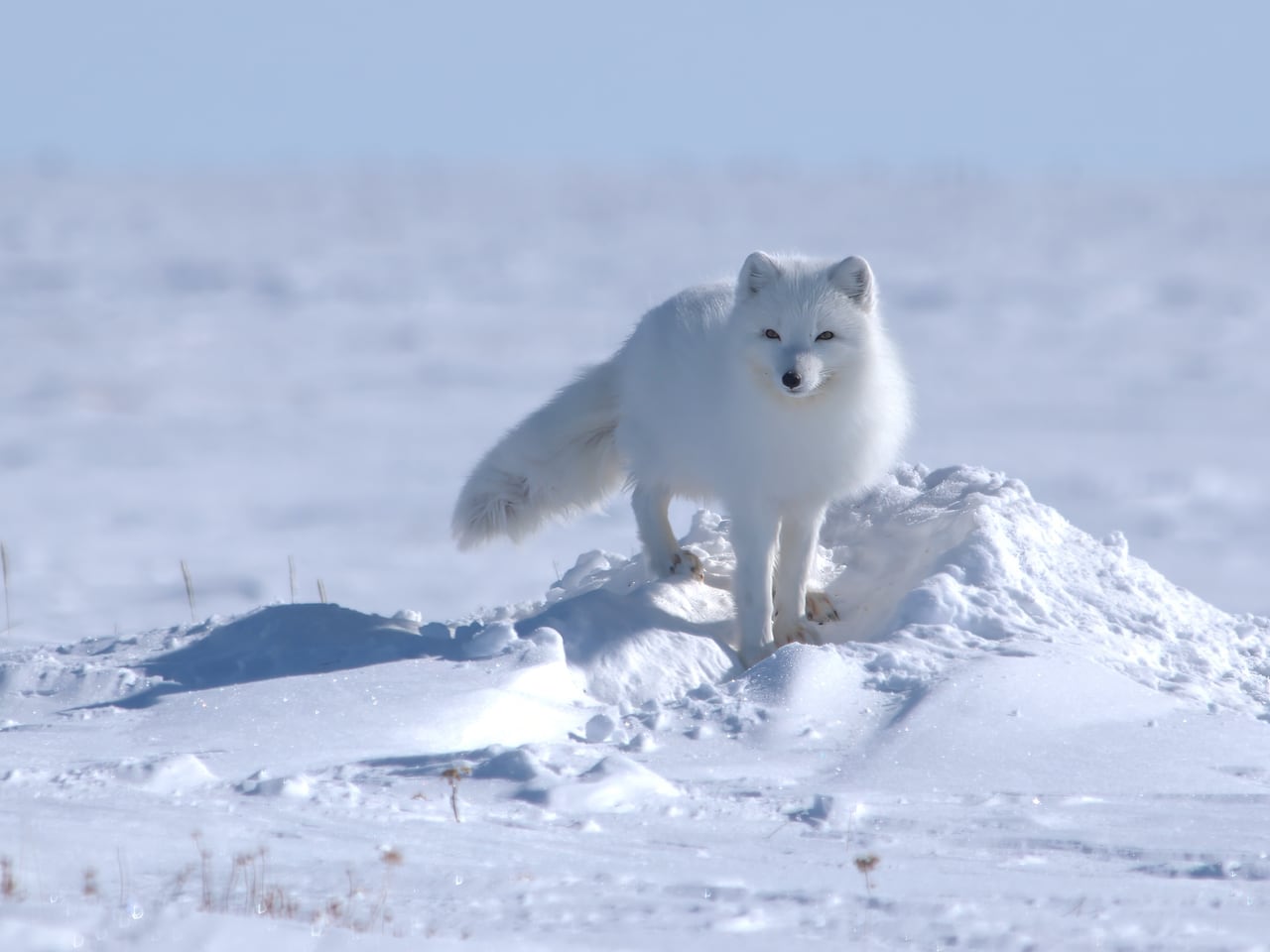 An arctic fox in Churchill, Manitoba (Audrey Moizan)We finally know why golf balls ‘lip out’ of the hole LISTEN | John Hogan explains the physics behind the golfer’s curse:
Quirks and Quarks8:59We finally know why golf balls ‘lip out’ of the hole
A “lip out” is when a golfer putts the ball towards the hole, except instead of going in, it skims around the edge, before popping out and continuing along its way. It’s long been called golf’s greatest mystery because there seemed to be no rhyme or reason as to why it happened. Now, mathematicians have figured out the mechanics and physics behind the golfer’s curse. John Hogan, a mathematician from the University of Bristol, says ultimately it comes down to the speed, spin, and line of the ball. The research was published in the journal Royal Society Open Science.
 Wyndham Clark of the United States reacts after missing a putt at The Players Championship at TPC Sawgrass on March 17, 2024 in Ponte Vedra Beach, Florida. ( Kevin C. Cox/Getty Images)Snake bites are a deadly problem. Meet the researchers trying to solve itLISTEN | Alistair Evans and Nick Burlet share how they are studying venomous snake bites:
Quirks and Quarks17:32Snake bites are a deadly problem. Meet the researchers trying to solve it.
Globally, snake bites kill 140,000 people each year, but even for those who survive, the venom can lead to paralysis, blood disorders, tissue damage, and irreversible kidney damage.
Australian researchers are using high speed cameras to figure out how different snakes launch their attacks. The team, including evolutionary biologist Alistair Evans from Monash University, filmed 36 species of venomous snakes striking ballistic gel at 1,000 frames per second. They discovered that strategies differ wildly, with vipers able to move their fangs independently to find the perfect spot, while elapids — which includes cobras and mambas — can bite repeatedly in a matter of seconds, and colubrids saw their heads back and forth to break more of the skin. Their research was published in the Journal of Experimental Biology.
In Denmark, Nick Burlet — from the Technical University of Denmark — and his colleaguesare working to develop a new nanobody-based broad-based antivenom that would be more shelf stable and would be half the cost of current antivenoms. Preliminary tests in mice have been shown this cocktail can neutralize the venoms of 17 of the most dangerous snakes. The research was published in the journal Nature.
WATCH | Video of a blunt-nosed viper bite: