
Rebecca BrahdeIsle of Man
 MNH
MNH

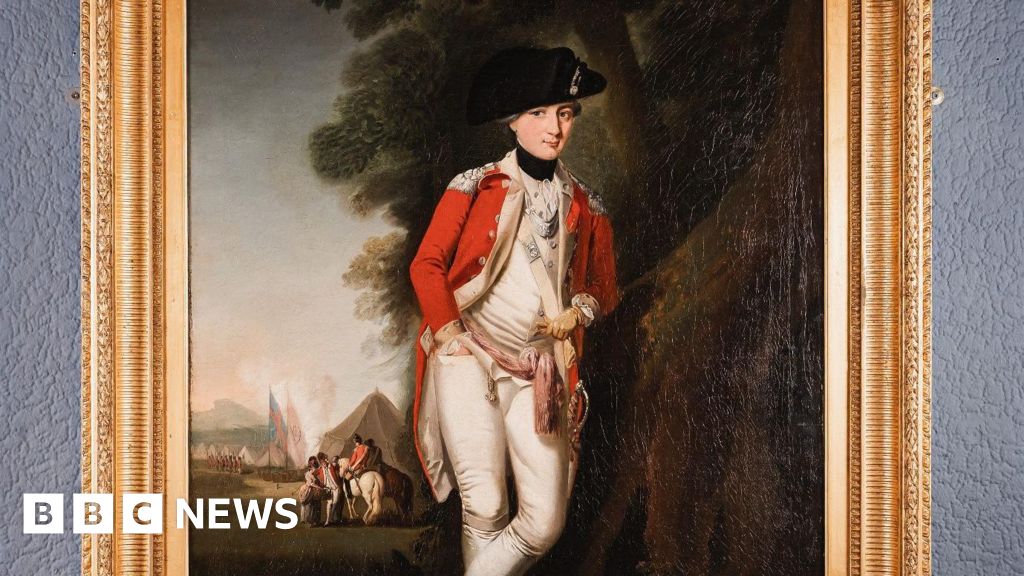
Manx National History has acquired a nearly 250-year-old oil painting of Paul Crebbin, who rose to the rank of major in the marines
An 18th Century oil painting of a Manx marine is “indicative of a much wider tradition of seafaring” on the Isle of Man, a historian has said.
The piece, painted by Arthur Davis in about 1780, is a new addition to the island’s national collection after being held by the same family for more than 200 years.
The work depicts Major Paul Crebbin, believed to be 17 at the time to mark his entry into the marine corps, which later became the Royal Marines.
Matthew Richardson, art and social history curator at Manx National Heritage, said the painting “tells us a great deal of how young men of this era were making their way through the world”.
Who was Major Paul Crebbin?
The son of a clergyman, Paul Crebbin was from Santon on the island.
“He came from quite a humble background,” said Mr Richardson, “but through his own merit, his own achievements, his own bravery, he rose quite high to the rank of major”.
Major Crebbin served in the American War of Independence and the Napoleonic Wars.
Mr Richardson explained that, “having fought through all these battles at sea when his life was in danger, he was returning home by ship in 1819 to see his family [when it) sank in a storm and he drowned”.
Why was his portrait painted?
The oil painting would have marked Major Crebbin’s entry into the marines.
It would also have been commissioned as a reminder for his family, who would likely not have seen him for a long time.
While portraits like this were “probably pretty common” at the time, Mr Richardson said “only a handful have come to us today over the ravages of time as they get lost or destroyed”.
The Royal Marines Museum described Major Crebbin’s portrait as “extremely rare”.
One of his letters has also survived, in which he describes some of his experiences.
 MNH
MNH
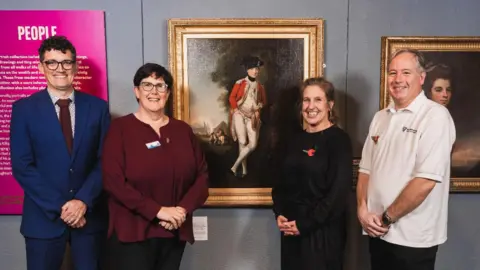
Dan Walker on behalf of Major Crebbin’s family, Sara Kelly of Manx Lottery Trust, Kirsty Neate Head of Collections for Manx National Heritage and Matthew Richardson Curator of Art and Social History.
What does it tell us about Manx history?
Mr Richardson said the painting was important because not only does it “document one man’s career path, but he is indicative of a much wider tradition of seafaring in this era among Manx people”.
It was a period when the Royal Navy was rapidly expanding during the American War of Independence, he said.
Mr Richardson explained that traditionally strong seafaring Manx people had previously been taken against their will into the Royal Navy.
However, during Major Crebbin’s time there was a “change in outlook where young men would see it as a career,” he said.
“If you took part in an enemy capture, that ship would become a prize of war [and] would be worth a lot of money, and you would be given a share of that.
“It was a dramatic time in history where the groundwork of the modern world is being established,” said Mr Richardson, adding: “The Isle of Man played a crucial part in that.”
Newspapers from the time indicated that every vessel in the Royal Navy had a Manxman on board, he said.
Where can I see the painting?
The painting has been cleaned and retouched, restoring it to its original glory, with the conservation funded by the Manx Lottery Trust.
The portrait is now on display in the Temporary Exhibition Gallery at the Manx Museum.
In the spring, it will be shown in the Mann at War Gallery, which also includes uniforms from the battles of Trafalgar and Waterloo.
“It is a powerful and inspiring addition to the national collection, not only capturing the image of a young Manxman at the start of a distinguished military career, but also connecting us to history through his own words,” Mr Richardson said.