
Breadcrumb Trail Links
If mergers are approved, Stratford and Perth County would be part of the Lake Erie Regional Conservation Authority.
Published Nov 17, 2025 • 3 minute read
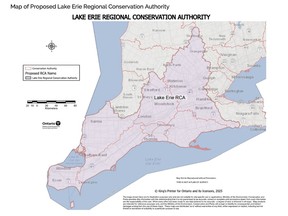 The boundaries of the proposed Lake Erie Regional Conservation Authority (Government of Ontario). jpg, SF, apsmcArticle content
As the provincial government continues to take steps to make significant changes to Ontario’s conservation authorities, a local environmental activist is sounding the alarm that a loss of local autonomy could lead to a reduced responsiveness to unique environmental conditions and “a downgrading of local knowledge.”
Advertisement 2
This advertisement has not loaded yet, but your article continues below.
Article content
“It could be something as simple as a blocked waterway, as we saw last summer, when unusual weather caused (Lake Victoria) to empty, threatening our local tourism industry. We will be seeing more unusual weather. Climate change will see to that,” said Sharon Collingwood, a member of the Perth County Sustainability Hub.
Article content
Recommended Videos
Article content
The Upper Thames River Conservation Authority “has protected us in the past,” said Collingwood, pointing to the 2002 July that flooded hundreds of homes, leading to a $7.7-million settlement between the city and 800 homeowners.
“(That) flood would have been much worse if it hadn’t been for (the conservation authority’s) upstream flood control infrastructure,” Collingwood noted.
On Oct. 31, Environment Minister Todd McCarthy announced the Ford government would soon introduce legislation to create the Ontario Provincial Conservation Agency and consolidate the province’s 36 conservation authorities into just seven watershed-based authorities. Creating this agency will “provide centralized leadership, efficient governance, strategic direction and oversight of all conservation authorities,” the announcement stated, while freeing up resources for front-line conservation.
Advertisement 3
This advertisement has not loaded yet, but your article continues below.
Article content
One of the agency’s top priorities will be to create a single digital permitting platform to make the process to apply for a conservation authority permit the same across the province, McCarthy added.
The provincial government also claims these changes will help get shovels in the ground faster on new home builds and other local infrastructure projects.
According to McCarthy, 130 municipalities are currently under the boundaries of two or more conservation authorities.That proposal would lower this figure to 48. Standardization, however, is not our friend, Collingwood said.
“Local knowledge is what’s needed. We’ve got to start seeing the connection between ‘natural’ disasters and economic decisions. Prioritizing economic goals over environmental security is penny wise and pound foolish,” she said.
Advertisement 4
This advertisement has not loaded yet, but your article continues below.
Article content
Last week, the province released a map of the potential new conservation authorities, with Stratford, St. Marys and the four lower Perth County tiers located in the Lake Erie Regional Conservation Authority. This regional authority, as proposed, stretches from Windsor and Essex County in the west to the edge of Hamilton in the east and as far north as Shelburne.
In a statement on the day of the announcement, the Upper Thames River Conservation Authority officials noted that, historically, conservation authority boundaries have been based on watersheds, where water naturally flows, rather than municipal borders. Authority officials, however, also said they were “committed to working with the Government of Ontario to modernize and streamline services and appreciates the opportunity to be engaged during the provincial consultation.”
Advertisement 5
This advertisement has not loaded yet, but your article continues below.
Article content
The province has also committed to maintaining staffing levels, the local statement noted. However, another local environmental activist, Bill James-Abra, co-founder of Climate Momentum, questioned who these planned changes serve and who they are for.
“You have to suspect that this is about serving developers, and not developers who are building mixed-residential affordable housing that’s within existing city limits, but suburbs that pave over farmland, destroy wetlands and compromise watersheds,” James-Abra said.
“The government talks about making the permitting process more efficient, but that just begs the question — efficient for who and so they can do what?”
Collingwood agreed with that sentiment, saying Ontario residents have heard this kind of talk before from the province.
Advertisement 6
This advertisement has not loaded yet, but your article continues below.
Article content
“Remember Walkerton?” she said, pointing to that community’s 2000 water-quality crisis that killed seven people.
James-Abra also questioned the timing of the announcement, given that it was made on the day of Halloween while a Toronto Blue Jays World Series game was also scheduled that night.
“If the government wanted the public to take notice of these changes, they’d have announced them on a weekday morning at a public event, with a crowd of smiling conservation staff standing behind the minister at some podium, but that’s not what they did,” he said.
During the morning press conference that announced the planned mergers, McCarthy was only joined by Hassaan Basit, who was appointed as Ontario’s first chief conservation executive earlier this year.
The proposed changes are set to be implemented in late 2026 and into 2027.
The ministry is now collecting feedback on the conservation authority consolidation, and the new proposed boundaries, until Dec. 22. Feedback can be submitted at ero.ontario.ca, or by emailing the public input co-ordinator at ca.office@ontario.ca.
Feedback can also be submitted by mail to the ministry’s Conservation and Source Protection Branch.
Article content
Share this article in your social network