

Listen to this article
Estimated 3 minutes
The audio version of this article is generated by text-to-speech, a technology based on artificial intelligence.
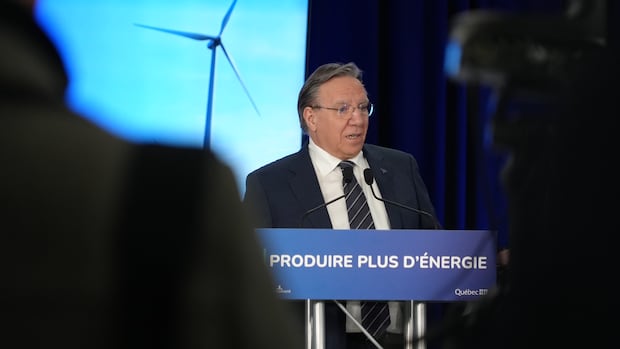
The Quebec government announced it is continuing the expansion of the province’s wind energy sector and investing up to $4.5 billion in a wind power project in the Lower St. Lawrence region.
The project, dubbed Wetsok, meaning “in the direction of the wind” in the Wolastoqey language, will see wind turbines built between the Montmagny regional municipality and Témiscouata, Que.
Making the announcement in Cacouna, Que., on Tuesday, Premier François Legault says the project is a collaboration between Hydro-Québec and the Alliance de l’énergie Est — 209 communities and territories, including Wolastoqiyik Wahsipekuk First Nation.
Grand Chief Jacques Tremblay of the Wolastoqiyik Wahsipekuk First Nation says this is an opportunity for his nation to be treated as an equal partner in the energy sector and to ensure the economic benefits are directly felt by its members.
This partnership is part of the strategy of the government and Hydro-Québec to develop more than 10,000 megawatts of new wind power capacity in collaboration with First Nations and the municipalities.
Legault says among other projects, this one will help diversify the revenue of communities and municipalities and create jobs, which he claims will help those currently facing layoffs in the region as a result of U.S. tariffs, especially in forestry.
Earlier this month, Legault cited the forest industry’s 60,000 jobs as examples of positions that are at risk due to punishing 45 per cent tariffs.
While wind turbine projects are bound to bring economic benefits regionally, Francis Albert, general manager of Groupement forestier de Témiscouata, says there’s no “direct link” to the employment of forestry workers.
“These are sustainable development and green energy projects. So that’s very good. We are happy that this money is being invested in our territories,” he added.
Pascal Paradis, Parti Québécois energy critic, says positioning the project as an opportunity to fill some of the jobs lost in the forestry sector is not the right approach.
“Admitting that our forest industry is in disarray and that there’s nothing to do about it is not the way forward,” he said.
“We’ve been saying that forests are a strong part of our economy and we need the reform of the forest regime and we need to be defending our own interests at the international level.”
Moving forward, he says he will be hoping to see Quebec-made materials used in the project. The project will undergo social acceptability studies and consultations will be held with local partners to better identify the realities of the area, according to the government.