
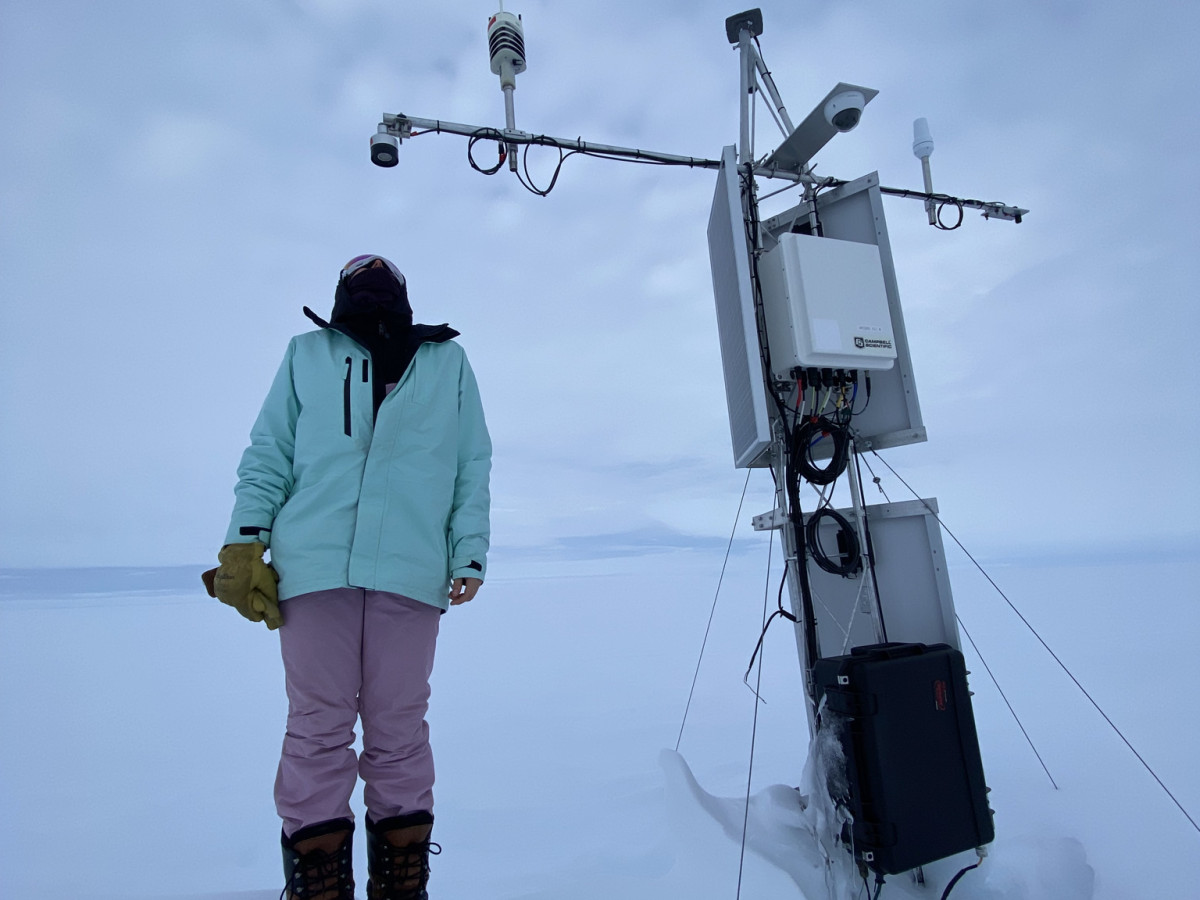
So far, we’ve heard about this year’s COP30 summit and the current trajectory of climate change gas emissions reaching a new record in 2025 – 38.1 billion tonnes of CO2. But what does that translate into on the ground through the eyes of the scientists who study the impact of global warming? Michelle Maclennan is a climate scientist with the British Antarctic Survey…
Michelle – It’s hard to learn about Antarctica. It’s a very remote environment. It’s difficult to reach in person, so we use products like satellites. Those can tell us about clouds, how warm conditions are, and how wavy the ocean is around Antarctica. Just like in the UK, there are weather stations in Antarctica that record information on temperature, air pressure, winds, and snow. We also use computer models, and that way we can get a sense of the big-picture patterns that are happening.
Chris – How far back into the past does the data go, and therefore how far back can you look in order to inform the future?
Michelle – A lot of information about the past climate, up to thousands or even millions of years ago, is stored in the ice in Antarctica. What happens over time is that snowfall falls on the surface of the ice and then compacts into ice, and that also stores some small air bubbles. Those air bubbles can tell us about the past climate of the Earth for many thousands of years. The work that I specialise in really started in 1979 with the beginning of the satellite era, that’s because I look at very short-term weather patterns on the scale of a week or a few days. Having satellites that give us information about conditions in Antarctica was essential for that work to develop.
Chris – And how are things changing? Because we’ve just had this enormous hurricane in the Caribbean, and many in the climate community are saying this is probably a product of global warming – higher sea surface temperatures, and more energy in the water means more energy in the air, which means more energy in the storm. Is Antarctica falling victim in the same way?
Michelle – Yes, all of those types of extreme weather events also occur in Antarctica, and we have found that just like in the rest of the world, climate change has made those types of events far more likely to occur. This is important because it shows us that climate change isn’t just having impacts on long-term increases in temperature or sea-level rise – it’s having very dramatic short-term impacts.
Chris – Are there knock-on effects from this? As in, Antarctica does lock away a lot of water. It also has interesting things to do with atmospheric chemistry. There’s a reason the ozone hole has formed over Antarctica, for example. It’s important from a biology and wildlife perspective, but if you get this extreme departure in climate conditions, what are the knock-on consequences for people who don’t visit or live anywhere near there?
Michelle – That’s a great question. Antarctica has memory in it. When an extreme weather event that comes and impacts the ice – for example bringing a lot of heat and causing surface melting – the system remembers that. So the next time a weather event that comes, if there has already been significant melting, the next one is likely to cause much more extensive surface melting. We should all care because sea-level rise is a global issue. It impacts all of us. I live in a very low-lying area of the UK, which will be particularly affected in the centuries to come, and millions of people across the world will be too. At the same time, these impacts don’t only relate to sea-level rise. They also cause global changes to things like atmospheric circulation and weather patterns. We’ve seen changing patterns of animal migrations that are impacted by processes happening in Antarctica, and we’ve also seen changes to ocean circulation, again controlled by processes that are happening in Antarctica.
Chris – On the ground in Antarctica, what is happening, and what do you expect to happen based on the trend you’re seeing in your data? What do you expect the next 10 to 20 years to hold?
Michelle – The data tell us that in the last few years we’ve seen a surge in extreme weather events in Antarctica. We’ve had record-breaking heatwaves and very intense storms that bring snowfall and rainfall with them, or cause stormy ocean conditions leading to storm surges and ice breaking up at the coast. We’ve seen all these events in action, especially in the last few years. Waves can cause ice shelves – the ice at the coast – to completely break apart in a few days. We’ve also seen far more frequent heatwaves in many regions of the continent, causing giant lakes or ponds of meltwater at the surface. They look like lakes you’d see anywhere else in the world, except they’re sitting on ice and they cause so much pressure on it underneath. We know that all these effects will have long-term consequences for sea-level rise.
Chris – Has it ever happened before? If we use that ice clock you mentioned earlier, which captures Earth’s past climate, and interrogate the memory of Antarctica, has it been through phases like this before, or is this a new departure?
Michelle – There have been warmer periods and colder periods, and the data show that. The difference with today’s climate is that we’ve seen far more rapid changes in the last 40 years than ever before, and it’s the speed of those changes that makes the future so unpredictable.
Chris – If we’ve made it happen this quickly, do you think it’s possible it will be reversible on the same sort of time scale, if we fix the cause that we believe is down to us?
Michelle – What scientists have shown from looking at sea-level rise and the glaciers in Antarctica, and how they’re changing, is that there is a lot of momentum in the system. So the changes that we’ve caused at this point, even if we stopped emissions today, would likely still continue to drive massive sea-level rise in the future. I do think, though, that any difference we can make now through climate action or emissions reduction would certainly help to give us more time to mitigate and adapt to climate change, which is extremely important for everyone in the world.