
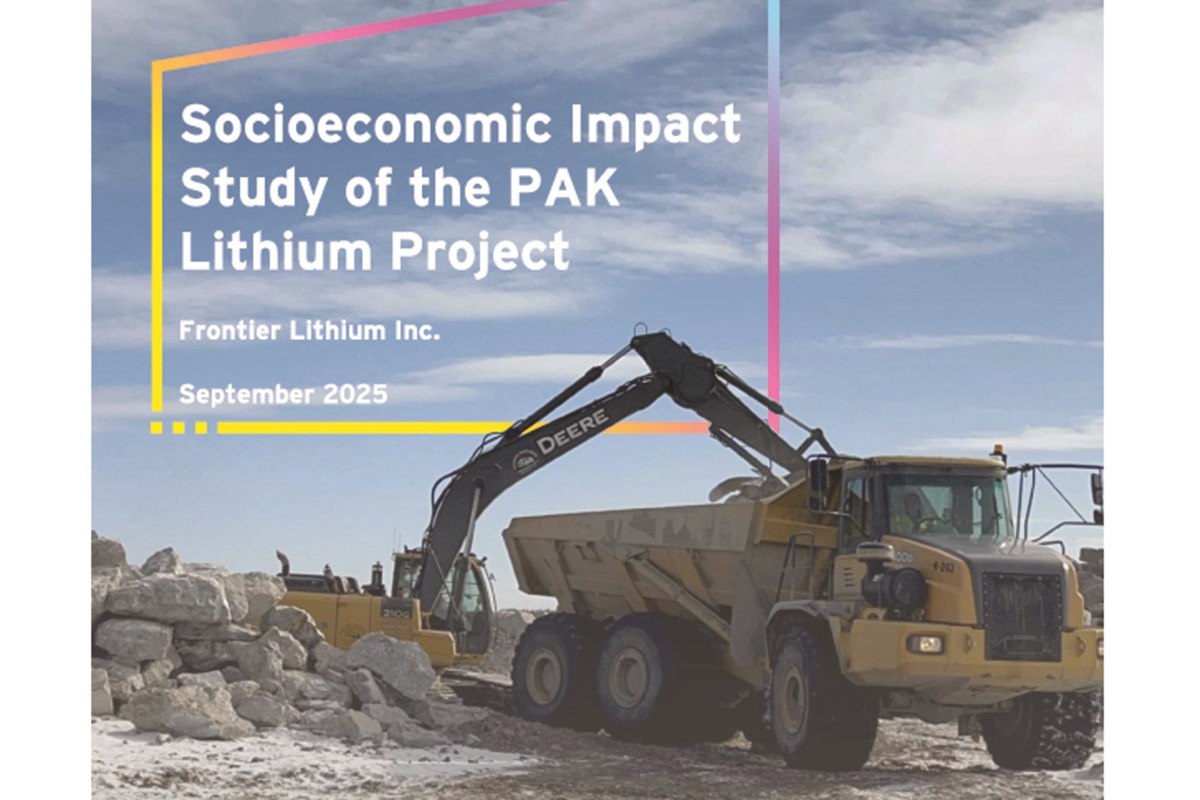
New study measuring the economic benefits of Sudbury company Frontier Lithium Inc.’s mining and processing project north of Red Lake finds it will boost Canada’s GDP by nearly $1B during construction and a nearly $100M GDP boost every year of its 30-year lifespan
A third-party study on the PAK Lithium Project shows there will be “significant economic and labour impacts” from the development of a new lithium mining and processing facility in Northwestern Ontario, said a news release from the Sudbury based Frontier Lithium Inc.
The PAK Lithium Project, located north of Red Lake, is the first company in Ontario to be accelerated as part of Ontario’s new One Project, One Process (1P1P) framework.
The 1P1P process is the new buzzword in Ontario mining as the provincial government is promising to speed up the process of approval for new mining projects in Ontario.
The new study was conducted by Ernst & Young LLP (EY) for Frontier’s proposed integrated mining and processing operations.
Through the PAK Project, which is a joint-venture (JV) between Frontier Lithium and Mitsubishi Corporation of Japan, the company seeks to establish a lithium mine and mill, and a lithium conversion facility, said the report.
Their goal is to become a key supplier of both spodumene concentrates and battery-grade
lithium chemicals to the expanding electric vehicle (EV) and energy storage markets in North America, said the report.
Sudbury’s Trevor Walker, Frontier’s president and CEO, said the project will be an economic driver in Northwestern Ontario.
“The PAK Lithium Project will deliver meaningful benefits to Northwestern Ontario, driving economic growth, employment, and support for local businesses. These positive impacts will cascade across the region, strengthening community prosperity and enhancing economic vitality,” he said.
The project is also expected to support multiple economic, national security and defence objectives as described in the critical mineral strategies for both Canada and Ontario, said the company news release.
The project will also contribute to the G7 Critical Minerals Production Alliance, “reinforcing the strength of North America’s battery supply chain and positioning Canada as a key contributor in the global energy transition,” said the release.
The study by Ernst & Young said the development of the mine and mill in the coming years will contribute substantially to the Canadian economy:
The projected mine and mill capital expenditures for the PAK Lithium Project between 2027 and 2030 are estimated to contribute $931.1 million in GDP to the Canadian economy, generate $75.2 million in taxes, and sustain 1,232 full-time equivalent (FTE) jobs during construction.
From 2030 to 2060, the mine and mill operations are estimated to contribute $92.6 million towards the Canadian GDP, generate $4.9 million in taxes, and sustain 535 FTE jobs annually.
Additionally, the operations are expected to generate $82.3 million annually in corporate income and mining tax revenues.
In addition, the study said there will be a benefit in terms of local employment.
“The mining sector provides employment to local and nearby communities,” Ernst & Young said. “The development of the PAK Lithium Project will provide high-quality jobs for people in the region, including Indigenous people, increasing employment in the sector.”
Socioeconomic benefits will also occur for nearby communities in the North, said the study.
“Typically, such projects can contribute to the well-being of communities by creating job opportunities, stimulating local economies, and fostering community development,” Ernst & Young said in the study. “Frontier Lithium has been engaging with local communities for several years and continues to explore ways to support meaningful community participation in the project.”
The full 56-page study document is available online at the Frontier Lithium website.