
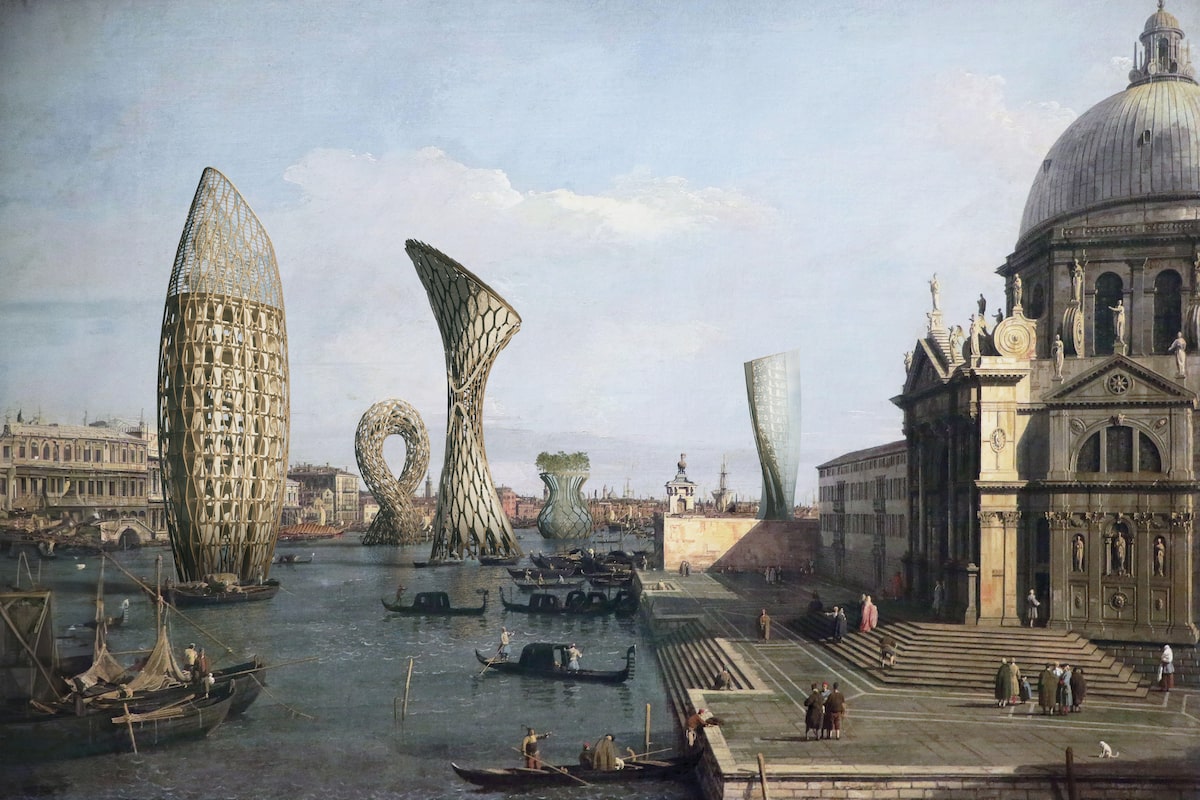
Symplasma within Canaletto’s Santa Maria della Salute and the Riva degli Schiavoni in Venice. Henriquez Partners Architects used AI to create this image. Across the country, more architecture firms are experimenting with how the technology can be integrated within their work.Bartosz Palus & Henriquez Partners Architects
Artificial intelligence is beginning to redraw the blueprints of architecture. From design studios to university labs, Canadian architects are experimenting with the technology – transforming the idea of creativity within the profession.
For Vancouver architect Gregory Henriquez, this feels both thrilling and unpredictable.
“It’s like a wild horse right now,” he says. “It requires rigour and experimentation.”
His firm, Henriquez Partners Architects, recently used AI to create images for its Venice Biennale entry – a tower inspired by sea sponges, set against dreamlike Renaissance landscapes by Canaletto. “It’s in its genesis, but it’s fascinating.”
That sense of both excitement and uncertainty runs through Canada’s architecture community.
At McGill University’s Peter Guo-hua Fu School of Architecture, associate professor Theodora Vardouli reminds her students that AI isn’t as new as it seems.
“AI is just a brand for many kinds of computational techniques,” she says. “And those have been percolating since the 1960s in architecture.”
Across Canada, that long evolution is colliding with a sudden flood of accessible tools and the results look very different from firm to firm.
Toronto’s Core Architects Inc. – known for projects ranging from One Bloor West, soon to be the city’s tallest condominium, to office and recreation spaces – is all in on AI.
Partner Brian Laye says the firm has spent two years exploring AI’s potential. One director devotes part of each week to AI research, while the building-information modelling specialist develops custom tools to automate repetitive work.
The firm relies heavily on Midjourney, a text-to-image generator that turns written prompts into visuals.
“It’s a really good way to get inspired,” Mr. Laye says. “It’s like any firm looking for images in books or magazines.”
AI is also used to generate still images and fly-through videos of proposed buildings, bringing blueprints to life long before construction. For Core, it’s a tool for speed and inspiration – not a replacement for creativity.
“Our office has made a deliberate move to do this,” he says. “And our BIM (Building Information Modelling) specialist is creating custom tools – anything that can relieve the manual efforts on repetitive tasks.”
Diamond Schmitt, another major Toronto firm, takes a more cautious approach.
While AI helps visualize early design ideas, public tools such as Midjourney are banned, says principal Victor Lima. Instead, the 350-person firm uses proprietary in-house software to ensure data privacy and quality control.
“It’s saving us quite a bit of time and effort,” Mr. Lima says.
Architecture schools are adapting, too.
At the University of Toronto’s Daniels Faculty of Architecture, Landscape and Design, professor Vivian Lee is studying AI’s impact on curriculum. She has students evaluate dozens of tools and map which stage of design they serve best – from early concept generation to project management.
Visualization remains the simplest and most effective entry point.
“That’s something AI does fairly well,” Ms. Lee says.
Using AI to generate a raft of early design possibilities is something she finds is useful for students because they can devote their time to assessing what’s good and bad about quickly generated concepts rather than agonizing and getting defensive about something they spent days painfully drafting.
“It’s helping them. It’s a faster way to announce what they’re looking for.”
But she also sees limits because architectural design is much more complex than just generating models.
“We teach students how to evaluate and prioritize, how to couple two competing goals into one.” That’s not something any AI tool can do at this point.
Mr. Laye echoes that sentiment. “Architecture is one of the oldest professions. No inventions have replaced the need for critical thinking.”
He and others recognize AI’s pitfalls – bias, distortion and overreliance.
Back in Montreal, Prof. Vardouli describes a student project that exposed AI’s biases. Student Suehayla Eljaji created avatars of herself in different outfits and asked AI to place them in “appropriate” apartments and cities. The results revealed assumptions baked into the algorithms: the avatar in scruffy sweats ended up in a dim Detroit flat, while the avatar in a floral skirt was cast as a “creative” in a bright Boston loft.
Mr. Laye has also observed that AI can understand basic instructions but not what’s feasible in the real world. Asked to design a bedroom that is 100 square feet, it could generate a room that is two feet by 50 feet – “technically correct but functionally useless.”
And there’s what everyone in all fields of AI is worried about – people losing their skills as they rely on a computer to do cognitive work.
“There is danger of disabling a generation of human beings,” Mr. Henriquez says. But, he recognizes it’s more than a tool – it’s a new art form, the way photography and film once were. “This is a new medium. Not only is it a tool for synthesizing information but we can create something totally new.”