
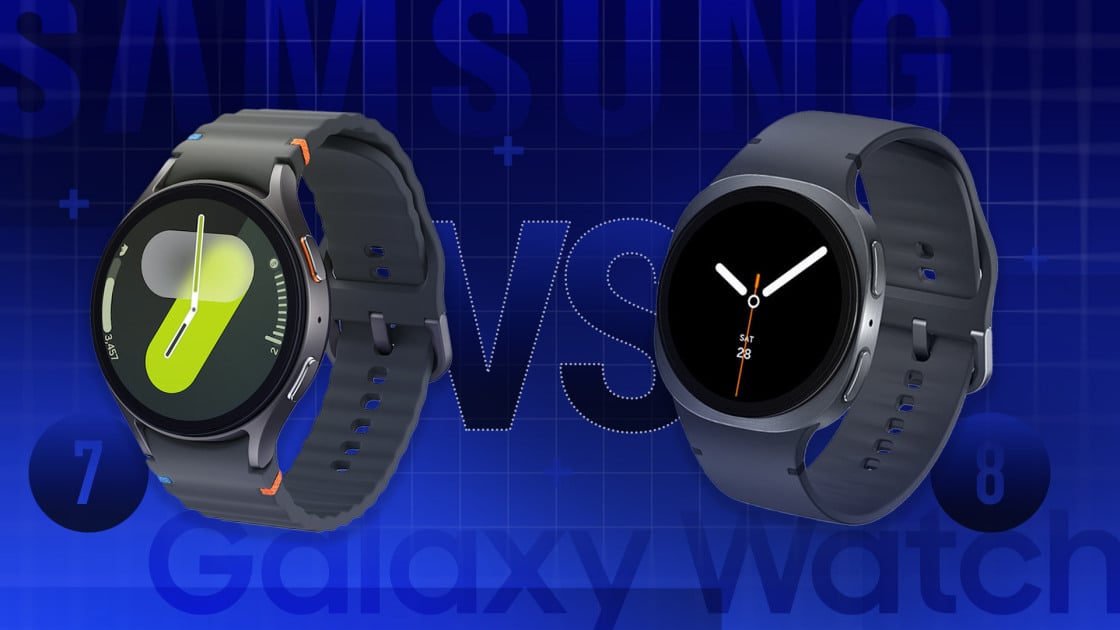
Price
The Galaxy Watch 8 costs $50 more than the Galaxy Watch 7 did at launch. The Watch 8 starts at $349.99 for the Bluetooth-only 40mm version, while the Watch 7 started at $299.99 for its corresponding model. The Galaxy Watch 7 currently starts at $249.99, and since it’s older, you can often find it at a steeper discount. Both models charge a $30 premium for their respective 44mm versions, and an extra $50 for LTE functionality.

Left to right: The 44mm and 40mm Galaxy Watch 8 (Credit: Eric Zeman)
Both watches are available in 40mm and 44mm versions, with two color options for each. Watch 8 is available in graphite or silver. The small Watch 7 is available in green or cream, while the larger variant is available in green or silver.
Winner: Galaxy Watch 7
Power
Both the Galaxy Watch 8 and the Galaxy Watch 7 feature a five-core Exynos W1000 processor, paired with 2GB of memory and 32GB of storage. The Galaxy Watch 8 ships with Samsung’s One UI 8 interface on top of Google’s Wear OS 6 software, whereas the Watch 7 launched with Samsung’s One UI 6 interface and Google’s Wear OS 5. The upgraded software is now available for download on the Watch 7, excluding the Galaxy AI-enabled features detailed below, which allows it to keep up with the newer model.
Winner: Galaxy Watch 7
Battery Life
For years, our biggest gripe with Samsung’s Galaxy watches has been battery life, and the Galaxy Watch 8 finally addresses this issue. The larger Watch 8 features a 435mAh cell, while the smaller model has a 325mAh battery, both of which are larger than the 425mAh and 300mAh cells of the previous generation, respectively.
The increase is relatively small, and Samsung has tempered expectations around it, noting that the extra power is primarily intended to maintain similar battery life despite the added features in the newer models. Specifically, a rep estimated both versions of the Watch 8 would last 40 hours without the always-on display active and 30 hours with it enabled.
In my real-world testing, the Galaxy Watch 8 fell just short of those estimates, lasting 39 hours with the always-on display disabled and 26 hours with it enabled. Both times beat those of the Galaxy Watch 7. Under the same test conditions, the Watch 7 lasted 28 hours without the always-on display enabled, and 22 hours with it activated.
Winner: Galaxy Watch 8
Screen
The Galaxy Watch 8 features a brighter screen than the Galaxy Watch 7, but its dimensions and resolution remain identical. On both the Watch 8 and the Watch 7, the 44mm models have a 1.5-inch, 480-by-480-pixel Super AMOLED screen, while the 40mm versions have a 1.3-inch, 432-by-432-pixel screen.

The Galaxy Watch 7 in sunlight (Credit: Andrew Gebhart)
The Watch 8 can reach 3,000 nits of brightness, whereas the Watch 7 tops out at 2,000 nits. The Watch 7 is still bright enough to be seen even in direct sunlight, but the Watch 8 offers even greater visibility in such circumstances.
Winner: Galaxy Watch 8
Design
Both the Galaxy Watch 8 and the Galaxy Watch 7 can survive harsh weather conditions and elements. They share a 5ATM waterproof rating, meaning they can survive up to 164 feet of fresh or salt water for 10 minutes. Both also have MIL-STD-810H certification, meaning they can withstand extreme temperature changes, blowing sand, and other environmental stressors, such as vibration and shock. They’re also both rated at IP68 for general dust and water resistance.
The Galaxy Watch 8 features a more squared-off bezel (Samsung refers to it as a “cushion design”) and a dynamic lug system borrowed from the Galaxy Watch Ultra series. Samsung claims that the design changes will enable the watch to move more naturally and comfortably on your wrist. On the inside, the tech components have been rearranged, allowing for a frame that is 11% thinner than the last generation.

Get Our Best Stories!
All the Latest Tech, Tested by Our Experts

Sign up for the Lab Report to receive PCMag’s latest product reviews, buying advice, and insights.
Sign up for the Lab Report to receive PCMag’s latest product reviews, buying advice, and insights.
By clicking Sign Me Up, you confirm you are 16+ and agree to our Terms of Use and Privacy
Policy.
Thanks for signing up!
Your subscription has been confirmed. Keep an eye on your inbox!
Thinness aside, I actually prefer the more rounded look of the Galaxy Watch 7.
Winner: Galaxy Watch 7
Fitness and Health
Samsung focused on improving activity, exercise, sleep, and stress tracking with the Galaxy Watch 8, but health monitoring is already a strength of the Watch 7 and its predecessors.
The previous-gen model can detect sleep apnea and give you a detailed picture of your metabolism through advanced glycation end products (AGEs) index tracking. Like earlier Galaxy Watches, the Galaxy Watch 7 can monitor your heart rate and blood oxygen saturation (SpO2) levels, as well as measure body composition and body fat, similar to a smart scale. It can track your sleep and even your snoring if you have a nearby Samsung phone.

Energy Score on the Watch 7 (Credit: Andrew Gebhart)
The Galaxy Watch 7 was the first Samsung watch to use AI for holistic health tracking. It encapsulates all of your health metrics into a single daily Energy Score from 0 to 100, and then uses that score to offer a personalized daily wellness tip designed to help improve your overall well-being.
Recommended by Our Editors
The Galaxy Watch 8 builds on that, utilizing Samsung’s AI to provide additional details in its health and sleep tracking. A Sleep Coach feature will learn your body’s circadian rhythm over time and then provide advice on when to go to bed to help optimize your rest and restoration. While you sleep, the Watch 8 measures your vascular load for additional insights into your stress and energy levels.
A Watch 8 Running Coach can gauge your fitness level with a 12-minute test, then help you create a personalized plan for an upcoming marathon or fitness goal. It’ll even offer tailored encouragement while you work out, similar to Apple’s Workout Buddy.
The Watch 8’s coolest new feature could even save you a trip to the doctor. It can measure your antioxidant levels with a simple test that involves putting your finger on a sensor on the back of the watch. Similar tests typically involve drawing blood.

You can place your finger on the back of the Watch 8 to measure your antioxidant levels (Credit: Eric Zeman)
Altogether, the improved AI in the Galaxy Watch 8 does much more than provide a single, static score and piece of advice, as the Watch 7 does. It’s been integrated into much more of the minutiae of tracking and can provide details and coaching while still offering a holistic overview of your wellness.
These AI insights are still exclusive to the newer model, even after updating the Watch 7 to One UI 8.
Winner: Galaxy Watch 8
Lifestyle Features
On the lifestyle front, the Watch 8 comes with Google’s Gemini built in if you need help from a generative AI assistant. Gemini can answer questions, send texts, and interact with Samsung apps, such as Calendar, Clock, Health, and Reminder, providing a new hands-free way to interact with your watch. The Watch 7 now has access to Gemini, too, through a software update.
Otherwise, the Watch 8 and Watch 7 have access to all of the same apps through Google’s Wear OS. They both do everything else you’d expect, such as making phone calls and sending texts.
Winner: Galaxy Watch 7