
The original illustration from Robert Munsch’s book, Love You Forever.Fred Lum/The Globe and Mail
When I read the classic children’s book Love You Forever to my kids, there was one image I always found a little unsettling.
And no, it wasn’t the mother strapping a ladder to her car to sneak into her grown-up son’s house at night. (Come on, that part is funny!)
It was the haunting image at the end of the book where the father pauses at the top of the stairs and contemplates both his elderly mother and the daughter he has just brought into the world.
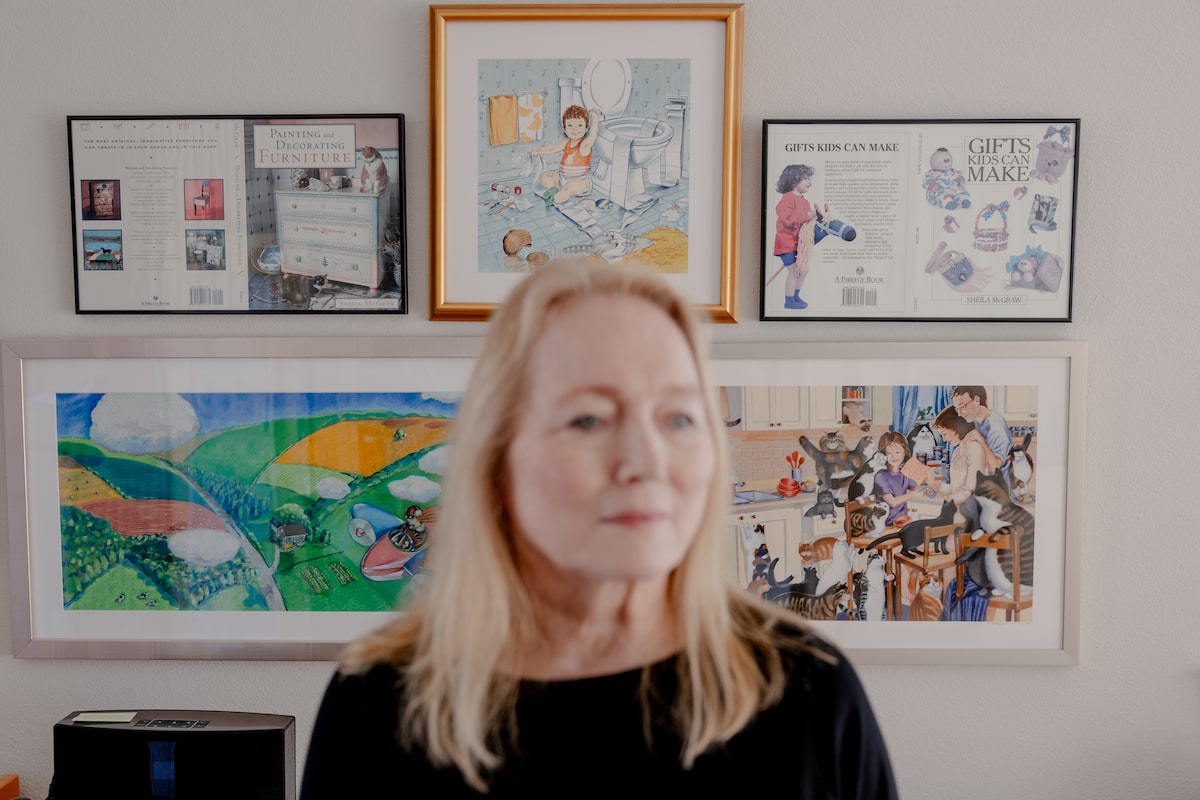
Sheila McGraw illustrated Robert Munsch’s Love You Forever, which was first released nearly 40 years ago.Lexi Parra/The Globe and Mail
It just didn’t seem right. And now I know why.
I should start at the beginning.
Love You Forever, by Robert Munsch and Sheila McGraw, was first published in 1986. It tells the story of a mother who watches her son grow up. Every night she holds him and rocks him back and forth, back and forth, back and forth, and sings: “I’ll love you forever / I’ll like you for always / As long as I’m living / my baby you’ll be.” She continues until one day she is too old and sick to do it, and so her son holds her and sings the song. Then he carries on the tradition with his own daughter.
My mother read Love You Forever to me countless times when I was a kid. I memorized every word.
The story resonated strongly with me. For one, the home I spent the most time in was like the one in the book: just a mother and her son. And the message of the book – that the mother would always love her son, no matter what, and he would do the same when he was a parent – was one that I hoped would be true for us, too.
So of course, years later, I wanted to read the book to my own children.
When the time came for me and my wife to get our library together for our first child, we got an avalanche of books from friends and family and dug out what childhood books of our own we could find. One of the first books we read to our newborn was Love You Forever.
Sheila McGraw colours a sketch of the boy from Love You Forever in her home studio in Kemah, Texas.
Lexi Parra; Fred Lum/THE GLOBE AND MAIL
The book and its message still resonated. I loved it as much as I ever had.
But the second-to-last illustration, of the now-grown-up son pausing at the top of the stairs, just didn’t look right. I couldn’t place why but I kept it to myself.
Until a few weeks ago. A family member had died in the spring and I ended up with boxes of family memorabilia, which I am slowly sorting through.
In one, I discovered some of my old childhood books, including a copy of Love You Forever, with a little inscription from my mom.
I flipped through the book until I got to the second-last page. And that’s when I discovered my unsettled feeling was correct. It was a different illustration.
It was still the father pausing at the top of the stairs, but the angle, the lighting, everything about it was completely different.
My immediate feeling was vindication, that there was a reason the illustration hadn’t seemed right. But my next feeling was curiosity. I’m a reporter; my job is trying to discover new information and solve mysteries. So it was time to apply my reporting skills to this question.
The revised illustration from Love You Forever.Fred Lum/The Globe and Mail
First, it’s not clear when the illustration was changed. It happened sometime between the ninth printing in 1988, which had the original illustration, and the 25th printing in 1990, which has the updated picture. The 124th printing is currently on shelves.
I started to contact people who worked on the book. The first person I reached was Lionel Koffler, the president of Firefly Books, which published Love You Forever.
He said the answer was simple: The image was changed during reprinting because the illustrator – McGraw – was unhappy with it and, unlike most other pictures in the book, it did not include a cat.
It was then I realized – and this may complicate the narrative a little – that the book I grew up with is the version still in print today. The copy I had read to my children was, in fact, the original.
I showed the images to my wife. She said the original version (without the cat) was exactly what she remembered from her childhood, which explained why she never saw anything amiss. We figured it must have been her childhood copy.
I then got in touch with McGraw. She lived in Toronto when she worked on the book and lives in Texas now. While she has continued to illustrate and write her own books over the years, Love You Forever remains perhaps the work she is best known for. It has sold some 40 million copies.
“I’m always amazed to see one of the first edition books with the defunct illustration,” she said. She wondered if the copies with the original illustration are now collectors’ items.
She recalled the backstory of how the book came together. In March of 1986, she was illustrating for magazines, newspapers and advertising agencies. Koffler reached out because he liked her “impressionist” pastel style and thought it would be perfect for Love You Forever. She would have until September – six months – to deliver the illustrations to accompany Munsch’s story.
“I didn’t want to show the subject’s emotion in anything other than his posture,” McGraw said.Lexi Parra/The Globe and Mail
But days later, Firefly told her they were actually going with a different illustrator. When that didn’t work out, they came back to her in August. She once again agreed to do it.
“I accepted the job, but now I was left with four to six weeks to produce 15 full-colour drawings,” she said. She called herself “Quick Draw McGraw.”
She left the drawing of the man climbing the stairs until the very end. She had been dreading it.
“I didn’t want to show the subject’s emotion in anything other than his posture,” she said. “No weeping or tears. This was a kids’ book after all, and I’d already shown his distress in one previous illustration where the man rocks his old, frail mom.”
Plus, she hated drawing stairs. “I can’t seem to get the perspective right.”
With a deadline looming, she had no choice but to get something done and hand it in.
Still, the illustration bothered her. In subsequent printings, she asked the publisher if she could redo the drawing.
“Instead of explaining my faulty execution, I pointed out that the man’s cat wasn’t in the picture, even though the cat appears in every scene throughout the book,” she said.
She said the final rendering had a spark the original lacked. “The energy of the oblique pencil shading strokes, the warm blue and revolving perspectives that are carried through the rest of the book’s illustrations.”
She added: “The man is calm and contemplative.”
And after finally solving this mystery and reflecting again on what this book means to me, so was I.
The final drawing had a spark the original lacked, evoking the “revolving perspectives that are carried through the rest of the book’s illustrations.” And, of course, it included the cat.
Fred Lum/THE GLOBE AND MAIL