

November is the Halifax Examiner’s subscription drive. All this month, we are writing essays and stories about AI. Click here to read other stories and commentaries in our series.
The biannual subscription drives are super important to the financial stability of the Halifax Examiner. As with all publications, we experience a bit of subscriber “churn” — people’s credit cards expire, they experience a turn in their personal finances and have to direct their money elsewhere, they get pissed off at us for some reason and quit their subscriptions — and so there’s always a downward pressure on subscription revenue.
The subscription drives serve to counteract that downward pressure and top us up. They allow me to better plan the budget for the Examiner’s next few months, decide how much money can go towards larger investigative reporting, how much of a raise employees get, whether we can hire new employees, and so forth.
So if you value the Halifax Examiner, please consider valuing it with your money by subscribing or dropping us a one-time donation. You can subscribe here, or drop us a donation here.
Earlier this week, my colleague Suzanne Rent reported on opposition to a data centre proposed in Saint John and interviewed a person from a group opposing a data centre in Tucson, Arizona.
As Rent notes, “I found plenty of communities across North America fighting against data centres. Here are just some of the groups I found: No Data Centers in Ozaukee County; No Data Center in DeForest; No Janesville Data Center; and No Henry County Data Center.”
These are people on the ground concerned about the effects data centres will have on their specific local communities — how the power demands of the data centres will affect their own utility bills, the depletion of the aquifer beneath their feet, and so forth.
These are of course completely legitimate concerns. And as with most big projects promising economic salvation for communities struggling economically, the data centre proposals are wrapped in bullshit and lies, promises of employment that won’t be realized, never-ending demands for tax breaks and government subsidies, and corruption of local officials.
That’s how Big Money operates. That’s just a fact.
And right now, Big Money is the driving force behind the AI industry and its associated data centres. Play with it at your own risk. You’ll certainly lose.
But today I’m going to zoom out and take a broader look at the environmental impacts of the AI industry. We’ll see that the energy demands are so enormous that if the industry is successful in its growth projections, it will be impossible to stave off cataclysmic climate change.
This article by Alistair Alexander in Truthdig gets into the details about the production of the chips used in data centres, but I was particularly struck by this:
In an internal memo from September, CEO Sam Altman said that OpenAI’s “audacious long-term goal is to build 250 gigawatts of capacity by 2033.” If Altman achieves this goal, OpenAI will need almost exactly as much electricity as India’s 1.5 billion people, and is likely to emit nearly twice as much carbon dioxide as ExxonMobil, the world’s largest non-state carbon emitter.
And OpenAI is just one company. The biggest AI company, yes, but it is joined by Alphabet (Google), Meta (Facebook), Anthropic, whatever that thing Elon Musk uses is called, and others, each looking for electricity for more and more data centres.
As such, in the pursuit of ever-more compute with the data centres, big tech has completely abandoned its carbon-reduction goals, reports Jemma Green for Forbes:
Another study suggests electricity consumption of AI and global data centers is projected to double by 2026, potentially consuming as much energy as the entirety of the Netherlands by 2027….
As AI’s energy demands surge, many corporations are abandoning their previous commitments to carbon neutrality. Alphabet Inc., Google’s parent company, had claimed carbon neutrality since 2007, by purchasing offsets to counterbalance emissions from its operations. But in 2024 it ended its programme, citing the rapid expansion of AI data centers, which caused Google’s greenhouse gas emissions to rise by 13% in 2023 alone. Over the past five years, these emissions have surged nearly 50%…
Similarly, Microsoft’s emissions have grown by 29% since 2020, primarily due to the construction of new data centers to support AI development. The company stated that this has made achieving its goal of becoming carbon negative by 2030 more challenging.
There is no quick fix for this. Sure, in some theoretical world, all this power could be generated with renewables or nuclear, but we don’t live in a theoretical world; we live in the very real world facing a climate catastrophe right now, not a fictional world 20 years from now that has decarbonized the grid. And in this real world, generating enormous amounts of power quickly and cheaply means burning fossil fuels.
Note that the AI data centre proposed for Saint John will rely on a methane-burning generating plant in Tantramar for its power.
Alberta is embracing data centres, and is also planning to power them with methane (“natural gas”) burning plants, reports Kyle Bakx for CBC, who somehow spins this as a good thing:
For Alberta, the financial opportunity is much larger than just the data centre itself, considering the province relies on natural gas power plants for the majority of its power. All those computing machines require a vast amount of electricity, which requires building more power plants and more natural gas production. The spin-offs could include higher employment, tax revenues and royalties collected by the provincial government on all the natural gas pumped out of the ground.
(I’m purposefully avoiding discussion of the accounting gimmicks and magical thinking around carbon offsets and carbon capture schemes and the like because they’re, well, bullshit, and even entertaining them to discount them gives them a legitimacy they don’t deserve).
The business law consulting firm Norton Rose Fulbright puts it bluntly:
Data center developers are navigating a complex energy landscape.
The sheer volume of electricity needed is bringing renewed interest in natural gas…
The old adage in real estate — location, location, location — has taken on new meaning in the data center world.
For data centers looking to scale, proximity to natural gas pipelines is useful. The ability to tap directly into a high-capacity pipeline can make or break a site’s viability for large-scale data center development.
Developers should look to put new data centers along major pipeline corridors, where they can “drill a hole and interconnect,” (perhaps not that easy, but close enough) minimizing infrastructure costs and permitting hurdles. In certain cases, where the economics are compelling, gas pipeline companies may be willing to build small lateral lines to reach data centers, with the costs of construction recouped through long-term service agreements.
What kind of insanity is this? Just as humanity is facing the existential crisis of climate change, we’re going to add enormous amounts of carbon to the atmosphere by burning more fossil fuels to power ChatFuckingGPT?
As I’ve pointed out before, there’s a false story about Easter Island that goes like this:
The people of Easter Island were so committed to their religion of building giant heads, that they didn’t even realize that they had cut down the last tree to use it as a roller to move a head from the quarry to its position on the coastline, and this single-minded devotion without regard to their environment led to their downfall. It’s a story of hubris and collective stupidity.
That story is a lie. The great civilization of Easter Island did not collapse because of self-induced stupidity. Rather, the Easter Islanders were victims of imperialism, ravished by disease and predatory traders, and then by slavers — at one point in the late 19th century, the entire Indigenous population of the island was enslaved.
But I can think of no better analogy for our present situation than the false tale of Easter Island. We’re so enamoured with the religion of AI and the supposed god of AGI (artificial general intelligence) that will never arrive, that we either cannot see or we simply accept that we’re going to destroy our environment in its service.
I’m repeatedly in situations where discussion of the environmental effects of AI are not just ignored, but are completely off the table:
I was the only one who spoke about the environmental and social costs of generative AI. It’s not that others discounted those costs, or thought they could eventually be mitigated for. Rather, they simply refused to engage with that critique at all.
For them, the hoped-for future benefits of something vaguely called “AI” are completely disconnected from the actually existing real world harms of generative AI. Don’t worry your little head about it.
It is madness.
(To send or post this item, copy the website address at the top of this page.)
NOTICED
1. Sub-orbital rocket launch

(Send this item: right click and copy this link)
2. Halifax Workers’ Action Centre launches new guide to workers’ rights
 An online notice from the Halifax Workers’ Action Centre about their new workers’ rights guide. Credit: Halifax Workers’ Action Centre/Facebook
This item was written by Yvette d’Entremont
On Monday, the Halifax Workers’ Action Centre (Halifax WAC) launched a robust new workers’ rights guide.
The “Guide to Workers’ Rights in Nova Scotia” is intended for non-unionized, provincially regulated employees in the province, and provides a general overview of laws governing most employment relationships in Nova Scotia.
Covering a range of topics that fall under the umbrellas of labour standards, human rights at work, and occupational health and safety, a Halifax WAC social media post describes the guide as bringing together “the essential information workers need to know their rights on the job.”
Created by students and workers at the Halifax Workers’ Action Centre, the guide can be found via this link, or downloaded as a PDF here.
(Send this item: right click and copy this link)
THE LATEST FROM THE HALIFAX EXAMINER:
1. Andy Fillmore says ‘nothing is off the table’ when it comes to making cuts in Halifax budget
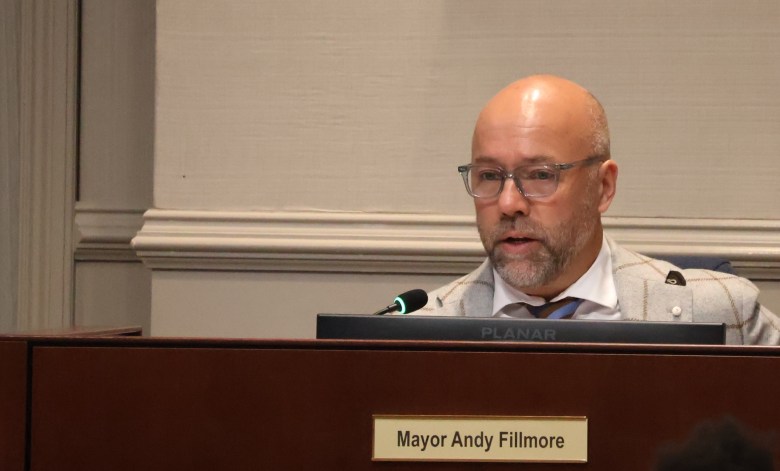 Mayor Andy Fillmore on Sept. 23, 2025. Credit: Suzanne Rent
Suzanne Rent reports:
Halifax regional council’s budget committee meeting started the process for the 2026-2027 budget, and Mayor Andy Fillmore says “nothing is off the table” when it comes to making cuts.
Early on Wednesday morning, acting CAO Brad Anguish was at the budget committee meeting to present the 2026-2027 budget direction, which includes a 10.5% hike on the average residential property tax bill. That increase would cover an $88.9 million increase over the 2025-26 budget.
The 10.5% property tax increase represents about $276 on the average annual tax bill.
Anguish said the direction from council was made clear in July when councillors voted to keep expenditures flat, look for operating efficiencies, and allow only for increases in inflation, contractual obligations, and mandatory provincial contributions.
“Despite the efforts of staff to achieve some efficiencies, rising costs in compensation, reserve replenishment, and previously approved initiatives means we’re facing an annual average property tax bill increase of approximately 10.5%, which is covering a potential $88.9 million budget increase,” Anguish said.
Last year, council voted in favour of keeping the tax rate flat and to increase the average homeowner’s property tax bill by 4.7%. Fillmore called that decision a “gift to the community.”
Click or tap here to read “Andy Fillmore says ‘nothing is off the table’ when it comes to making cuts in Halifax budget.”
A couple of thoughts.
First, “average” does a lot of work here. The managers at the municipality use the word “average” because it obscures the reality — because of the property tax cap, the taxes on people who have owned their houses for a while won’t go up much at all, while the taxes on commercial apartment buildings will go up at a much steeper rate and will be passed on to renters.
There’s a lot to talk about here. The context is obviously housing prices in a limited market. Many of these concerns would be alleviated if there were lots and lots more non-market housing — government-owned and managed social housing, cooperative housing, and so forth.
It’s absolutely the failure of multiple governments over decades that we’re in the straits we’re in now. Let’s not let ignore that elephant in the room while we have the rest of the conversation.
Because of that failure, all other pressures on the market end up hurting people. When Americans started buying up oceanfront properties and building McMansions on them, the assessments on nearby houses in small communities soared, and so it’s completely understandable that residents asked for tax relief for a situation they did not create. The same as the influx of Ontarians during the pandemic lockdowns. Similarly with the gentrification of Halifax’s north end and long-time residents, many from the historic Black community, finding their assessments going skyward. So we got the assessment cap.
Now, however, as each year passes, the blanket rental cap is playing out as an inter-generational transfer of wealth, as young renters are subsidizing services that are used by older homeowners.
This is not how the property tax system was designed. Property taxes were first proposed by business people as a means to make the city more attractive to investment and shopping. If you survey the history of any city in North America, you’ll find it was the chambers of commerce and the upper middle classes who pushed for taxes primarily on themselves to pay for things like sewers, paved streets, garbage collection, sidewalks, and the like. The property tax was seen as the simplest and fairest way to allocate those costs.
Property taxes were, and still could be, a wealth tax.
But now we’re in a completely different situation. Property is no longer the primary asset for the truly wealthy. Most (by no means all) homeowners have portfolios of stocks and retirement funds, and the very wealthy have the means to shelter their wealth from taxation completely in offshore accounts and the like.
I’m a fan of a wealth tax. Income is not a good reflection of wealth. I doubt Elon Musk has any income at all; he simply borrows against his stock holdings to meet whatever cash needs he has. You and I likely pay more in income tax than many of the tech titans.
So we as a world need to end the tax sheltering of wealth. We need wealth taxes so the rich pay their fair share and underwrite the economic order that allowed them to get wealthy in the first place.
And on the local level and housing, governments need to pump enormous amounts of money into off-market housing to make it possible for normal people to have reasonable rent and mortgage payments.
That conversation needs to happen before we get into the particulars of property tax rates.
Still, understanding that contextual reality, we should move away from property taxes as the primary means of financing local governments. Municipalities should get a cut of provincial income taxes.
Second, of course Fillmore wants to cut stuff. That’s what his kind of politician does.
We need politicians who make life better for normal people.
(Send this item: right click and copy this link)
2. Nova Scotia Energy Board approves $685 million transmission line
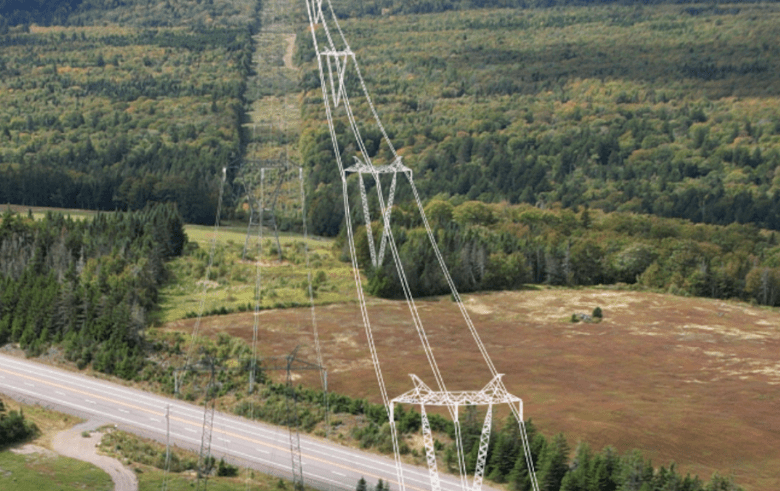 The existing transmission line between Nova Scotia and New Brunswick. Credit: Nova Scotia Power
Jennifer Henderson reports:
A project decades in the making that would relieve a bottleneck and increase the ability to move electricity between Nova Scotia and New Brunswick moved a step closer today.
The Nova Scotia Energy Board has approved forecast construction costs of $684.7 million to build a 160-kilometre overhead power line parallel to an existing line between Onslow, N.S. and Salisbury, N.B. The 345 kV “intertie” line is expected to be in service by the end of 2028. A Nova Scotia Power graphic showing the route of the new transmission line can be found here.
Click or tap here to read “Nova Scotia Energy Board approves $685 million transmission line.”
(Send this item: right click and copy this link)
3. 87% of Bird Canada riders in Halifax use e-scooters, report finds
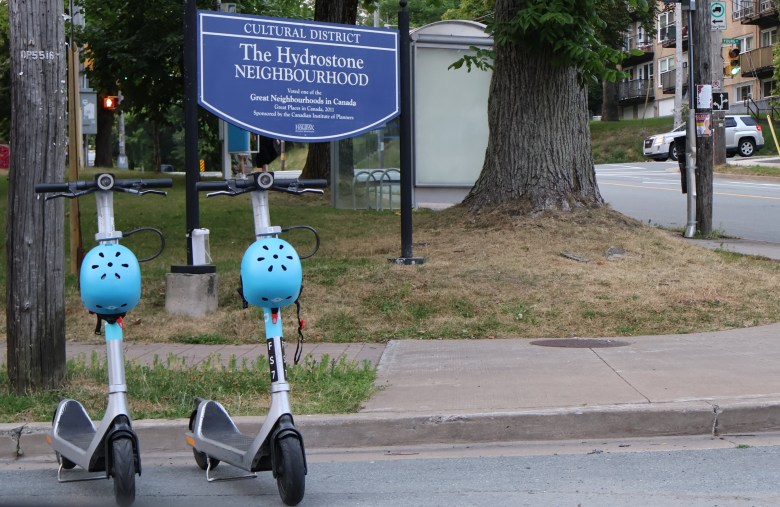 Two scooters owned by Bird Canada are docked at the corner of Gottingen and Kaye streets in Halifax on Aug. 4, 2025. Credit: Suzanne Rent
Suzanne Rent reports:
It’s been just over six months since Bird Canada launched its two-year pilot project that has hundreds of e-bikes and e-scooters in locations across Halifax Regional Municipality (HRM).
…
The project put 300 e-bikes and 300 e-scooters in various neighbourhoods around HRM. Another 300 e-bikes were added to the project during the second phase in September. During that phase, the service area was expanded into parts of Dartmouth and Bedford.
[Brittney MacLean, project manager for shared micromobility at HRM] said the total ridership from May 15 to Nov. 5 was 118,246. Of those rides, 13,840 were for the e-bikes, while 104,406 were for the e-scooters.
Click or tap here to read “87% of Bird Canada riders in Halifax use e-scooters, report finds.”
(Send this item: right click and copy this link)
Government
City
Budget Committee – Contingency (Friday, 9:30am, City Hall) — more info
Province
No meetings
On campus
Dalhousie
PhD Defence: Chemistry (Friday, 9:30am, Room 3107, Mona Campbell Building) — Joshua MacMillan will defend “Nickel-and Palladium-Catalyzed Mono-α-Arylation of Carbonyl Compounds and the Synthesis of Heterocycles from Nickel-Enolates”
Noon Hour Free Live Music Series: Brass (Friday, 11:45am, Strug Concert Hall) — details
PhD Defence: Industrial Engineering (Friday, 1:30pm, online) — Angela Akofa Amegboleza will defend “Analysis of Sustainable Supply Chains”
Navigating Tradition in Neoliberal Times (Friday, 2:30pm, Room 1116, McCain Building) — Pauline Hoebanx, St. Mary’s University, will speak about her research in the Department of Sociology and Social Anthropology’s Speakers Series
NSCAD
Artist’s talk (Friday, 12pm, Anna Leonowens Gallery 1) — J. Armstrong will discuss “In the Deep and On the Shoulders of Giants”
Pɨtewey Friday Crafter-noon (Friday, 2pm, Treaty Space Gallery) — details
Saint Mary’s
Solving the Universe: Past, Present and Future (Friday, 7pm, McNally Main Theatre Auditorium) — Laurie Rousseau-Nepton from the University of Toronto will talk
Literary Events
Friday
No events
Weekend
Storytime & Book Launch (Saturday, 10:30am, Tantallon Public Library) — with Nancy Rose & Jennifer Britton
Book signing (Saturday, 12pm, Indigo Bookstore, New Minas) — Timothy Brushett will sign Crusoe and the Stone Gardener
Open Book Club (Saturday, 1pm, Open Book Coffee) — Danica Roache‘s Five Seasons of Charlie Francis
Opaat Press Second Anniversary Poetry Bash (Saturday, 2pm, Halifax Central Library) — details
Author talk (Saturday, 2pm, Halifax Central Library) — Bringing the Past to Life Through Historical Fiction, with Jill MacLean and Sarah Emsley
Who-dunnit? afternoon with Anne Emery & donalee Moulton (Sunday, 3pm, Dartmouth Book Exchange) — details
In the harbour
Halifax,
05:30: MSC Santhya, container ship, arrives at Pier 42 from Le Havre, France
07:45: Splendid Ace, car carrier, sails from Autoport for sea
08:30: Lake Qaraoun, car carrier, arrives at Autoport from Southampton, England
11:30: Lake Qaraoun sails for sea
15:30: Dong-a-Glaucos, car carrier, arrives at Autoport from Emden, Germany
16:00: Eagle II, container ship, sails from Pier 27 for sea
16:30: MSC Santhya sails for sea
17:00: Oceanex Sanderling, ro-ro container, arrives at Fairview Cove from St. John’s
17:30: One Hawk, container ship, sails from Pier 41 for sea
Cape Breton
07:00: UHL Fable, heavy lifter, arrives at Atlantic Bulk Terminal from Cherbourg, France
13:00: CSL Kajika, bulker, sails from Aulds Cove quarry for sea
17:00: CSL Koasek, bulker, arrives at Coal Pier (Sydney) from Puerto Prodeco, Colombia
19:00: HTM Warrior, oil tanker, sails from EverWind for sea
20:00: Indigo Sun, oil tanker, arrives at EverWind from Saint John
Footnotes
This week, I had what I thought was a little one-off story I’d write about for a single item in a Morning File, 500 words or whatever, just some historic background for a contemporary news item.
So I did some internet research, popped by the provincial archives for a couple of hours, but then learned that the history was much more than I anticipated. There’s actually not much written about this historic event, and all of what is written gets a basic fact wrong and additionally misses the drama of the event.
And so my little one-off Morning File item has ballooned into something much bigger. I’m travelling next week, and have much more important things to write about besides, so this story will have to wait until mid-December.
But that’s how it goes sometimes. My time gets pulled away unexpectedly, and you don’t see my byline as often as you used to. Thankfully, the rest of the Examiner crew is continuing to do their excellent work. I really appreciate them.