

Eurovision organizers unveiled Friday a slate of new changes to the contest’s voting system, seemingly aimed at assuaging concerns raised by member countries after Israel’s landslide win in the popular vote earlier this year.
While the announcement on the voting reforms does not mention Israel by name, the changes match up to a number of complaints made about Israel following this year’s competition in Switzerland, where Yuval Raphael ran away with the popular vote and finished second overall.
The voting changes, aimed at appeasing some angry member states, are yet another sign indicating the European Broadcasting Union is leaning toward allowing Israel to remain in the competition, after it scrapped a vote planned for this month on the issue.
In a public letter, Eurovision director Martin Green wrote that he hopes the new voting system “allows for the Contest to acknowledge the sometimes-difficult world in which we live but resist attempts to turn our stage into a place of geopolitical division.”
Under the new system, the EBU will “discourage disproportionate promotion campaigns… particularly when undertaken or supported by third parties, including governments or governmental agencies.” One of the allegations lobbed at Israel after this year’s contest was over government-sponsored campaigns urging votes for Raphael, although several other countries did the same, and the rules allowed it. The new rules prohibit broadcasters or artists from supporting third-party campaigns.
Get The Times of Israel’s Daily Edition
by email and never miss our top stories
By signing up, you agree to the terms
The reforms also include fewer maximum votes per voter, capped at 10 instead of 20. Some broadcasters had complained that Israel supporters were maxing out their support for Raphael, while traditional Eurovision fans were spreading their support around their favorite acts.
Under the new system, the professional juries will also return for the semifinals instead of just the finals, with those also now being decided by a 50/50 mix — as they were until 2023. The EBU will also be working to enhance its “technical safeguards” to prevent any voter fraud.
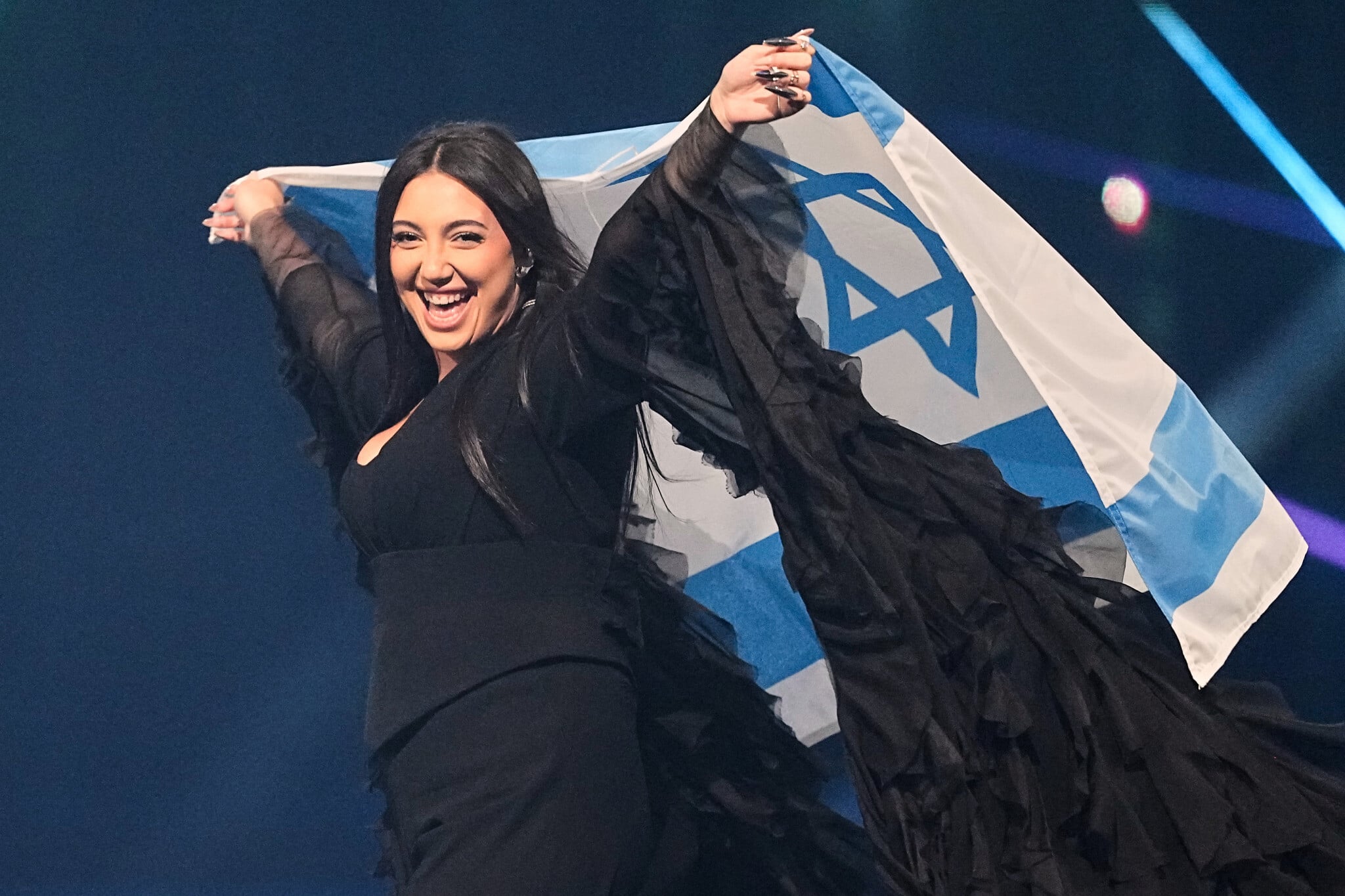
Singer Yuval Raphael from Israel holds the national flag during a dress rehearsal for the Grand Final of the 69th Eurovision Song Contest, in Basel, Switzerland, May 16, 2025. (Martin Meissner/AP)
The EBU said that member states “will be asked to consider this package of measures and safeguards and decide if they are sufficient to meet their concerns around participation without having a vote on the topic” at its upcoming General Assembly next month. The assembly is also where a final decision will be made on whether Israel will be allowed to participate.
The public broadcasters of some participating countries, including Spain, Ireland, and the Netherlands, have pledged to withdraw entirely if Israel takes part in the contest, and several others, including Iceland, Slovenia, and Belgium, have threatened to follow suit.
While the EBU originally announced a vote among all member states on the issue, it scrapped the idea following the ceasefire in Gaza, instead saying that it would now “discuss participation” in the contest, and that “further details” would be provided later to EBU members.
The controversy over Israel’s participation heavily overshadowed the 2023 and 2024 Eurovision contests, with most international media coverage of those competitions focusing on the efforts to bar Jerusalem by countries outraged at Israel’s war against Hamas in Gaza following the terror group’s invasion of Israel on October 7, 2023. The subsequent backlash and campaign to drum up support for Israel’s contestants led them to ultimately soar in the public vote.
Meanwhile, Israel is moving full steam ahead with its plans to compete, with the newest season of “Hakochav Haba” (Rising Star), which traditionally selects the country’s Eurovision entrant, officially kicking off last week.
Neither the hosts nor the judges gave any indication during the show’s kickoff that Israel’s participation at next year’s Eurovision hangs in the balance, discussing instead what kind of singer and song the country should send this year and predicting a win for the Jewish state.
Israel has participated in the song competition since 1973, backing out of only three contests in the past 52 years – 1980, 1984 and 1997 – when the dates conflicted with Memorial Day or Holocaust Remembrance Day. Israel has won the contest on four occasions – in 1978, 1979, 1998, and most recently in 2018, with Netta Barzilai’s “Toy” — and has hosted it three times.
Watch DocuNation Season 3: The Heart of Israel
when you join the ToI Community
In this season of DocuNation, you can stream six outstanding Israeli documentaries with English subtitles and then join a live online discussion with the filmmakers. The selected films show Israel beyond the conflict: a place of storytellers and musicians, of dreamers, makers, and communities rooted in meaning and trust.

When you watch DocuNation, you’re also supporting Israeli creators at a time when it’s increasingly difficult for them to share their work globally.
To learn more about DocuNation: The Heart of Israel, click here.
Support ToI and get DocuNation
Support ToI and get DocuNation
Already a member? Sign in to stop seeing this
You appreciate our journalism

You clearly find our careful reporting valuable, in a time when facts are often distorted and news coverage often lacks context.
Your support is essential to continue our work. We want to continue delivering the professional journalism you value, even as the demands on our newsroom have grown dramatically since October 7.
So today, please consider joining our reader support group, The Times of Israel Community. For as little as $6 a month you’ll become our partners while enjoying The Times of Israel AD-FREE, as well as accessing exclusive content available only to Times of Israel Community members.
Thank you,
David Horovitz, Founding Editor of The Times of Israel