

The Province of Manitoba has launched an online interactive tool to provide hunters and landowners with real-time access to data in the monitoring and management of Chronic Wasting Disease (CWD) that infects the cervid populations of deer, elk, moose and caribou.
The CWD Dashboard can be found on the Province of Manitoba website where Manitobans can filter maps by choosing the different hunting seasons and regions, species of concerns, or obtain directions to the nearest sample drop-off depot location.
These are just a few of the tools offered through the new Dashboard, which is the first of its kind in Canada. A tutorial video also instructs on how to obtain a properly collected tissue sample to be brought to a drop-off location within 7 days of harvest.
What is Chronic Wasting Disease (CWD)?
While Chronic Wasting Disease (CWD) affects our cervid population, which include white-tail deer, mule deer, elk, moose and caribou, and is caused by misfolded prions, which are proteins that are normally present in the animal’s body, but they change their shape and become harmful,” explains Wildlife Health Manager for the Province of Manitoba, Fahar Ibtisham.
“This disease is 100% fatal, which means any animals with this disease will eventually die,” he adds. “And as of today, there is no treatment, no vaccine available. However, there are some scientists that are working on vaccine development, but I would say they’re still in early stages.”
Ibtisham says it’s very important for us to understand the detriment CWD has to our cervid population should we see a rise in infection, because once CWD enters a big game population, it’s extremely difficult to remove. These prions that cause CWD can stay in the environment or on the landscape for years. Some researchers believe CWD can survive for decades on the landscape which makes stopping the spread that much more critical.
 (photo credit Province of Manitoba CWD website video)
Is CWD transferrable to other species, like?
“So far what we know about CWD, we have not seen any cases jumping from … a deer to cattle, a deer to a human,” shares Ibtisham. “However, what we have seen is within species, for example from a deer to moose or deer to elk. We have seen those cases, but not from a deer to cattle or any other species.”
Is CWD transferrable to humans?
“So as of today, we don’t know. However, because previously one very, very well-known disease, mad cow disease, that one we have seen the cases jumping from cattle or a bovine to human. So that’s why most of these public health agencies, their recommendation is not to consume any animal which is either tested positive for CWD. Or if you don’t know about the results, it’s better not to consume because previously we have seen the cases in other diseases where they have jumped from one species to another one.”
Variant Creutzfeldt-Jakob disease (vCJD) is a rare and fatal brain disease caused by a prion, an infectious protein, that is linked to eating beef from cows infected with ‘mad cow disease’. vCJD illnesses have been very rare since the early 2000’s.
With CWD being a prion-based disease like vCJD, it’s the fear of CWD crossing the blood-brain barrier in humans by ingesting an infected animal that has researchers extremely concerned.
“I would say we still are in early stages,” says Ibtisham. “These things they need years and years and decades of studies before we know actually what’s going on or what are the risks.”
How prevalent is CWD in Manitoba today?
The first positive case of Chronic Wasting Disease in Manitoba was found in a male mule deer near Lake of the Prairies on November 1, 2021. Since then, over 14,000 samples have been tested with 30 confirmed positive test results. Of those 30 positive cases, 23 were mule deer, and 7 were white-tail deer. The majority of animals testing positive were found along the Manitoba-Saskatchewan border. However, CWD infected deer have been found just north of Deloraine, and one case south of Morden.
 The red dots are positive cases in the dark blue areas of heavily monitored regions in Manitoba.
Fahar Ibtisham says we can only prevent the spread of CWD when the prevalence is low. With the current positive number of cases in Manitoba being 30 the prevalence of CWD in the province is around 0.2%, which means out of every 100 deer, there is a 0.21% chance that the animals will test positive for CWD.
“This is very, very low compared to our neighboring province, Saskatchewan, where they have about 80%,” he adds. “So out of 100, 80 animals are tested positive for CWD.”
“And most importantly, we have not detected CWD in elk, moose, or caribou. But our neighbor province Saskatchewan, they have detected CWD in elk, and moose and I believe this is because the presence of prions in their landscape, because they have high prevalence … they have prions on the landscape almost everywhere, which is so far not the case for Manitoba.”
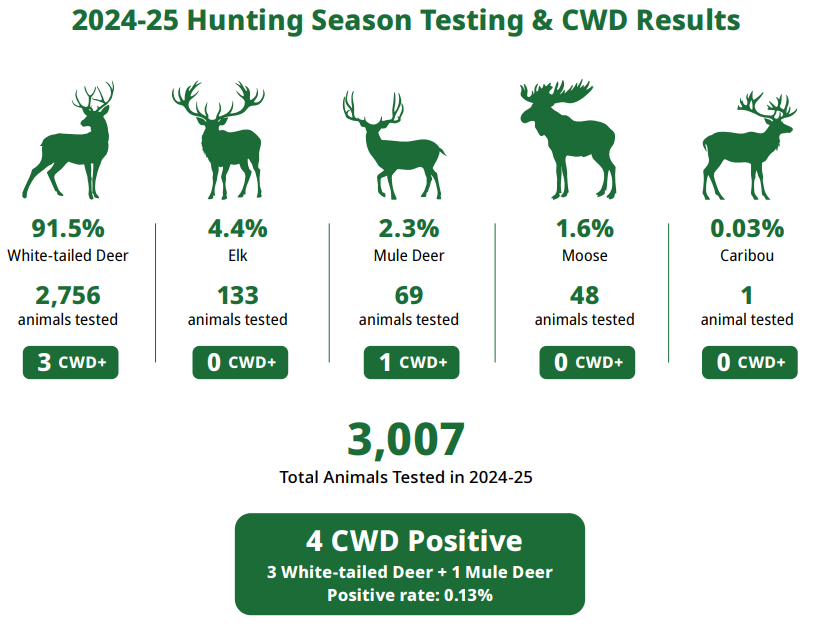 Excerpt from the Chronic Wasting Disease Summary Report 2024-2025 Hunting Season
“So, when prevalence is low, that’s when you can take some action to prevent its spread,” he explains. “So therefore, keeping that in mind in 2024, this government they made preventing the spread of CWD as a mandate item and the direction we received from our minister was to develop a plan for a transparent and hunter supported system to prevent the spread of CWD in Manitoba.”
“One of many initiatives that we started was to develop a CWD Dashboard,” adds Ibtisham.
What does the CWD Dashboard offer hunters and landowners?
The CWD Dashboard is a new interactive online tool that gives Manitobans a real-time access to CWD data. The public has easy access to a map that shows where CWD cases have been detected, which species, what gender, and exactly where that animal was found.
 (photo credit Province of Manitoba CWD website page)
The provincial government has developed a CWD surveillance area where it is mandatory to submit a tissue sample for testing CWD. The Dashboard map gives hunters pertinent information on the prevalence and the likelihood of harvesting an infected animal in a specific area. As well, hunters can find drop off locations for sample submissions on the dashboard.
Previously, hunters would need to bring the entire head of the animal to the drop-off location. This has changed where sample collection is literally in the hands of the harvester, making for faster lab tests, quicker results and thereby facilitating the processing of the animal, or the proper eradication of an infected animal.
What should Manitobans do if they see an animal that looks sickly?
An animal that is infected with CWD looks thin, acts sluggish, has decreased social interaction and seems to have a loss of awareness, and a loss of fear of humans. Other symptoms include excessive drooling, holding its head down in a lowered and depressed state, and the grinding of teeth.
If you see any animal that looks sickly, it is important not to touch it, but to call the Manitoba Conservation TIPS line at 1-800-782-0076. Reporting an animal that looks ill will prompt the animal to be tested and disposed of properly and safely by Conservation officers trained in this situation.
“And that’s how we found our first case too because that was a symptomatic mule deal that we dispatched and then later on we found out that it was positive for CWD,” shares Ibtisham.
He adds it’s vitally important for the proper handling and removal of an infected animal to thwart the spread of CWD to other animals.
“The earlier we remove that animal from the landscape, it will be better for us because it will help us to prevent the spread. The more that animal stays on the landscape, there are high chances of that animal spreading that disease CWD to other animals. So we try our best to remove them from the landscape as early as possible so that they do not spread it to other animals.”
 (photo credit Province of Manitoba CWD website page)
What is most important for hunters and landowners to remember?
“I would encourage every hunter to do two things,” says Ibtisham. “First thing is for sure, submit your sample for testing because, again, testing is the backbone of how we see where the disease is and how it’s moving. The more samples we receive, the better we can protect healthy population for the future. So that’s for sure going to be the first thing.”
Secondly, promoting best practices is crucial to keep the prevalence of CWD low. This is the best time for us to take action and promote best practices to prevent the spread of CWD, he adds.
“Best practices are avoid moving high-risk [animal body] parts. These prions which cause CWD, they are usually highly concentrated in the brain, spinal cord, spleen, and lymph nodes. Our suggestion is you leave this high-risk material at the kill site because that minimizes the chances of spreading CWD prions from a positive area to a negative area.”
“And then of course, dispose of the carcasses properly. Please do not throw them in the backyard or on your property. Just dispose of them properly so that we minimize the spread of CWD.”
“And one of the most important things I would like to mention here is please do not use any attractant or feeding. Now as a Canadian and Manitoban, we are kind-hearted people and during a harsh winter, many of us try to feed deer, believing it will help them survive. While the intentions are for sure good, unfortunately, the disease does not recognize good intentions.”
Ibtisham is quick to remind us that any practice that brings cervid populations, big game, together significantly increases the risk of spreading CWD.
“So, it’s my humble request, please do not feed deer. Again, feeding might help them, you know, with hunger in short term, but in long term it’s a greater risk because if an animal or deer dies because of CWD, that deer most probably will take many others with them too, because again, they will spread this CWD to other animals before they die.”
“So, we try our best not to feed them. The best way to help deer is let them remain in the wild and avoid practices that increases disease spread,” adds Ibtisham.
“The only thing I want to say, I truly want to thank all our hunters and landowners,” says Ibtisham.
“Becoming the first province to launch this type of dashboard would not have been possible without their help and participation,” he shares.
“And at the same time, I also would like to gently remind them that most of our western and southern border GHA’s are in mandatory sample submission areas. So please make sure they submit their harvested animal sample within seven days of harvesting.”
“And finally, this dashboard is really about transparency and partnership with our hunter communities and giving people the tools they need to understand what is happening on the landscape. And as always, if hunters see any deer acting strangely and notice something unusual, please contact us at the TIPS line so that we could dispatch that animal and get that animal tested.”
The CWD Dashboard will be updated December 1st and also before the Christmas break, so hunters and landowners can follow along and see the latest data during this hunting season.
If you see any animal that looks sickly, it is important not to touch it, but to call the Manitoba Conservation TIPS line at 1-800-782-0076.
Reporting an animal that looks ill will prompt the animal to be tested and disposed of properly and safely by Conservation officers trained in this situation.
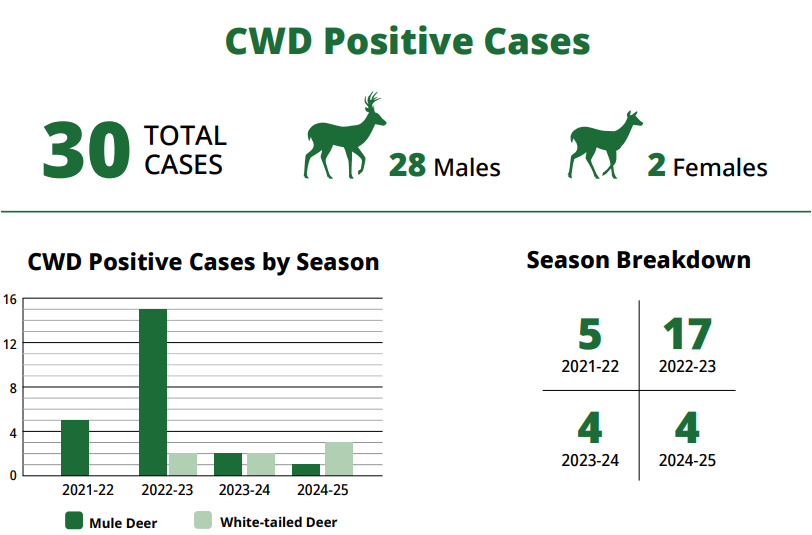 Excerpt from the Chronic Wasting Disease Summary Report 2024-2025 Hunting Season