
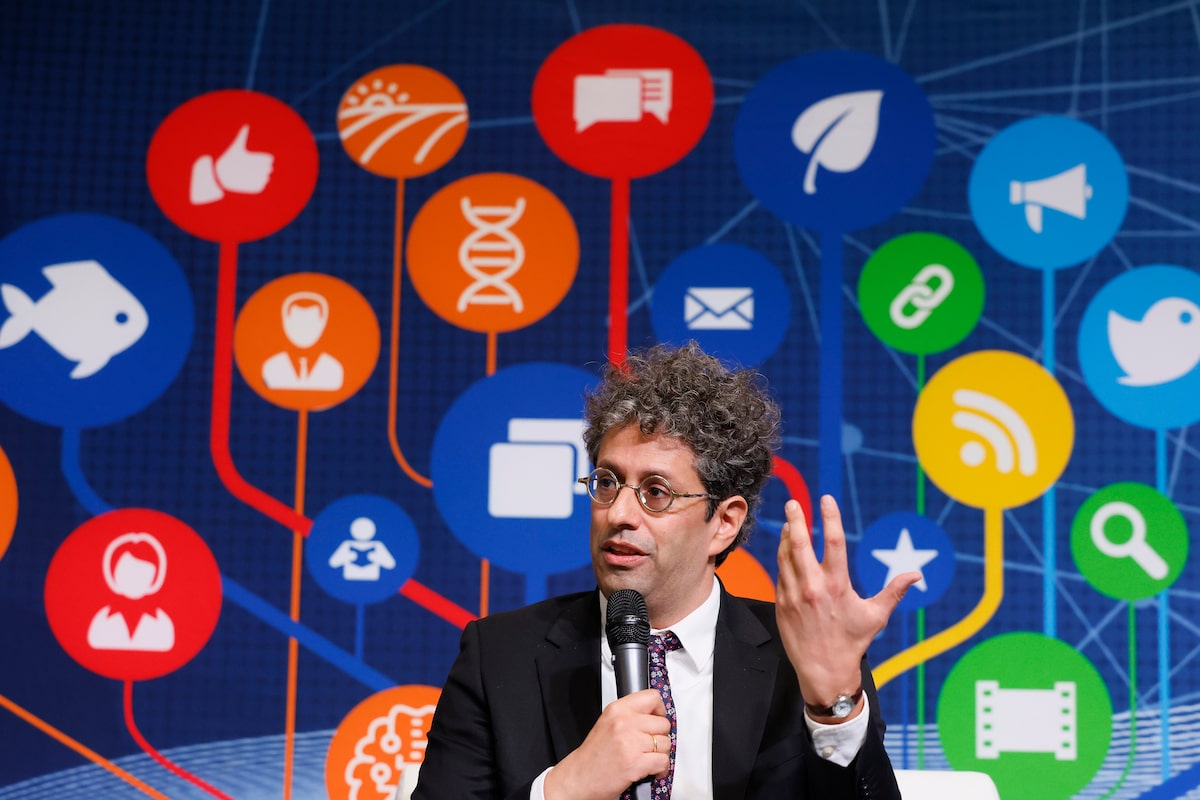
Karim Bardeesy, Parliamentary Secretary to the Minister of Industry, at the Canadian Science Policy Conference in Ottawa, on Wednesday.Blair Gable/The Globe and Mail
For the regulars at the annual Canadian Science Policy Conference in Ottawa, discussions about the country’s struggles with research and development have a familiar ring.
But this year the context has changed – a lot.
With a U.S. President who is hostile on trade and a world in the throes of a Gutenberg-level disruption triggered by artificial intelligence, the question of how to bolster Canadian economic sovereignty with Canadian science and technology has become a glaring priority for those who think about such things.
This week Prime Minister Mark Carney’s government wanted people to know it is thinking about that question too.
“The economic circumstances and the trade circumstances have changed sufficiently that we just don’t have any choice,” said Karim Bardeesy, a newly elected Liberal MP from Toronto and parliamentary secretary to the Minster of Industry, Mélanie Joly.
Canada’s research and scientific spending is declining relative to other nations, report says
Mr. Bardeesy was the government’s voice on research investments this week, appearing at the 17-year-old Ottawa conference three times –including a packed session where he addressed a mammoth new report on Canada’s R&D efforts.
The report, released on Tuesday by the Council of Canadian Academies, underscores the persistent nature of Canada’s challenge to link university-led research efforts with business-led growth.
In his responses, Mr. Bardeesy mostly stuck to ways in which this month’s federal budget aims to address the issue.
It includes $1.7-billion to help recruit international talent to Canada with the goal of bringing in more than 1,000 international researchers. Other measures include increasing the reach of tax credits that reward Canadian companies that invest in scientific research and extending another program that helps to protect their intellectual property.
In a separate comment to The Globe and Mail, John Fragos, a spokesperson for Finance Minister – and former industry minister –François-Philippe Champagne said one intention of the budget is “to signal to investors that Canada is serious about its R&D ambitions, and to derisk Canada’s investment ecosystem to accommodate renewed investments in R&D.”
In his remarks at the conference, Mr. Bardeesy also turned to the deeper question about why Canada, despite its strength in academic research, is far less adept at applying research to economic activity. This, he suggested to those present, required something more like a culture shift beyond specific programs or tax measures.
“We need you pushing the doors down,” he said. “It’s not just hard science, it’s not just manufacturing. Every sector represented in this room has the potential, I believe, to bring their knowledge into an economically beneficial arrangement with a company, with a not-for-profit, with government, that can help advance prosperity.”
Research advocates tend to agree that creating a more robust R&D environment in Canada is something that Ottawa cannot accomplish on its own. However, there are ways that the federal government can transform the current system into something more nimble and economically productive.
Opinion: Culture eats strategy: Overcoming Canada’s innovation barrier
Examples include more direction over granting councils when investments are required in national priorities and major research facilities. These options were highlighted in a 2023 report chaired by Frédéric Bouchard, dean of arts and sciences at the University of Montreal, and they have yet to be implemented, despite being mentioned in successive federal budgets.
Baljit Singh, who is vice-president of research at the University of Saskatchewan and was a member of Dr. Bouchard’s panel, said that the government still has unfinished business in restructuring key aspects of the research support system.
Had that work already concluded, he said, Canada would be in a better position to address the growing challenges from abroad.
The worry, he said, is that “we are leaving things at the table which we can leverage today without any additional investment to generate value for Canadians to add to their prosperity if we had a system to co-ordinate it.”
Peter Nicholson, an economist and science policy expert who chairs the Canadian Climate Institute and who was a reviewer of the CCA report, said that while the report is particularly deep on the measures that show how the economy is not engaging with innovation, more work is needed on the “why.”
Opinion: Canadian science can help drive wealth creation and grow the economy
“Any individual company can get its strategy wrong and the marketplace takes care of those,” he said. “But when you see that an entire economy over decades is not devoting as much energy and resources to some notion of innovation then there must be something that we’re not understanding that is at the root here.”
Much of the answer, he said, lies with the structure of the Canadian economy.
Comparing Canada’s R&D performance to a sailboat, he said that business’s role is like wind, which ideally should be doing most of the work. Where Ottawa is needed is as a thoughtfully applied hand at the rudder. It’s unknown how adept a hand the current government will prove to be.
A decade ago, federal Liberals were similarly in the spotlight at the Canadian Science Policy Conference shortly after Justin Trudeau first swept into power.
The party’s campaign promised then to “restore science to its rightful place” later took shape in the re-establishment of a federal science adviser and implementation of integrity policies to prevent the muzzling of government researchers. In later years, science-informed decisions on climate, species protection and the pandemic response mostly won approval from the research community.
But on structural questions related to funding and the organization and optimization of Canada’s research enterprise, Mr. Trudeau’s government was increasingly criticized for a slow response and lack of direction. Recommended overhauls like those proposed in the Bouchard report and a 2017 review led by former University of Toronto president David Naylor were accepted but actions remain pending.
If Mark Carney’s Liberal government is still in power by the next science policy conference, a key question that is likely to be asked is whether Canadian R&D is still a genuine preoccupation or merely a talking point for those who are steering the ship.