
I’m often behind cars that suddenly slow down or stop entirely before turning right at a green light. Is that legal? Aren’t you only supposed to stop before making a right turn when the light is red? If I was distracted for even a second, I could easily rear-end them. – Nick, Toronto.
When you’re turning right at a green light, it’s right to slow down or even stop to make sure it’s safe.
“Green does not mean go blindly,” said Sean Shapiro, a road safety consultant and former Toronto traffic cop. “Slowing or even briefly stopping for a right turn on green is normal defensive driving.”
There’s no law in Canada that requires you to slow down or come to a complete stop at a green light before making a turn.
But every province, including Ontario, requires that all turns be made safely.
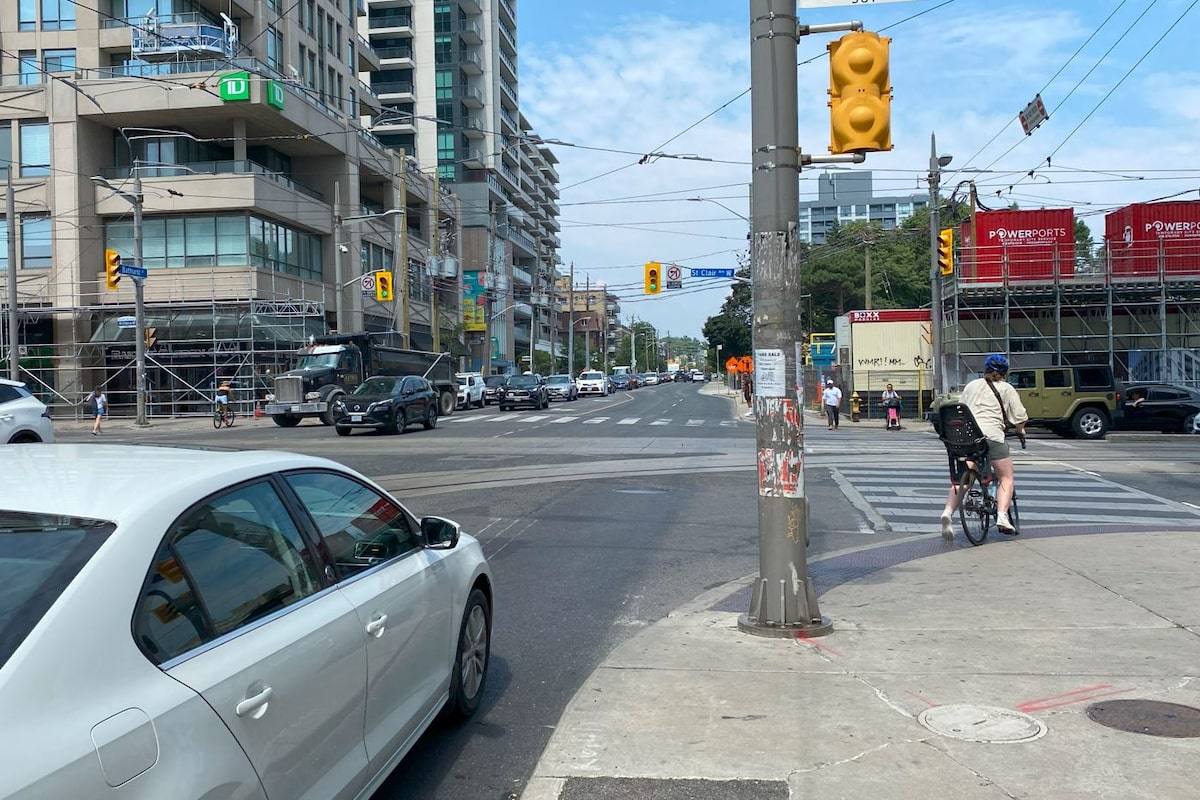
“That means checking for pedestrians in the crosswalk, cyclists coming up on the right, mobility devices, scooters and anyone else who might be where you are about to drive,” Shapiro said. “So, if that means slowing to a crawl, that is not only legal, it is the correct choice.”
If pedestrians have the walk signal, you must give them the right of way, he said. But, even when they don’t – for example, if they started crossing after the red hand started flashing – you could still get charged if you hit them. Plus, even if there’s nobody in the crosswalk, you may have to slow down or stop.
For example, you might see a group of kids on the sidewalk to your right just about to enter it.
Or, your view could be blocked by a tree, for instance, and you can’t clearly see approaching pedestrians.
“Or, it’s dark or there’s glare or there’s [a pedestrian] who looks like they’re going one way, but then they change their mind and go another way,” Shapiro said. “You must predict and assume that the unthinkable is going to happen – and that’s what a good driver does … and the driver behind you can’t always see what you see.”
Blind followers?
So what happens if you slow down or stop at a green light and another car hits you?
That driver would be charged with following too closely, Shapiro said.
“You’re responsible for everything your vehicle does. If you rear-end a car that slows or stops to make a safe turn, that is on you,” he said. “You can’t use the excuse of ‘he didn’t need to stop there.’ You don’t know what’s in front of that person’s car. They have the right to ensure they are not running over a pedestrian.”
While every province has laws against tailgating, most, including Ontario, don’t give a specific distance that cars must leave in front of them.
It’s up to police to decide whether you’re following too closely. So you may be charged if a police officer sees you tailgating – or if you rear-end the car in front of you.
How far should you be from the car in front of you?
Ian Law, president and chief instructor of Brampton, Ont.-based ILR Car Control School, said you should keep at least a three-second distance in good weather and longer when roads are slippery or icy.
To gauge your following time, pick an object up ahead, either on or next to the road – a line on the pavement or a post, for instance. Watch when the car in front of you passes it, and then count how many seconds it takes for you to pass it.
The more space you can leave, the better, Shapiro said.
“You need enough space to stop in case the car in front of you stops suddenly,” he said. “It might be because of a kid that’s chasing a ball into the street or a cat running out. Even if the guy in front of you sneezes and hits the brakes [for no reason], you need to be able to respond accordingly.”
Have a driving question? Send it to globedrive@globeandmail.com and put ‘Driving Concerns’ in your subject line. E-mails without the correct subject line may not be answered. Canada’s a big place, so let us know where you are so we can find the answer for your city and province.