
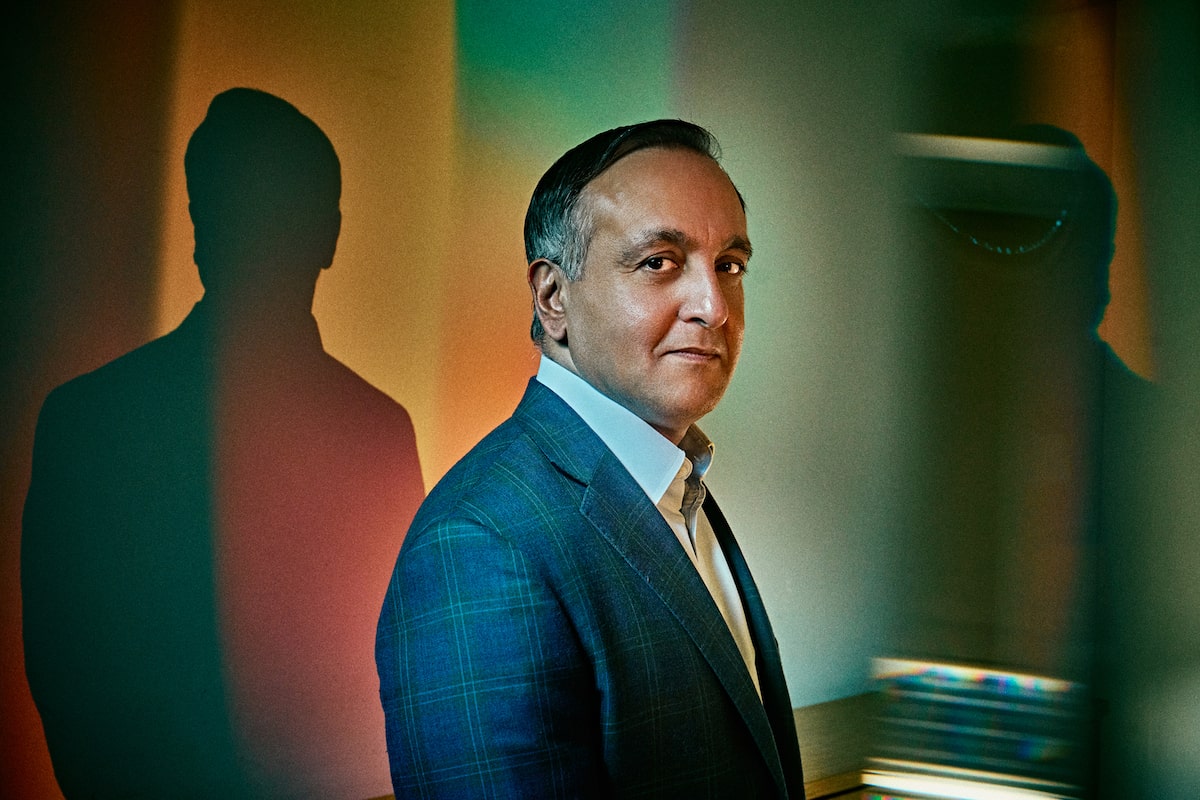
Zahid Salman was hired as CEO of GreenShield when the company’s board saw a threat to its social mission.Duane Cole/The Globe and Mail
About seven years ago, as the fourth-largest player in Canada’s $40-billion health and benefits industry but the only one operating as a non-profit, GreenShield found its margins getting squeezed.
Seeing a threat to its charitable mission, its board realized it needed the help of someone on the for-profit side. As it happened, Zahid Salman, who’d worked with insurance companies for years as a pension consultant, admired what GreenShield was all about.
In 2018, he took over as CEO and instilled a focused, commercial mindset that turned the company around. Since he reshaped GreenShield into the country’s first “payer-provider,” its annual revenues have more than doubled, and its social impact has grown.
Maybe it’s fitting that in a few months, GreenShield will move its Toronto office into the heart of the financial district, where the serious money plays. We spoke to Salman at his current office in North York.
Has GreenShield always been non-profit?
Since day one. We were founded by a pharmacist by the name of Bill Wilkinson. A young mother walked into his pharmacy with two prescriptions. One was for herself, one for her young daughter. She couldn’t afford both, so she ended up going without the medication she needed so her daughter didn’t have to. This led Wilkinson to create North America’s first pre-paid drug plan. That design didn’t exist until he created it. The next thing he did was set up GreenShield as a non-profit.
What does your non-profit status allow you to do that for-profit companies can’t?
It allows us to think in the long term. It took Wilkinson 20 years to get that pre-paid drug plan off the ground. It was only when he worked with the United Auto Workers Union to convince GM, Ford and Chrysler to adopt that design in their benefits plans, and then hire GreenShield to administer it, that it took off. Would he have waited 20 years if he was not a non-profit? I don’t think so. The other thing it allows is, we don’t have to return excess earnings. “Excess” meaning any earnings we don’t need to reinvest in the business. We can invest those in our communities. So we fund all sorts of social impact programs.
When you became CEO, what was your mandate?
There were a lot of headwinds. Things like the push for single-payer pharma care, which is still an agenda item today. A lot of new entrants with new business and pricing models. There was a fear that Apple or Google might get into insurance. Price compression was another big one. Since we use all of our excess earnings to fund our social mission, that’s a big worry – would we still be able to do that? So the board asked me to chart a diversification strategy to make the company more resilient and advance the social mission.
How did you arrive at the payer-provider model?
Initially we thought, should we go into life insurance? Disability insurance? But those markets are already well served. Instead, we diversified into health care. Because we were founded by a pharmacist, we have these deep roots there. And we saw a trend. More and more employers didn’t want to just provide coverage for the 30% of health care services that aren’t covered under government-funded services. They wanted to provide access to the care, as well. And in some cases they wanted to improve the experience of their employees around accessing the care. So what if we were actually delivering the care as well as the coverage? So we invested in some digital health startups.
As CEO, Salman built Canada’s first integrated health and benefits company for GreenShield.Duane Cole/The Globe and Mail
So now you’re the country’s first “integrated health and benefits company.” How does that actually work?
The three services we started with were mental health, pharmacy and telemedicine. Let’s say I have a splitting headache I can’t shake. I can go onto the GreenShield app and access our telemedicine services, and get in front of a doctor within 30 minutes. The first thing the doctor could say is, “I’m going to give you some medication to manage the pain.” The prescription automatically goes to our digital pharmacy, and it gets delivered to your door the next day. At the same time, the doctor might say, “Longer term, perhaps what’s driving the headaches is stress and anxiety. So you should speak to a counsellor.” Through the app, you can get in front of a counsellor, as well. That’s why we chose those three areas, because they fit with each other.
These extra services add cost to your clients. Why do they want to pay that cost?
Most employers already offer employee assistance plans. So we now offer an EAP that includes digital mental health services that are fully integrated with your insurance. So it may add a cost in terms of what they’re paying us, but in terms of total spend, they’re already paying that somehow. Employers have been seeing greater demand for telemedicine. One in five Canadians do not have a doctor. Those who do often wait four or five days to get in front of them. So there’s a real demand for facilitating better access to care. Employers themselves find it beneficial because it helps with productivity and reduces absences at the back end. So there’s ROI to the plan sponsor.
With your digital pharmacy, the Health Depot, have you created a preferred provider network?
It’s not a preferred provider network. We don’t require anyone to use the Health Depot. They may choose to, if they see a benefit in integrating their pharmacy with the telemedicine and getting quicker reimbursement. But most individuals already have a relationship with a pharmacy, and we respect that and pay claims from any pharmacy. Where we do offer a preferred provider network is on a subset of the prescription drugs called specialty drugs. These are drugs that cost more than $10,000 a year. They’re managed by specialty pharmacies separate from the Health Depot.
Is there an inherent conflict of interest there? You’ve got a doctor saying you need a medicine, and you’ve got your own pharmacy selling that medicine.
It’s a fair question. We don’t see it as a conflict. If I can create an experience for a patient that provides greater integration between a doctor, a pharmacist, a mental health counsellor, and all that gets seamlessly enabled by a benefits plan—because these services aren’t covered under provincial Medicare—I don’t see it as a conflict. It would become a conflict if I forced it on anyone or provided large incentives to steer them, but we’re not doing either of those things.
The other question would be, are you monetizing the relationship between patient and doctor?
We charge a fee for all the services we deliver, and then we pay compensation to whatever practitioner is delivering the services, whether it’s a pharmacist, a doctor or a counsellor. So for sure, we look to make a margin on the fees. Again, that’s how we fund the mission, and every company would do that.
GreenShield disrupted Canada’s benefits industry with its payer-provider model. Has the model started to catch on here?
Yes! We’ve been growing at two to three times the market rate for a few years now. Obviously that raises some eyebrows. A few of our larger competitors have adopted their own version of payer-provider. Sun Life bought a company called Dialogue and put it under their Lumino Health brand. Manulife has done it through a partnership with Telus Health, which delivers the health care services, and a company called League that delivers the underlying technology. We are still viewed as the leading payer-provider in terms of the strength of the integration we’re creating. As long as we can maintain that first-mover advantage and differentiation around breadth and integration, we think we’ll win a disproportionate share of the payer-provided opportunities that come to market.
There must be a tension between wanting to use your excess earnings for social programs and wanting to increase your services. How do you decide where the money goes?
Think of what we do as social dividends. You want to make sure that you’re investing enough in the business so that it can grow and the dividends can increase over time. But you also want to make sure you’re carving out enough funding to maintain stable dividends. When I joined, we’d contribute a small amount to the social mission—about $2 million to $3 million a year. Then we started to bring a more commercial mindset. The target we set for ourselves is 15% to 20% of pre-tax excess earnings. So this year it’ll be about $18 million. For the first strategic plan under my tenure, which took us through 2025, we set a goal of reinvesting $75 million into social impact initiatives, on top of whatever investment we need in the business for technology, for new products, for acquisitions.
You’ve now hit your $75-million target. What’s next?
In February, our board approved the 2030 strategic plan. It continues to be focused on building out this payer-provider model, and we think the $75 million will grow to $125 million. We also recognize that we can’t do everything ourselves. So we want to partner with other like-minded organizations to amplify the amount that we can do good with. Those other organizations could be private sector, public sector, government agencies, wherever there’s alignment of interest. For 2030, the goal would be to find another $75 million to make it $200 million. And we believe with that pool, instead of improving the health and well-being of only a million lives, we can get to three million.
GreenShield talks about democratizing access to “culturally appropriate health care.” What does that mean?
If you look at EAPs that provide counselling, the average utilization rate would be anywhere from 7% to 10%. Across the equity-seeking groups, it’s much, much lower. And one of the big reasons is because there’s a lack of culturally appropriate care, which means, in English, ethnic fit with the counsellor.
So this is a way for you to differentiate your services and attract clients with diverse employee bases?
Exactly. Our app will ask you what you’re looking for in a counsellor. And then it will find the counsellor that meets as many of those attributes as possible. So it might take a bit longer, but then you’ve matched with a counsellor who’s a better fit.
You’ve talked about leaders exercising humility as a strategic necessity. How does that apply in your own experience?
During the pandemic, characteristics like authenticity, empathy and humility became much more valued in leaders. What is the value proposition to an employee to join GreenShield versus another organization? The purpose is really the big differentiator. So can you run a company that attracts people to the purpose if you yourself don’t have that empathy, humility and authenticity, and demonstrate commitment to the social mission and doing good for people beyond just the clients that you serve? For me, it’s a very, very important attribute.