
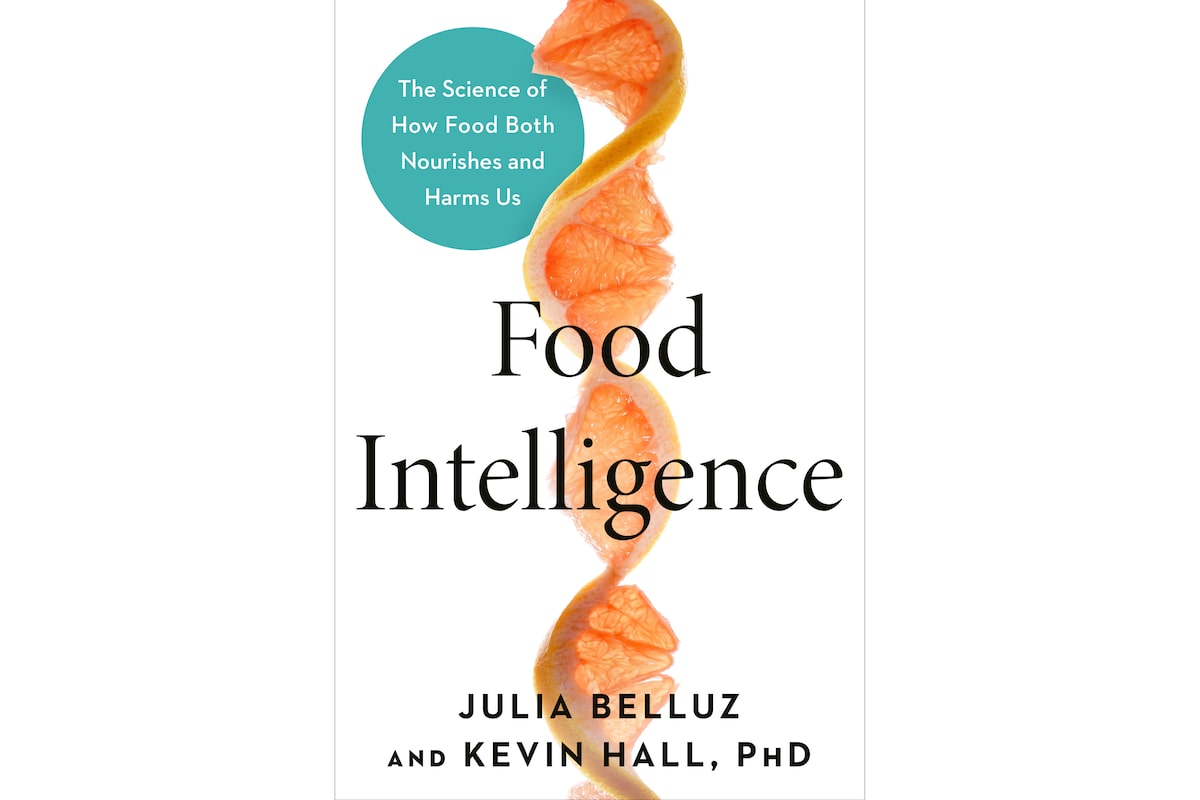
Food Intelligence by journalist Julia Belluz and nutritionist Kevin Hall.Supplied
Canadian journalist Julia Belluz has made a career out of deep dives into pressing health and medical issues. Writing for big-name publications such as Vox and The New York Times, Belluz penned blogs, interviews and explainers emphasizing a facts-based, scientific approach to wellness, fitness and medicine. But she often found her work competing against dozens of social media posts that offered bad information and catch-all solutions.
Adding to the challenge was that many readers lacked a shared vocabulary for everyday terms and a basic understanding of how food and exercise actually affected their bodies. When we refer to metabolism, what do we actually mean? How do protein, fat, carbs and vitamins work? How do “food environments” drive our eating behaviours and the nutrition choices we make?
Belluz teamed up with Kevin Hall – a nutrition and neuroscience expert best known for his clinical research investigating links between diet, psychology, and obesity – to write the new book Food Intelligence: The Science of How Food Both Nourishes and Harms Us. It’s an attempt to cut through the noise of social media for an honest look at what we eat, why we eat it, and how that affects our health. Recently we had a chance to speak with Belluz about the book, why people gravitate toward wellness influencers regardless of their credentials, and what changes readers can make to impact their everyday food habits.
Belluz’s book hopes to provide readers with fundamentals on nutrition.Katarina Lindbichler/Supplied
You wrote Food Intelligence with nutrition scientist Kevin Hall. What were your larger goals for the book?
We’re in this moment where people are just inundated with claims about diet and how best to eat. People are told that they should eat more protein. They should use particular supplements. They should go on a certain macronutrient diet. But they’re never told these fundamentals about nutrition. While I was writing this book I would ask almost everyone I came across, “what is metabolism?” And almost no one could answer the question correctly. We don’t even know what metabolism is. So our idea was to team up to give people these kinds of fundamentals on nutrition science that just seemed to be sorely missing in this space right now.
Are there best practices for deciding who to listen to when people are offering advice on nutrition and fitness?
There are many people who are dealing daily with some problem that either isn’t acknowledged or can’t be helped by their doctors or other health professionals. Wellness influencers fill in that gap. But in many cases, the help just isn’t founded on very solid science. There are still so many components in food we still don’t understand. I’m always wary of people who are giving ultra specific advice and targeting a general audience. What your needs are depends on what you’re trying to optimize and what stage of life you’re at.
Reading through the book made me re-evaluate the validity of some commonly held ‘truths’ around the fitness industry. Writing the book, was there anything that surprised you to learn?
We have this illusion that we control every bite that we eat. That’s not actually the case at all. To this very large degree, we have these internal signals that are shaping hormones or neural pathways. Those are interplaying with our environment in ways that are still somewhat mysterious. Maybe over particular meals and snacks we exert control, but in the long term these internal signals are interacting with our environment in ways that are taking over from that. What we argue in the book is changing food environments would have a much greater impact on diet-related disease instead of prescribing these individual fixes.
The term ‘food environment’ is a big component of this book. Can you talk to me about what that means and why you were focused on it?
Food environment is both the food that surrounds you and the economics and culture surrounding that food. There are now decades of research – including, more recently, randomized controlled trials that were done by my co-author – on eating behaviour in people. People exposed to ultraprocessed foods spontaneously overeat and gain weight. And it sounds obvious, but until he ran these studies, it had never been tested in a randomized control trial. It wasn’t that these people suddenly lost willpower during the trial. They were surrounded by foods that promote excess calorie consumption.
Some ultraprocessed foods are better for you than others, according to new science advisory
This is the thing that has been driving these costly and debilitating diet-related diseases like obesity, diabetes and cardiovascular disease. Until we address that, we’re not going to see reversals in these problems.
Can you speak to some everyday changes people can make if they’re trying to address their food environment?
We know that it’s not just ultraprocessed foods that are leading to calorie overconsumption. It was the subset of ultraprocessed foods that are hyper-palatable or energy dense. So think of things like chips or cookies. Once we start eating them, we can’t stop. On a precautionary basis, you can eliminate all ultraprocessed foods from your diet. That’s certainly a reasonable thing to do because of overeating but also because of the novel chemicals a lot of these foods contain. They’re generally deficient in the nutrients we know we should be eating. Personally, I cook almost everything. I do find it makes quite a difference, and it makes it easier to manage my weight. Where evidence has accumulated over many decades is this boring old advice that we all know we should be doing, but kind of a lot of people still struggle to do: eating a diet that’s rich in fruits, vegetables, legumes and whole grains.
Editor’s note: Using artificial intelligence detection tools, The Globe determined a photo that appeared in a previous version of this article was likely altered or generated by AI. The image has been removed.