
Read: 7 min
On a fog-shrouded morning in early November, I slip into the backseat of a white sedan that’s waiting for me, just outside a hotel in downtown Kharkiv.
I’m not a guest of the hotel; yet, the two women in the car had asked to meet me here.
“We try not to park near our offices,” explains one of the women, Olena Shustova, as we drive away. “Our colleagues from another organization were targeted a month ago.”
“People who work for organizations like HALO, who are clearing the land after Russians mined it — even they get targeted,” she says, referring to The HALO Trust, the world’s oldest and largest mine-clearance organization.
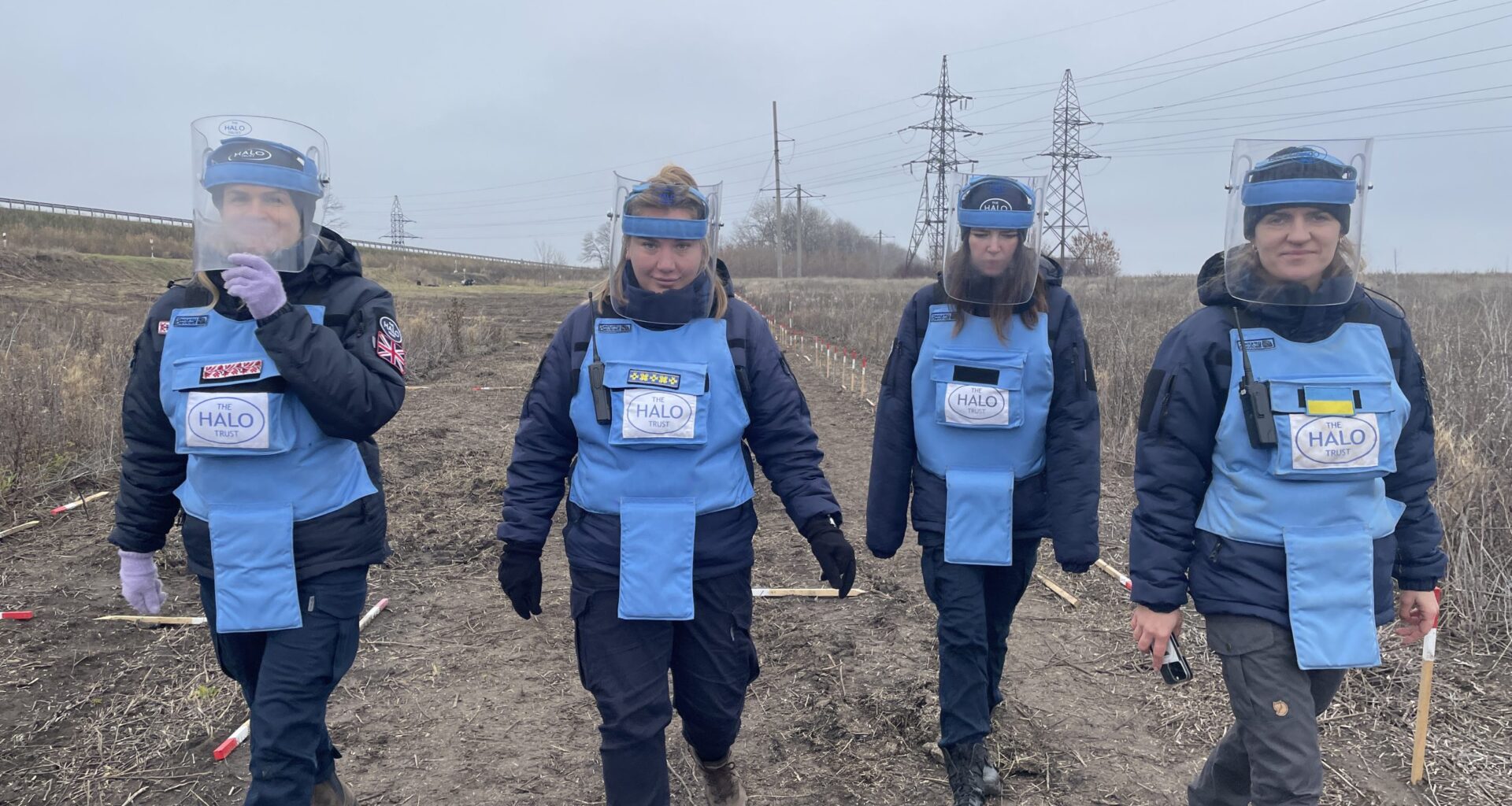
Shustova is media manager at HALO, which has been operating in Ukraine since 2015. She and the car’s driver, Valeria Shumska, have invited me — a Canadian journalist — to spend the day with them, witnessing HALO’s work.
That work includes training Ukraine’s women to make their country’s land safe again. Canada has played a part in this work. In early 2024, the Trudeau government — which had a feminist foreign-aid strategy — provided HALO with a $5-million grant to support its female demining efforts. Today, the future of such grants look uncertain.
Shustova tells me she has seen HALO become more female over her years at the organization. “When I started two-and-a-half years ago, there were much less [women],” she says.
Until 2017, demining was on Ukraine’s list of 450 occupations prohibited for women. Today, women make up 30 per cent of HALO’s 1,500 Ukrainian staff.
“[D]epending on your experience, your aspirations, your plans, you can become a deminer,” says Shumska.
“I’m not saying that it’s going to be easy, and not every woman is ready to do that … it’s physically demanding. But if you are ready to do that, you will be able to take the opportunities.”
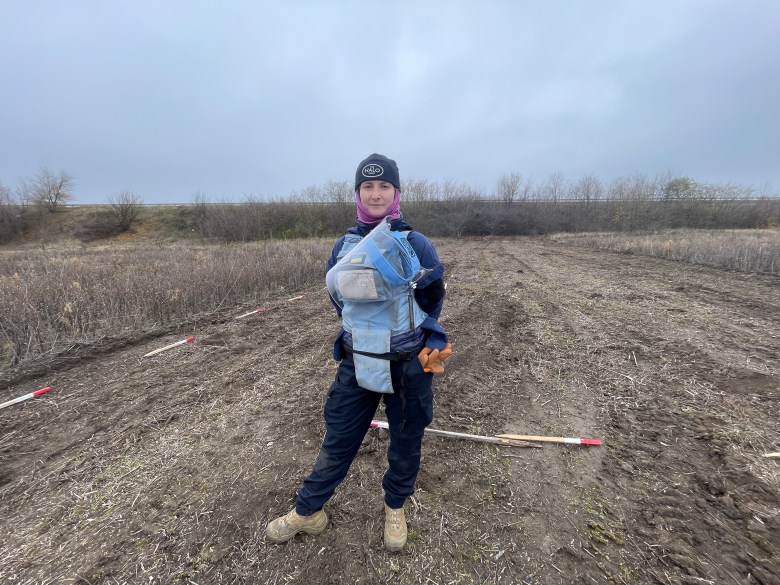 Karolina Prysiazhniuk, a deminer for HALO Trust, for takes a break from manual clearance using a metal detector near a minefield in Hrakove village, just outside of Kharkiv, Ukraine; Nov. 5, 2025. | Alexandra Keeler
Land back
For years, even before all-out war began, Russia has been littering Ukraine’s fields, roads and forests with mines, booby-traps and trip-wire explosives.
These efforts have turned Ukraine into one of the world’s most contaminated countries, some reports say. It is estimated that as much as a quarter of Ukraine’s territory — equivalent to the Canadian Maritimes in size — is mined.
The effect is devastating. As of May, explosive ordnance had killed nearly 500 people and injured another 1,000.
The contaminated lands mean farmers cannot plant crops, families cannot rebuild their homes and children cannot play safely outside. It also threatens global food security, undermining Ukraine’s agricultural output and role as Europe’s so-called “breadbasket.”
In 2023, Ukraine’s Ministry of Economy set a goal of clearing 80 per cent of Ukraine’s contaminated lands within 10 years.
This is where HALO comes in.
HALO begins its demining work by interviewing villagers who lived under Russian occupation, pinpointing the enemy’s former military positions and past mine incidents.
“It’s a lot about talking. It’s a lot about building communication with local people,” says Shumska as we navigate a pothole-riddled road.
After an hour’s drive, we reach Hrakove, a village that was under Russian control from early 2022 until this September and is known to have contaminated schools, hospitals and roads.
We stop once we reach a six-acre, scrubgrass-covered field on the outskirts of the village. Dozens of red skull-and-crossbone signs dot the ground, warning of mines.
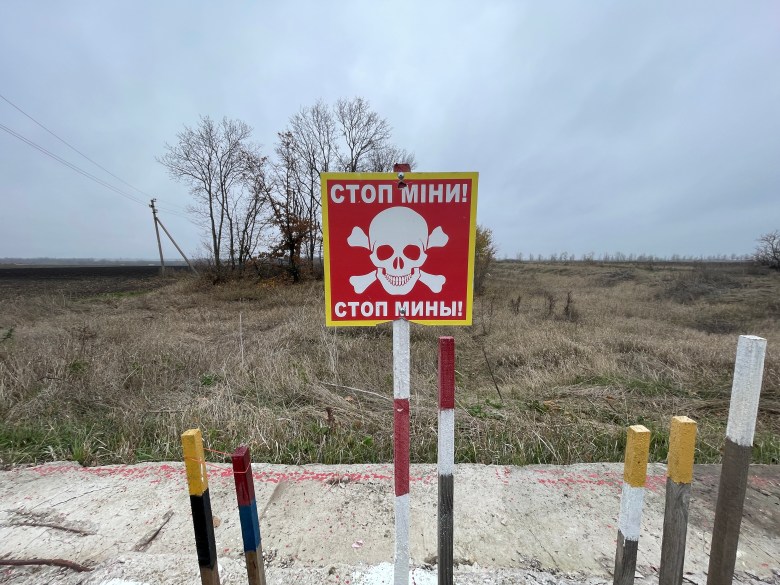 “Stop, mines!” warns a sign in a large minefield on the outskirts of Hrakove village, near Kharkiv, Ukraine; Nov. 5, 2025. | Alexandra Keeler
In the distance, five female surveyors are moving methodically across the terrain. My guides lead me to a uniformed woman, Liliia Hainatulina, who is studying a map. At just 31, she is HALO’s task group commander.
“In August 2022, there was an accident — a car hit an anti-vehicle mine,” she tells me, pointing to her handdrawn map.
But that was not the only incident. Since Ukrainian forces liberated the village on Sept. 7, civilians, farm animals and equipment have all set off mines.
While the military performed a mine-sweep near critical infrastructure, the rest is up to HALO.
The team maps explosives using surveys, satellite imagery and drones. Drones with thermal and multispectral cameras are used to detect some of the better hidden ones.
Next, machines are used to clear vegetation and neutralize tripwires. Human deminers remove surface mines by hand, while remote-controlled excavators tackle terrain considered too risky or too vast for people.
“I would like to … return the condition of our land in Ukraine to the condition it was before 2020, so that people can safely walk and drive in our land, and so that a farmer who decides to cultivate their food does not … [get] killed,” says Hainatulina.
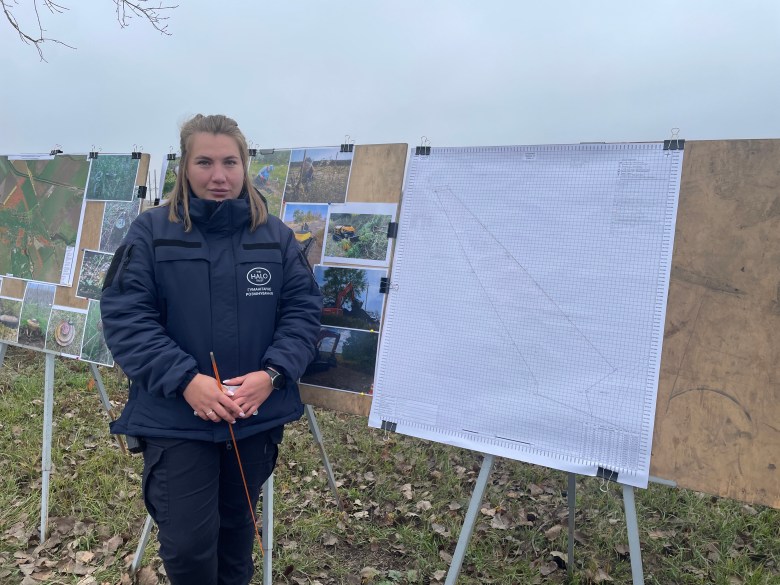 HALO Trust task group commander Liliia Hainatulina, explains manual and mechanical clearance operations in the farmland of Hrakove, near Kharkiv, Ukraine; Nov. 5, 2025. | Alexandra Keeler
Gender working group
For nearly four decades, HALO has been clearing landmines, cluster munitions and other explosives from some of the world’s most dangerous conflict zones.
Its work began in Afghanistan but today spans 30 countries. The non-profit employs more than 11,000 people and generates roughly US$200 million in revenue.
Its expansion into Ukraine has been supported by international donors, including Canada.
Samuel Fricker, a Canadian projects officer with HALO who is based in Langley, B.C., says he is glad to see Canadian dollars being put toward HALO.
“As someone who pays taxes in Canada, I’m … happy with where the money goes,” he tells me in a HALO team video call days later.
“The reason I work in this field is because of how tangible the impact is. You are seeing landmines being removed. You’re seeing genuine lives saved,” he says.
Canada’s $5-million contribution accounts for a small fraction of HALO’s $60-million annual Ukraine budget.
In keeping with the Trudeau government’s focus on gender-equity initiatives, this money has been used to help HALO launch a 20-member Gender Working Group. This group is responsible for gathering staff feedback, refining field policies and connecting HALO’s teams with military leadership and government — to influence workplace inclusivity measures nationwide.
Daria Hapirova, a gender expert at HALO, says training women to demine is crucial because hundreds of thousands of Ukrainian men have joined the military.
“Unfortunately, there is no time for us to act in a gender-neutral way,” she says on the call. “[W]ithout women right now, Ukrainian mine action wouldn’t function.”
Hapirova says there are halo effects to promoting gender equality in a niche sector like demining.
“We started to change our uniform sets, for example, to make it more inclusive, and not only suitable for female bodies, but also to be more practical and more inclusive for different shapes of man’s bodies,” she says.
Fricker says HALO is also more effective at its work when women are included.
Households headed by women — often widows or those whose husbands are fighting — are more willing to share information with female surveyors, he says.
“The interactions are much, much improved by having that diversity,” he says.
Canada’s $5-million grant ended in August, and HALO currently has no ongoing Canadian funding for Ukraine. “We are in discussions with [Global Affairs Canada] about potential future options for follow-on funding,” Shustova says.
But the political winds have shifted. On Nov. 23, Prime Minister Mark Carney said at a press conference in Johannesburg that Canada no longer has a feminist foreign policy.
He added, however, that gender equality will remain an “aspect” of Canada’s broader international agenda.
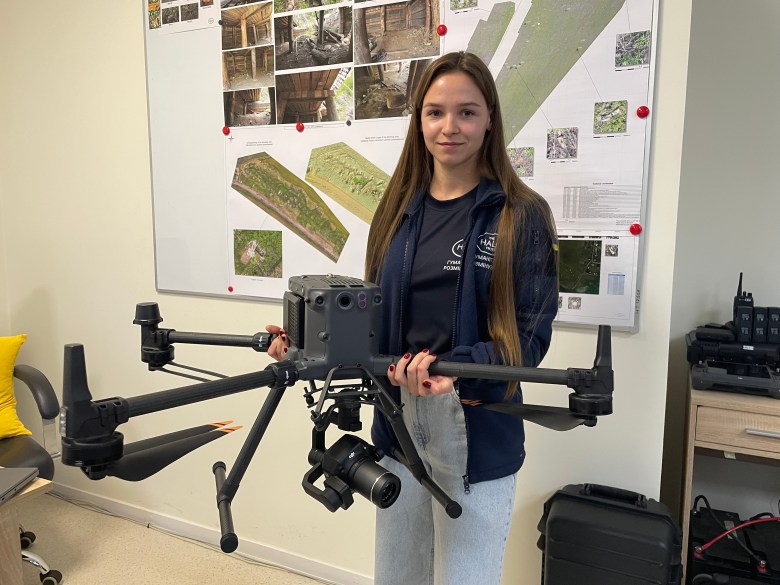 HALO Trust drone pilot Valentyna Vystoropska scopes out dugouts and enclosed trenches, detecting hidden explosives with drone-mounted high-resolution, thermal and multispectral cameras; Nov. 5, 2025 in Kharkiv, Ukraine. | Alexandra Keeler
With her bare hands
After strapping on body armour aprons and polycarbonate visors, I head with my hosts Shustova and Shumska to another field in Hrakove.
There, deminers are at work with their hands.
I watch Olena Zhornyk, a 39-year-old former shoe designer and mother of two, crawl through the grass, one bare hand extended, feeling for non-metallic tripwires. This hands-on method is used only for hazards that technology cannot detect, Shumska explains.
During her break, Zhornyk tells me she has become acutely aware of all the threats around her, so much so that she rarely lets her own children roam outside.
“They like being outside, but I’m not letting them go,” she says. “Because I [do this] work, I can see how many mines there can be.”
The sense of accomplishment that comes from making the land safer is, she says, immense.
“It’s a feeling that you cannot compare to anything else when you find some explosive ordinance and remove it … [knowing] your children will not have a risk anymore.”
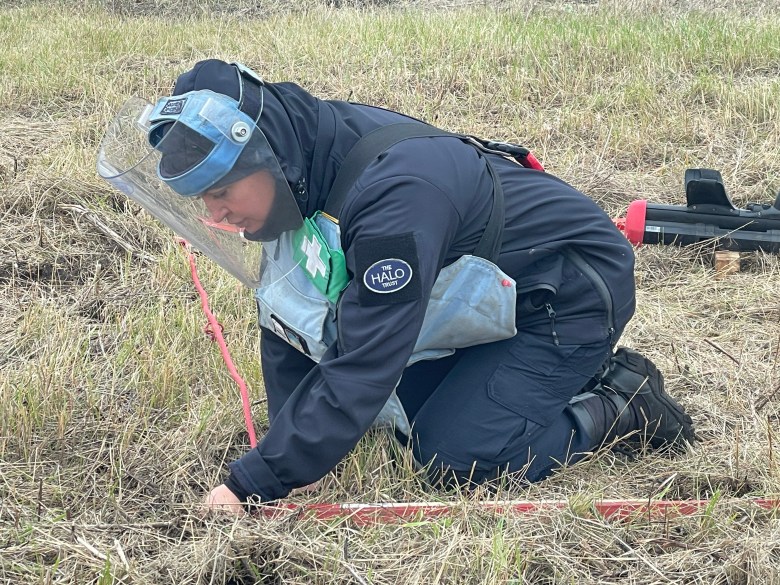 Deminer Olena Zhornyk carefully performs manual clearance with her bare hands to check for plastic trip-wires; Nov. 5, 2025. | Alexandra Keeler
Further afield, three large craters mark where anti-vehicle mines have detonated. A whistle signals the start of dangerous work, so we don protective visors.
Teams of two begin to move slowly along narrow paths, scanning the ground ahead of them with metal detectors. I find myself holding my breath, needlessly, it turns out. Their search turns up nothing.
After two whistles signal a break, Karolina Prysiazhniuk, 32, comes to speak with me. Prysiazhniuk used to work as a digital product designer — and says she much prefers her current work.
“When [I tell] someone that I’m a deminer, [they say] ‘My God, are you serious? Wow, that’s cool,’ and I’m like, ‘Oh yeah, I know’,” Prysiazhniuk tells me, giggling. “Sometimes I brag about it, but … why not? I’m doing my part.”
Beyond bragging rights, she says her work has given her a story to someday tell her grandchildren.
“These times are awful — but it’s happening. You need to be part of it and do something for the [greater] good … for the future, for democracy,” she says.
“In 50 years … your grandchildren will ask, ‘Grandma, what were you doing during the war?’ And what would you tell them?”
Related Posts