
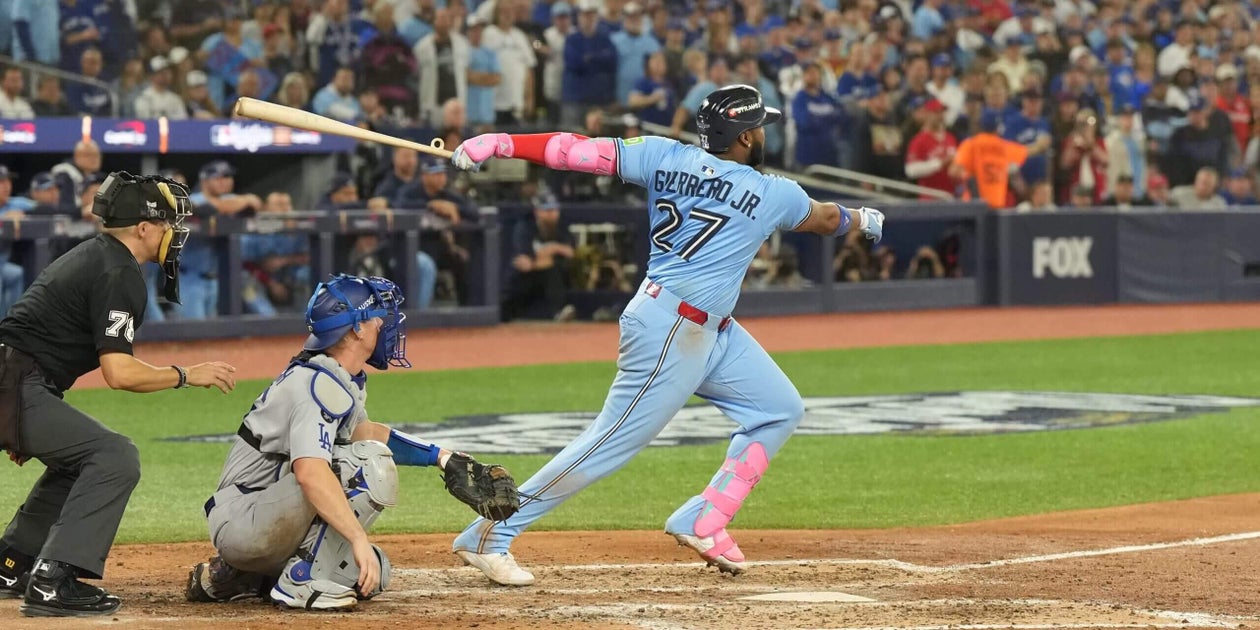
Four days after the Toronto Blue Jays peppered 12 hits across Yankee Stadium, winning Game 4 of the American League Division Series, Detroit Tigers president of baseball operations Scott Harris leaned into the microphone at his end-of-year news conference. As he outlined Detroit’s offseason plan and 2026 vision, the Blue Jays’ recent success lingered in his words.
“We need to make more contact as an organization,” Harris said. “We need to move the baseball more in the big leagues than we are.”
The proclamation was just the latest indication of a narrative that emerged in 2025, the one centered on making more contact.
MLB’s top regular-season teams, the Jays and Milwaukee Brewers, led their respective leagues in both batting average and contact rate. High-contact players like the Jays’ Ernie Clement and the Brewers’ Sal Frelick have grown from quiet contributors to known commodities.
In an era dominated by whiffs and home runs, the Blue Jays used contact to transform themselves from 74-win also-rans to American League champions. Toronto’s 20-win improvement and path to the World Series appeared so attainable for every other franchise hoping to make it into the playoffs. The allure is straightforward. Invest in contact and coast to the top of the sport.
But many executives aren’t sure how replicable that style is for other clubs. Repeating it, even for the Jays, won’t be so simple.
“That’s just part of the sports industry in general,” Blue Jays president Mark Shapiro said. “A narrative gets written based upon an outcome. People try to say, what parts of that can we learn? Good executives, good organizations are trying to stay ahead of that. By the time they react to it, it’s probably too late.”
Bat-to-ball dominance isn’t particularly new in modern baseball. The mid-2010s Kansas City Royals rode league-leading contact to consecutive World Series appearances, including a title in 2015. From 2017 to 2023, no franchise posted a higher contact rate than the Houston Astros. Even as home runs are undeniably crucial to postseason success, the league’s top team in contact rate has advanced to at least the Division Series in nine of the last 10 years.
MLB contact rate leaders (since 2016)
YearTeamContact rateWins
2025
80.6%
94
2024
82.6%
93
2023
80.3%
71
2022
80.8%
92
2021
80.6%
95
2020*
79.9%
29
2019
80.7%
107
2018
80.6%
91
2017
81.2%
101
2016
81.6%
93
Through it all, though, power remains king.
The balance between power and contact remains an “ongoing debate” in front offices, one executive told The Athletic. They speculated that the bat-to-ball narrative became so loud this season because fans desperately want the high-contact style deployed by the Brewers and Blue Jays to become a new normal. Fundamental defence and a steady stream of balls being put in play are more entertaining than six strikeouts, a walk and a homer.
But the same executive who cited those fan desires also admitted that a lineup filled with high batting average players can, for some reason, appear scarier than an equally productive lineup of high-whiff power hitters. Never mind that the perception is more narrative than proven reality.
The noise of that contact narrative still reaches the ears of baseball’s top decision makers. Brewers general manager Matt Arnold pointed to recent rule changes — with the infield shift banned in 2023 — as a potential opening for more contact success. His Brewers flourished alongside the Jays, capturing baseball’s attention with contact during the regular season. Frelick and Caleb Durbin became two of MLB’s most difficult hitters to strike out. They both ranked in the top 10 in contact rate.
The New York Yankees, at least by public perception, may be the antithesis of a contact-first team. They struck out the third-most in baseball in 2025, more than any other postseason team, while leading MLB in homers. At a news conference on Monday, when asked if the Yankees want to be more like the Jays, owner Hal Steinbrenner underscored the value of both slug and contact. He did, however, say the Yankees have been searching for more balance on offence, citing the addition of Jazz Chisholm Jr. in 2024.
“Guys that can put the ball into play,” Steinbrenner said. “I do think you need that. You can’t simply be a slugging home run team.”
In an era when pitching is arguably better than ever, St. Louis Cardinals general manager Chaim Bloom said that teams that consistently make contact stand out more. When pitching plans are often built around exploiting swing-and-miss tendencies, Atlanta Braves GM Alex Anthopoulos said that contact teams can frustrate pitchers more than any other. Philadelphia Phillies president of baseball operations Dave Dombrowski noted that the talk of success in Milwaukee and Toronto — even if the reason wasn’t entirely revolutionary — may have an impact on team building across the league.
“I find that it’s sort of a copycat league,” Dombrowski said. “If it works, people follow it.”
But as the three general managers noted, the issue with building teams geared toward more contact isn’t necessarily one of desire. Most teams have sought high-contact players through the three-true-outcomes era, they said. The skill is not ignored.
“It’s finding the players to do it,” Dombrowski said. “That’s sort of the secret. They’re not always easy to find.”
As power became a premium, productive contact players have become increasingly scarce. In 2015, 82 hitters posted contact rates over 80 percent. By 2025, that number has fallen to 53. That’s part of what makes replicating the 2025 Jays and Brewers so difficult.
Teams may be able to find their version of Ernie Clement or Joey Ortiz. But filling a lineup with the likes of Brice Turang, Frelick, Alejandro Kirk, Bo Bichette and Vladimir Guerrero Jr. isn’t simple. They were five of just 24 players last year to post a contact rate over 80 percent and a wRC+ over 110.
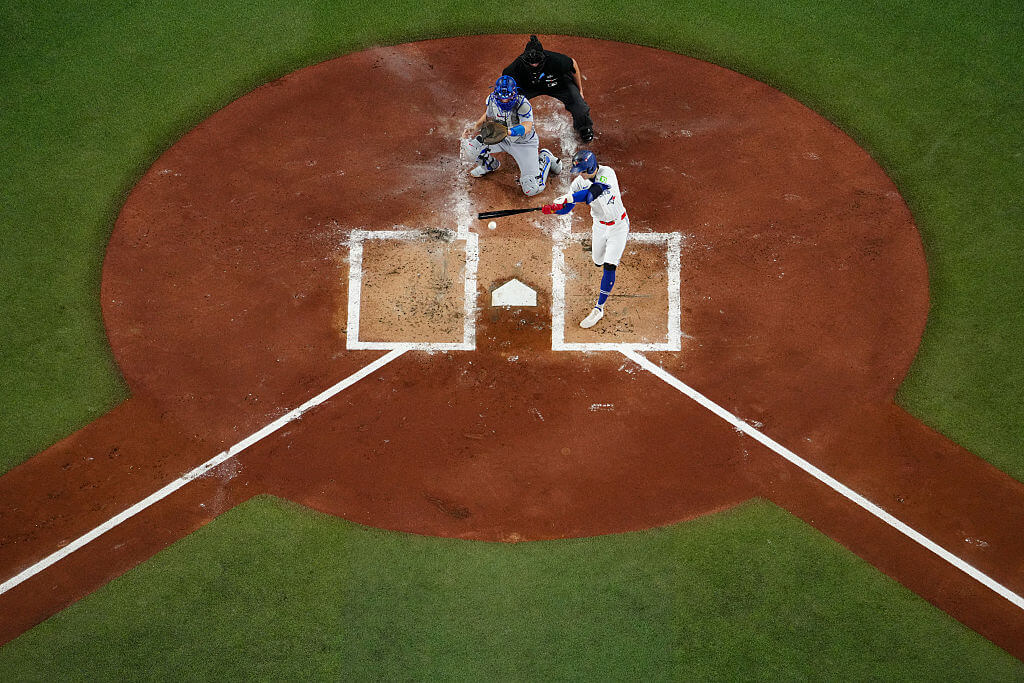
The Blue Jays’ Ernie Clement makes contact during the World Series. (Daniel Shirey / MLB Photos via Getty Images)
The Jays and Brewers were among just seven teams with multiple players who fit that description, while 11 teams had none.
Prioritizing contact at the cost of overall production can go too far. Over the last five years, both the Washington Nationals and Cleveland Guardians rank top-five in team contact rate while ranking bottom-10 in wRC+. Good contact, bad lineups.
“Really,” an AL executive said, “you just want good hitters.”
The ongoing debate remains ongoing. While the Tigers may be in search of more contact entering 2026, teams like the Astros and San Diego Padres now seek more power after embracing more contact. When Even for the Jays, general manager Ross Atkins said, bat-to-ball wasn’t a planned team identity. It was just one piece of the offensive puzzle.
Toronto has been a high-contact team for the last three years. They ranked top-five in contact rate in both 2023 and 2024 as well. But it was the rest of the offensive profile that failed them. In both years, they ranked outside the top-10 in slugging. Not until 2025 did the Jays find the right balance. Toronto led all teams in batting average in the postseason, but also led in on-base percentage and home runs.
“They’re a great team,” Steinbrenner said. “They definitely played better than us. They slugged better than us, and they hit the ball and put it in play better than us, and they pitched better than us. That’s why they won.”
It may have been the addition of new hitting coach David Popkins, who Atkins said “had a very good effect on our team.” Or perhaps it was a mostly healthy season from Bichette, the poster child of effective high-contact. Power breakouts from Addison Barger and Daulton Varsho helped — neither of whom consistently put bat to ball. Or, as players and coaches said amidst Toronto’s improbable run to the World Series, it may have been a matter of trust and chemistry.
“It’s hard to replicate true love,” Chris Bassitt said. “You can try to replicate this. A lot of people will try, but it’s not really possible.”
Replicating Toronto’s complete mix — contact, coaching and culture — won’t be easy for other teams. Teams may just latch onto the high-contact narrative. But, if it were that simple, Toronto would’ve made the World Series before 2025. Now the Jays — and 29 other teams — will search for the winning mix once more.
“They had a great year,” Steinbrenner said. “I’m curious to see next year how well they do with that roster.”
Said Shapiro: “We can’t rest either.”
— The Athletic’s Chris Kirschner contributed to this report.