

Sophia Bantanidis, analyst on the future of finance for Citi, joins BNN Bloomberg to discuss the recently published report ‘Agentic AI – Finance & the ‘Do It For Me’ Economy’ on how artificial intelligence can impact the future of financial services.
AI and Agentic AI can have a bigger impact on the finance industry than the internet era did, according to a new Citi report.
The report specifically highlights the impact of Agentic AI, which it describes as the “do it for me” technology, stressing that this year has been pivotal for the new form of AI.
“We say 2025 is the year of Agentic AI… because it is the moment where different pieces of the puzzle came together,” Sophia Bantanidis, analyst on the future of finance for Citi, told BNN Bloomberg.
Unlike generative data, which analyzes data, Agentic AI can create new data and make decisions by itself.
“It sets a goal, it plans a task, it takes action, and it adapts to feedback. This is very interesting in the financial services space,” said Bantanidis.
The report shows how the advent of the internet changed the finance sector by adding ecommerce. In contrast, Agentic AI is bringing productivity, personalization and Agentic AI workflows.
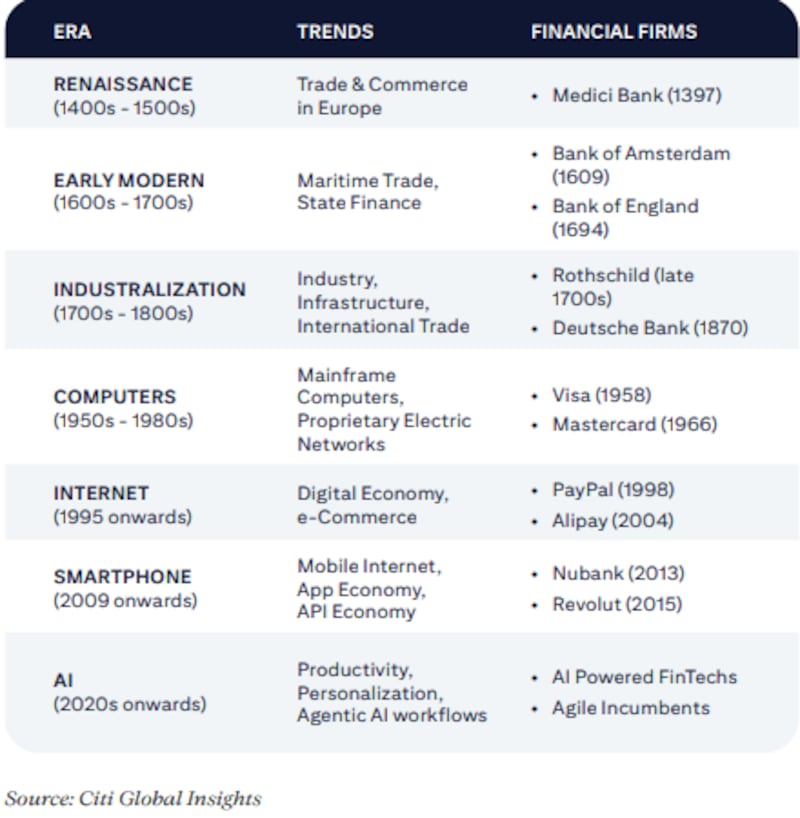 Citi Report
Bantanidis gives the example of the technology being used to resolve a payment error, where an agent can go through unstructured data, cross check information, confirm where the mistake has been made, amend the mistake, submit it for approval and then log it in the audit trail.
Many companies began rolling out the technology within the last two years, like OpenAI, which released its Operating and Deep Research features earlier this year, Microsoft Copilot releasing its agentic agents last year, which offer suggestions to the user, and even banks like Scotiabank allowing the technology to perform autonomous tasks in its commercial banking division this year.
Bantanidis said many big companies are already using Agentic AI and now the industry has the models, cloud infrastructure, enterprise controls and guardrails.
What’s next for Agentic AI in 2026?
In the new year, the technology will see more deployment and measurable commercial impact said Bantanidis
“We have a shift with AI from ‘wow, this technology is so cool’ to, ‘how are we implementing it to return on investment,’” she said.
She also said the next year will see a shift towards agentic commerce where agents will transact on your behalf, move your funds and even renew your mortgage, which she calls a ‘game changer’.
Will people lose their jobs?
Agentic AI won’t replace the workforce but it will reshape it, said Bantanidis.
She said jobs will change and productivity in general will rise, therefore the world will shift toward higher value activity and higher value tasks, which require human oversight.
While repetitive operational roles may shrink, new categories of work will emerge.
The examples she gives are of AI agent supervisors, AI ethics officers, AI guardrail and governance officers.
She also stresses that it is important to adapt to new technology.
“It will not just change the way we work, but also the way we live and the way we enjoy our lives, the way we play as well,” said Bantanidis.
Half of internet traffic is bots, mostly malicious
The report states that 50 per cent of bots “already account for half of global internet traffic, and a large part of them are malicious.”
That is likely to increase, said Bantanidis.
“The reason for this is that illicit actors can adopt technology at speed. They don’t have to adhere to any rules and regulations like we do, and they’re also very, very good at data sharing,” Bantanidis.
She said there are some precautions people can take to allow agents to act with sufficient authority without compromising security.
It includes having a pre-paid AI wallet and setting up an automated authentication layer for AI agents.
“Overarching all of this, of course, is the robust governance framework that firms need to put in place to find permissions, human in the loop, controls and secure enterprise infrastructure,” said Bantanidis.
With generative AI hallucinations, where AI models generate incorrect information, becoming common, Bantanidis said it’s important for governments to implement firm guard rails and frameworks like Europe has put in place with its The EU AI Act.