
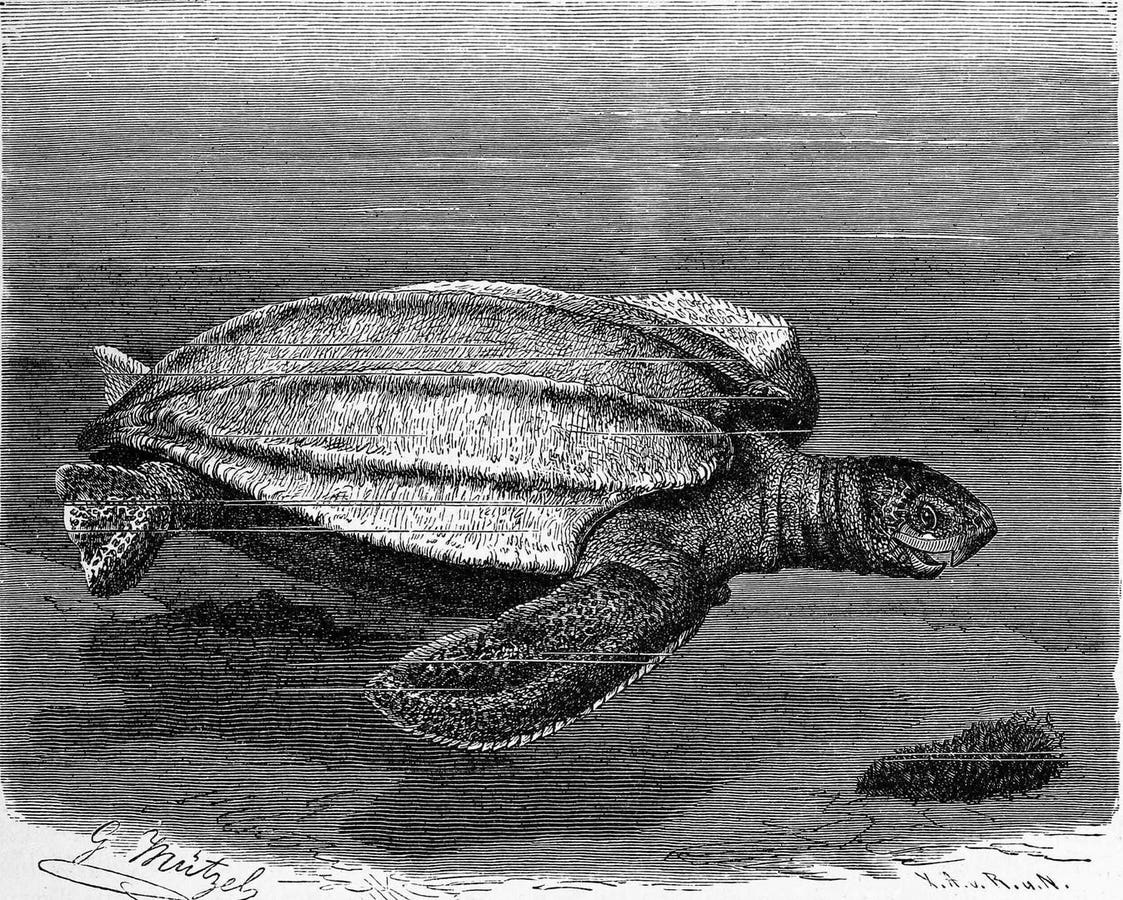
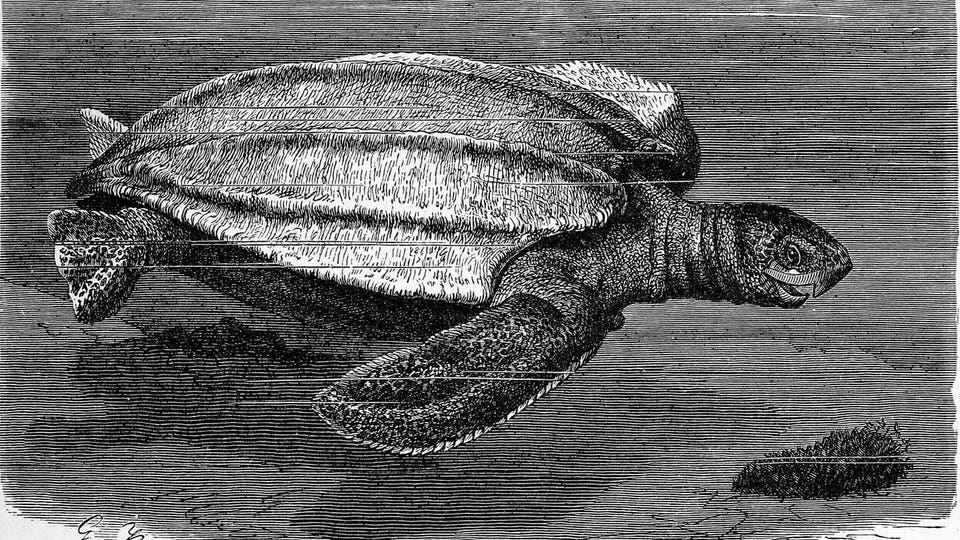
The leatherback sea turtle offers a rare look into prehistoric life and reveals how a lineage can survive mass extinctions, climate upheavals and 200 million years of evolutionary change.
Bildagentur-online/Universal Images Group via Getty Images
Despite the progress evolution has offered to lifeforms on Earth, some of the most astonishing organisms are, ironically, the ones that have barely changed at all. Turtles are among the oldest surviving vertebrate groups, with ancestral species dating back more than a whopping 220 million years to the Late Triassic. For reference, dinosaurs were only beginning their rise at that time.
Although the dinosaurs disappeared 66 million years ago, turtles somehow managed to endure. In fact, one modern species still swims the oceans today: the leatherback sea turtle (Dermochelys coriacea). These turtles are direct descendants of an ancient lineage that predates Tyrannosaurus rex.
Biologists consider the leatherback a living window into what the world looked like all those years ago. Here’s how its physiology, reproductive strategies and resistance to aging have given us clues about how life evolves under extreme pressures.
Leatherback Turtles Are Relics From The Triassic
To understand the significance of the leatherback’s persistence, it’s necessary to look at the broader context of the Late Triassic.
Specifically, ancient turtle fossils such as Odontochelys semitestacea (220 million years old) and Proganochelys quenstedtii (210 million years old) reveal that these ancient species already possessed a recognizable shell structure. However, it seems that the leatherback’s lineage diverged early.
The remains of an approximately eleven million year old leatherback sea turtle, found in a clay pit north of Hamburg. Photo: Daniel Bockwoldt/dpa (Photo by Daniel Bockwoldt/picture alliance via Getty Images)
dpa/picture alliance via Getty Images
Unlike modern turtles, which have very rigid and bony shells, leatherbacks developed a flexible, leathery carapace that are supported by small bones embedded within their thick connective tissue. This places them within the turtle family Dermochelyidae: an ancient family that split from other sea turtles around 100 to 150 million years ago. Over this long evolutionary history, all but one dermochelyid turtle species have disappeared; the leatherback remains the family’s only living representative.
Paleontological evidence proves that this lineage survived the catastrophic extinction that wiped out roughly 75% of Earth’s species. Although the leatherbacks we see today aren’t identical to their prehistoric relatives, their lineage continued almost completely uninterrupted from the time giant marine reptiles ruled the seas.
Leatherback Turtles Are Built For Extreme Life
Leatherbacks are the largest turtles on Earth. They’re often found to weigh more than 900 kilograms (2,000 pounds) and measure up to 2.5 meters (8 feet) in length. However, their immense size is only a fragment of what makes them such an impressive species. What truly sets them apart is their unique suite of biological innovations.
One of the most remarkable of these adaptations is their ability to regulate their internal temperature, as a 2015 study from the Journal of Thermal Biology explains. Unlike most reptiles, leatherbacks are able to keep their body temperature up to 18°C (32°F) above the surrounding water. This is made possible with thanks to their:
large body masscountercurrent heat exchangeinsulating fat layerscontinuous muscular activity
This “gigantothermy” enables them to thrive in waters across the planet, ranging from the tropics to the sub-Arctic. As such, it’s no surprise that they’ve been documented to migrate distances that exceed 10,000 kilometers (6,214 miles).
Satellite tracking has even shown individual leatherbacks crossing whole ocean basins purely in order to feed on jellyfish blooms — only to make the return trip back to their ancestral nesting beaches. Many of these beaches have been used by their lineage for millions of years.
Why Leatherback Turtles Lay Their Eggs On Land
Although leatherbacks live almost entirely at sea, they still rely on land for reproduction. Females are known to crawl ashore several times per nesting season to dig deep pits — almost a meter deep, at 80 centimeters (2.6 feet) — in which they lay 60 to 100 eggs in each clutch.
A man holds leatherback sea turtle hatchlings before releasing them into the sea at Lhoknga beach, Indonesia’s Aceh province on February 25, 2025. (Photo by CHAIDEER MAHYUDDIN / AFP) (Photo by CHAIDEER MAHYUDDIN/AFP via Getty Images)
AFP via Getty Images
Astonishingly, it seems that this strategy of theirs has remained unchanged for more than 200 million years. Early turtles evolved on land before returning to the ocean, and their descendants never transitioned to live birth. Most likely, the anatomical demands of a turtle shell made the evolution of viviparity (where embryos develop inside the mother, instead of inside an egg) nearly impossible.
Intriguingly, laying eggs on land also comes with a unique biological feature: temperature-dependent sex determination (TSD). In leatherbacks, it’s been observed that:
warmer nests produce more femalescooler nests produce more males
This ancient system most likely aided leatherback populations to adapt to their prehistoric climate fluctuations. However, research notes that TSD poses challenges today, as beaches continue to be affected by global warming. That said, its persistence over millions of years shows how effective it once was.
Leatherback Turtles Maintain Longevity Without The Usual Signs Of Aging
Leatherbacks display some of the primary traits associated with highly reduced and slowed aging. In fact, many sea turtles live to be between 60 to 100-years old. Yet what stands out is how little they seem to decline physically as they age. Comparative aging studies show that turtles often display negligible or extremely slow senescence. Several biological factors likely contribute to this, including:
low metabolic rate relative to body size reduces cellular stresslarge size protects against predators, allowing long-term maintenance mechanisms to evolverobust DNA repair pathways reduce genomic damagehigh resistance to cancerslow telomere shortening helps maintain cellular function
Even though leatherbacks have relatively higher metabolic demands than most turtles, their overall biology seems to be optimized perfectly for durability. This long-term resilience may be one of the primary reasons as to why their lineage was able to survive several mass extinctions.
What Leatherback Turtles Teach Us About Survival
Species that manage to survive for tens — or even hundreds — of millions of years do so because they aren’t limited in their adaptations. Rather than configuring their anatomy to one environment, they evolved in order to adapt to change itself. Today, however, leatherbacks face modern threats that their ancestors never had to experience, including:
plastic pollutionfisheries bycatchcoastal developmentwarming beaches that skew sex ratiosshifts in prey availabilityegg poaching
Depending on the region, the species is now listed from Vulnerable to Critically Endangered on the IUCN’s red list. This is perhaps one of the greatest evolutionary ironies there is: a lineage that survived asteroid impacts and ice ages now struggles against the pressures from things like plastic straws, which emerged in a geological instant.
Yet the leatherback sea turtle shows us that, sometimes, survival means a species just has to hold onto the strategies that worked for millions of years. They still lay their eggs on ancestral beaches. They still navigate their ancient migratory routes. They still swim with the same flipper-driven grace their predecessors used when giant marine reptiles dominated Earth’s oceans. And they are still here.
Do you have an eye for nature photography? Join my Nature Photography Club and take your plant photos to the next level.
Are you an animal lover who owns a pet, perhaps even a pet turtle? Take the science-backed Pet Personality Test to know how well you know your little friend.