
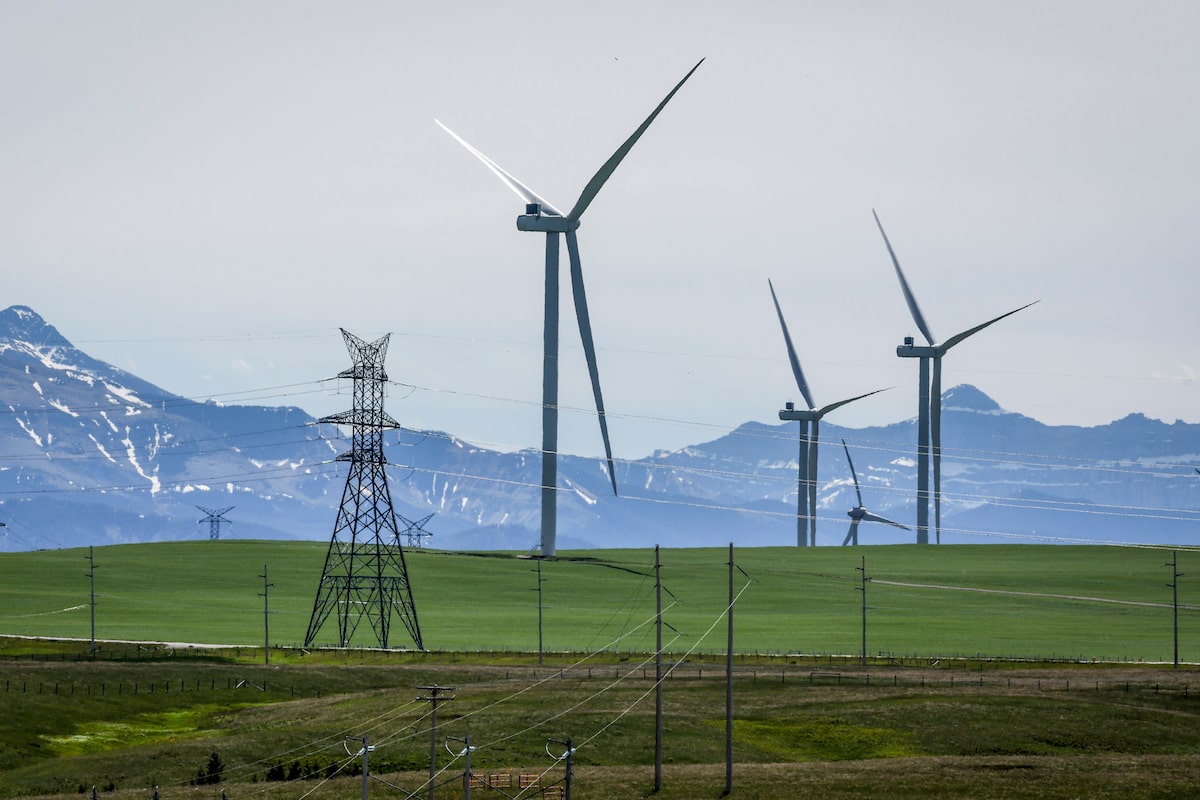
Power transmission lines and wind turbines near Pincher Creek, Alta. The province wants to attract AI data centres, but current infrastructure can’t handle their demand for electricity.Jeff McIntosh/The Canadian Press
Data-centre projects that come with the ability to generate their own power will be prioritized in Alberta under new legislation, as the province grapples with how to embrace the burgeoning sector but avoid straining the public grid.
The province has long wanted to attract massive data centres to power generative artificial intelligence, with the goal of $100-billion worth of projects under construction within the next five years. Dozens of projects already sit on a list in front of the Alberta Electric Systems Operator (AESO), the body responsible for the provincial power grid, requesting connection. But current infrastructure can’t handle their near-endless demand for electricity.
Bill 8, the Utilities Statutes Amendment Act, was tabled by Utilities Minister Nathan Neudorf on Tuesday to try and address that issue.
Alberta doubling down on AI data centres with new mandate for utilities minister
Opinion: The right way to win the race for data centres
If passed, the bill would allow data centres to bring their electricity with their projects, by either signing offtake agreements directly with power providers or generating their own power on-site, Mr. Neudorf told media Tuesday.
Those that do so will be prioritized, he said, which will accelerate their approval process. While they will still have to secure environmental, regulatory and transmission permits before they can be built, he said, the change will prevent new projects from straining the grid’s available supply and make sure consumers are not burdened with the cost of power infrastructure.
Mr. Neudorf said protections are in place to stop power producers defecting from general generation to providing electricity only to data centres, even if they can make more money.
“That’s why we have an Alberta Electric Systems Operator – to make sure that those kind of activities and behaviours don’t take place,” he said.
Still, Mr. Neudorf thinks it unlikely that all of the projects in the queue for power will go ahead. Nor would it even be technically possible, he said, given the “enormous amount of electricity” they would require.
“If all of those projects were to go ahead, it would be like adding 20 cities the size of Calgary into our grid,” Mr. Neudorf said. “I don’t think that’s possible, nor should it be necessarily our goal. We want to get the right ones to be the right fit within Alberta.”
Aaron Engen, the chief executive of AESO, said while existing power supply in the province is enough to meet Albertans’ needs today and in the near term, it cannot possibly serve all of the requests coming from data-centre developers without risking reliability.
Alberta knows that in part from keeping its eye on other jurisdictions – primarily in the United States – which has helped guide the new rules. Mr. Engen said watching those experiences and “not being the first one out the door” has provided valuable tips for how Alberta should roll out its own data-centre sector.
Bill 8 also proposes changes to continue work to modernize Alberta’s electricity grid, including the implementation of the restructured energy market, which was finalized in August.
The bill also proposes changes with the aim of improving electricity-transmission policy and encouraging more efficient use of existing power infrastructure. And it would outline detailed rules that would allow existing pilot projects to blend hydrogen and natural gas to apply for cost recovery.
The majority of the regulatory changes are expected to come into play in the spring.