
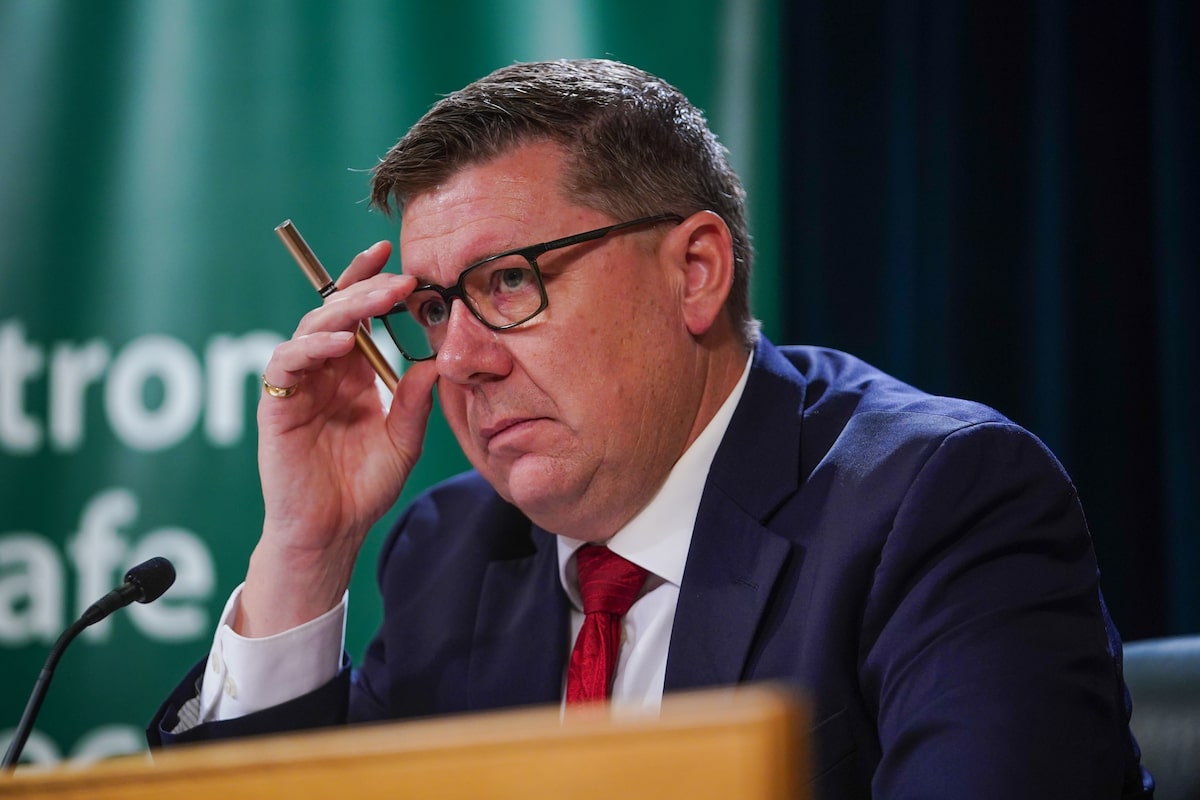
Saskatchewan Premier Scott Moe has maintained a relentless focus on pursuing new trade opportunities in India during his seven years in office.Heywood Yu/The Canadian Press
Canada and India are restarting free-trade talks and turning the page on two tumultuous years of diplomatic discord.
Much of the credit goes to Prime Minister Mark Carney for using his global gravitas to reset the bilateral relationship with Indian Prime Minister Narendra Modi. But Mr. Carney’s unofficial Western Canadian wingman merits a mention, too.
Saskatchewan Premier Scott Moe had a major hand in repairing Canada’s relationship with India because of his government’s behind-the-scenes efforts to strengthen business ties between the two Commonwealth countries – even when the antipathy between Ottawa and New Delhi hit new lows.
That persistence – let’s call it Saskatchewan soft power – underscores why the federal government must increasingly leverage this type of subnational savvy if it is serious about finally clinching a Comprehensive Economic Partnership Agreement with India after more than 15 years of on-again, off-again talks.
Canada and India have a shared ambition to double two-way trade to $70-billion by 2030. Toward that end, the countries have indicated their forthcoming free-trade pact will cover goods, services, investment, agriculture, agri-food and much more.
Canada to announce uranium export deal with India in further sign of warming relations
The Carney government has pledged to double non-U.S. exports over the next decade to diversify trade away from an increasingly protectionist United States. Canada must expand trade with India if it has any hope of achieving that goal.
With a gross domestic product of US$4.13-trillion, the South Asian country has the fifth-largest economy in the world. Canada, meanwhile, ranks 10th globally with a GDP of US$2.23-trillion, according to the International Monetary Fund.
That brings us back to Saskatchewan, which is proving to be the linchpin of Canada-India trade because of its exports of pulse crops, potash and uranium. In fact, the Prairie province accounts for roughly 40 per cent of Canada’s total exports to India.
Mr. Moe has maintained a relentless focus on pursuing new trade opportunities in India since he became Premier seven years ago. To his credit, he immediately understood the importance of showing up in person to bolster those commercial ties.
“India is one of Saskatchewan’s most important markets,” Mr. Moe said following his first trade mission to India in 2018.
“With an export-driven economy like Saskatchewan, we need to engage proactively with key markets like India to ensure we are creating wealth and opportunity for Saskatchewan people. That’s what trade missions like this are all about.”
Mr. Moe continued to travel to India – emphasizing the importance of business-to-business relationships – even after the rupture between Ottawa and New Delhi.
“Saskatchewan has been working alongside India for many years and I’m proud of the relationships we’ve built in that time,” Mr. Moe said about a trip he made in 2024.
His efforts have borne fruit.
In 2022, Canpotex, a Saskatoon-based potash exporter, signed a memorandum of understanding (MOU) to provide supplies to Indian fertilizer companies Coromandel International, Chambal Fertilisers and Indian Potash Ltd.
At the time, an Indian government minister hailed the MOU as a “path-breaking step” that would lead to “strengthening of our mutual relationship and furthering bilateral relations between the two countries.”
Earlier this year, the University of Saskatchewan and the Council of Scientific and Industrial Research, India, signed a joint declaration of intent to collaborate on research and development of critical minerals.
And in another sign of Saskatchewan suavity, The Globe and Mail reported Wednesday that Canada and India are finalizing a long-term uranium supply agreement worth US$2.8-billion. (Ottawa, of course, should demand that New Delhi drop its punitive tariffs on Canadian yellow peas before signing on the dotted line.)
Securing supplies of uranium is key to India’s plan of liberalizing foreign investment in the nuclear energy sector. This could present additional opportunities for Canadian companies and institutional investors. Global energy companies, including France’s EDF and U.S.-based Westinghouse, are already assessing such possibilities, according to a recent report in The Financial Times.
The Asia Pacific Foundation of Canada, meanwhile, has recently highlighted the importance of leveraging “subnational strengths” to further bilateral co-operation on critical minerals.
“As federal initiatives gain momentum on both sides, the next phase of Canada–India collaboration will also increasingly hinge on subnational engagement,” states a recent background note published by the not-for-profit organization.
“In both countries, provinces and states hold jurisdiction over natural resources and anchor key critical mineral projects, processing facilities, and investment ecosystems.”
There’s no denying that Mr. Moe is a polarizing politician. But he has also proven to be pragmatic on matters of trade.
Love him or hate him, he helped Canada mend its relationship with India. Sometimes being bloody-minded is a strength.